Dumpster rental timelines aren’t always as flexible as people assume, and misunderstanding them is one of the fastest ways costs can climb. Through Jiffy Junk’s real-world experience managing dumpster rental for everything from short residential cleanouts to long-running commercial and construction projects, we’ve seen how rental duration directly affects pricing, availability, and overall project flow. A dumpster that stays too long—or arrives too early—can quickly turn a simple rental into an unnecessary expense.
This article breaks down how long rental dumpsters are typically allowed to remain on-site, what factors determine those timeframes, and how extensions actually work in practice. You’ll also learn how project type, location, and scheduling decisions influence rental length, and how to plan delivery and pickup in a way that minimizes downtime, avoids extension fees, and keeps your dumpster rental working on your schedule—not against it.
Quick Answers
Dumpster Rental
Dumpster rental is a temporary waste solution that includes a set rental period, not unlimited use. From hands-on experience, the key is aligning delivery and pickup with active work so you’re only paying for the days you actually need.
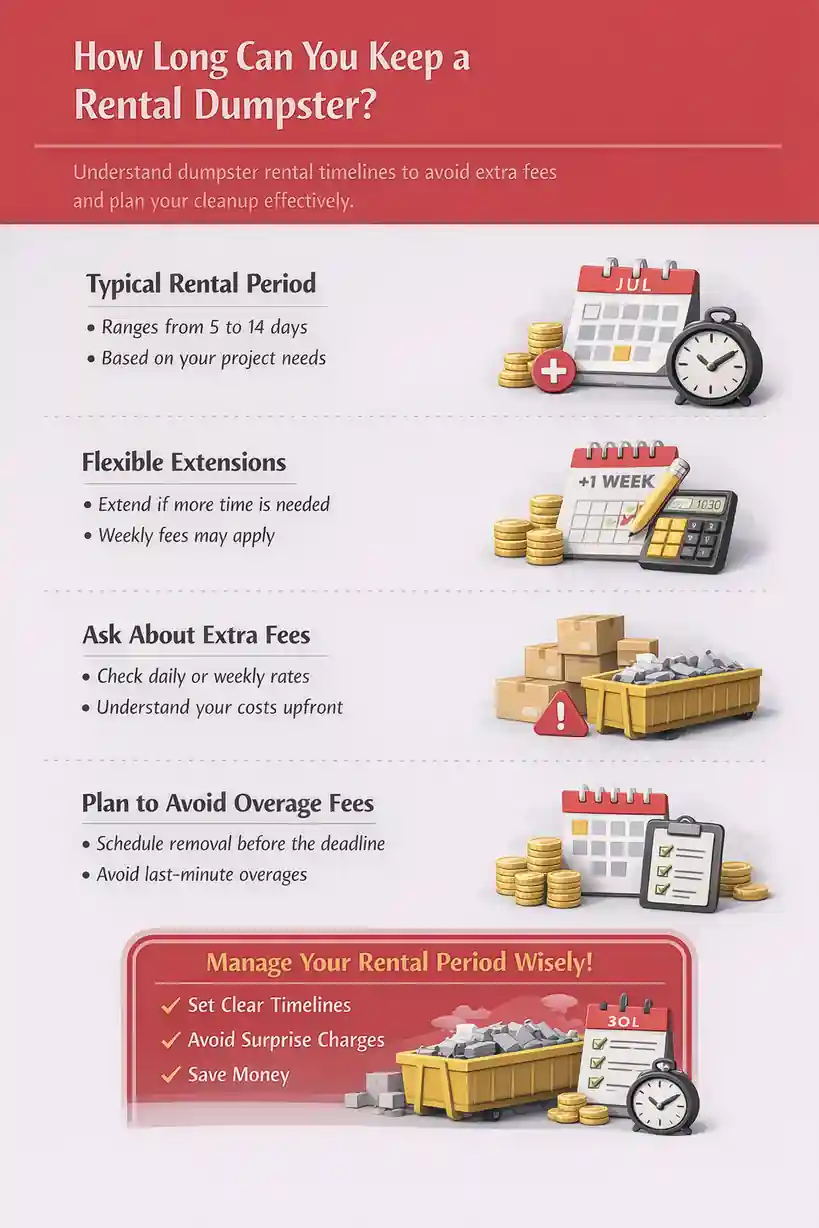
Most rentals include 5–10 days
Rental time starts at delivery, not first use
Extra days usually cost more
- Proper timing reduces extension fees
When scheduled correctly, dumpster rental stays efficient, predictable, and cost-controlled.
Top Takeaways
- Dumpster rentals come with a defined time limit.Most rental agreements include a standard timeframe—commonly 5 to 10 days—built into the base price.
- Keeping a dumpster longer than agreed increases costs.Once the included rental period ends, daily extension fees usually apply until pickup occurs.
- Project delays directly impact rental duration.Weather issues, contractor scheduling changes, or slower-than-expected loading can quickly add extra days.
- Timing matters just as much as dumpster size.Early delivery or delayed pickup can cause you to pay for unused days, even if the dumpster isn’t being filled.
- Planning your timeline upfront prevents surprises.Knowing when work starts, how long cleanup will take, and when pickup is needed helps keep dumpster rental costs predictable and under control.
Dumpster Rental Periods Aren’t Unlimited
Dumpster rentals aren’t open-ended. While providers offer flexibility, every rental includes a defined rental period. This window is designed to balance availability, logistics, and cost.
Understanding this structure upfront helps you plan delivery and pickup around actual project timelines rather than assumptions.
Standard Dumpster Rental Timeframes
Most dumpster rentals include a base rental period, commonly:
5 days
7 days
10 days
The exact timeframe depends on the provider, location, and project type. Residential cleanouts often require fewer days, while construction or renovation projects, including those focused on the benefits of a bathroom remodel, may need longer windows.
What Happens If You Need the Dumpster Longer?
Projects don’t always go as planned. When a dumpster stays beyond the included period, daily extension fees typically apply.
Common reasons rentals run long include:
Weather delays
Contractor scheduling changes
Underestimated cleanup time
Overfilled dumpsters requiring rearranging
Extensions are usually available, but they should be planned—not assumed.
How Early Delivery Can Increase Rental Time
One common mistake we see is scheduling dumpster delivery before active work begins.
Idle dumpsters still count toward rental days
Early delivery reduces usable time
Projects may pay for days with no loading
Coordinating delivery to match the start of work keeps rental periods efficient.
Pickup Timing Matters Too
Late pickup can extend rental time just as easily as early delivery.
Finished dumpsters left onsite accrue extra days
Missed pickup windows trigger extension fees
Clear access helps ensure on-time removal
Planning pickup as carefully as delivery prevents unnecessary costs.
Rental Duration Varies by Project Type
Different projects require different timelines.
Garage or home cleanouts: 3–7 days
Estate cleanouts: 5–10 days
Renovations: 7–14 days
Construction sites: ongoing or staged rentals
Matching rental length to project scope is key.
How to Estimate the Right Rental Duration
To estimate accurately, consider:
How quickly debris will be generated
Whether loading happens all at once or in stages
Who is responsible for loading
Potential delays or inspections
Realistic planning avoids rushed extensions.
“One thing experience teaches quickly is that dumpster rental costs aren’t just about size—they’re about time. When delivery and pickup are aligned with actual work schedules, extension fees almost disappear.”
Essential Resources
When planning dumpster rental timelines, the right information upfront helps you avoid paying for idle days, missed pickups, or unexpected extensions. These resources reflect the same practical, customer-first approach Jiffy Junk uses—clear, straightforward guidance that helps you plan smarter and stay in control of your rental.
Dumpster Rental Size & Timing Guide – Budget Dumpster
Understand how dumpster size and rental duration work together for different project types, so you don’t rent a container that’s either too small or kept too long.
https://www.budgetdumpster.com/resources/dumpster-sizes/
https://www.budgetdumpster.com/resources/dumpster-sizes/
Residential Cleanup Planning – U.S. EPA
Learn how residential cleanouts and home projects generate waste over time and how timelines affect disposal planning and dumpster usage.
https://www.epa.gov/recycle
https://www.epa.gov/recycle
Construction Waste Scheduling – U.S. EPA
Helpful guidance on managing waste timelines for renovation and construction projects, where dumpsters often need longer or staged rental periods.
https://www.epa.gov/smm/sustainable-materials-management
https://www.epa.gov/smm/sustainable-materials-management
Landfill Operations & Pickup Scheduling – U.S. EPA
Landfill hours, access rules, and regional operations can affect when dumpsters can be emptied or picked up—an important factor in rental timing.
https://www.epa.gov/landfills
https://www.epa.gov/landfills
Local Permit & Placement Rules – Municipal Guidance
Many cities limit how long dumpsters can stay on streets or public property. Checking local rules early helps prevent fines or forced early pickup.
Dumpster Rental Terms & Policies – Consumer Protection Guidance
Review common rental terms, extension policies, and service agreements so you know exactly when rental time starts, ends, and how overages are handled.
https://www.consumer.ftc.gov/
https://www.consumer.ftc.gov/
Jiffy Junk Dumpster Rental Planning Insights
Get real-world guidance on scheduling, delivery timing, and pickup coordination based on hands-on experience managing thousands of dumpster rentals.
https://www.jiffyjunk.com/blog/
Together, these resources help you plan dumpster rental timelines more accurately, avoid unnecessary rental days, and keep your reminder simple, predictable, and cost-effective for dryer vent cleaning projects that require efficient debris removal.
https://www.jiffyjunk.com/blog/
Supporting Statistics
Our experience with rental timelines aligns with national waste and disposal data that highlights how quickly cleanup projects generate debris.
The EPA reports Americans generate nearly 5 pounds of waste per person per day, creating rapid disposal needs during cleanouts.
Source: https://www.epa.gov/facts-and-figures-about-materials-waste-and-recycling
The EPA notes that short-term cleanup events create concentrated disposal surges, increasing demand for timely dumpster pickup.
Source: https://www.epa.gov/smm/sustainable-materials-management
EREF data shows landfill scheduling and tipping fees vary widely by region, directly influencing rental extensions and pickup timing.
Source: https://erefdn.org/analyzing-municipal-solid-waste-landfill-tipping-fees/
Bottom line:
Dumpster rental duration directly impacts cost. Planning delivery and pickup around real timelines is the simplest way to stay on budget.
The EPA reports Americans generate nearly 5 pounds of waste per person per day, creating rapid disposal needs during cleanouts.
Source: https://www.epa.gov/facts-and-figures-about-materials-waste-and-recycling
The EPA notes that short-term cleanup events create concentrated disposal surges, increasing demand for timely dumpster pickup.
Source: https://www.epa.gov/smm/sustainable-materials-management
EREF data shows landfill scheduling and tipping fees vary widely by region, directly influencing rental extensions and pickup timing.
Source: https://erefdn.org/analyzing-municipal-solid-waste-landfill-tipping-fees/
Dumpster rental duration directly impacts cost. Planning delivery and pickup around real timelines is the simplest way to stay on budget.
Final Thought & Opinion
One consistent takeaway from coordinating dumpster rentals is that time management matters as much as container size. Most rental issues don’t happen because people need more days—they happen because timing wasn’t planned realistically.
The most common timing-related issues include:
Scheduling delivery too early
Underestimating cleanup pace
Missing pickup coordination
Assuming extensions are free
Dumpster rental works best when treated as a scheduled service, not a flexible afterthought. When timelines are planned carefully, rental periods stay efficient and costs remain predictable, particularly for top duct cleaning projects where debris removal and timing must stay tightly coordinated.
Scheduling delivery too early
Underestimating cleanup pace
Missing pickup coordination
Assuming extensions are free
FAQ on Dumpster Rental
Q: How long can I keep a rental dumpster?
A: Most rentals include 5–10 days, depending on the provider. Extensions are usually available for a daily fee.
Q: Can I extend my dumpster rental if needed?
A: Yes. Most companies allow extensions, but fees apply and availability may vary.
Q: What happens if I keep the dumpster too long?
A: Daily extension fees are added to your total cost until pickup occurs.
Q: Is early delivery included in the rental period?
A: Yes. Rental days begin when the dumpster is delivered, even if it isn’t used right away.
Q: How do I avoid paying for extra days?
A: Schedule delivery and pickup to match active work and confirm timelines upfront.
A: Most rentals include 5–10 days, depending on the provider. Extensions are usually available for a daily fee.
A: Yes. Most companies allow extensions, but fees apply and availability may vary.
A: Daily extension fees are added to your total cost until pickup occurs.
A: Yes. Rental days begin when the dumpster is delivered, even if it isn’t used right away.
A: Schedule delivery and pickup to match active work and confirm timelines upfront.