After 8,000+ moving box pickups, we've watched the pattern repeat: customers who flatten boxes and stack them by the door pay $149 for jobs that cost $249 when boxes are scattered across three rooms. The cardboard volume is identical. The preparation makes the difference.
What you'll learn from our crews:
Flatten vs. leave assembled—when each approach actually saves money
What to remove so we don't charge sorting fees (foam, bubble wrap, packing peanuts)
Stacking location that cuts loading time from 45 minutes to 12 minutes
Photo angles that get accurate quotes without waiting for on-site estimates
The one mistake 60% of customers make that doubles their price
From our experience: Most people overthink this. You don't need perfect bundling or complex organization. You need boxes accessible, contaminants removed, and a clear path to the truck. That's it.
Ready to clear your moving boxes fast? This guide shows you exactly how we prefer to find cardboard when we arrive—straight from the crews who load trucks daily.
TL;DR Quick Answers
Cardboard Box Pickup Service
What it is: Professional service removes cardboard from your location, loads everything, delivers to recycling facilities.
Speed from our 8,000+ pickups:
42% same-day service (quote before 12 PM)
51% next-day pickup
7% within 48 hours (rural areas)
Pricing by preparation level:
Prepared (flattened, single location): $89-$199
Partially prepared (assembled, gathered): $199-$249
Unprepared (scattered, mixed materials): $249-$349
What we pick up:
Moving boxes (most common: 40-60 boxes per 3-bedroom home)
Delivery/shipping boxes
Appliance packaging
Furniture boxes
Commercial cardboard
Preparation that matters (5-10 minutes):
Remove foam, bubble wrap, packing peanuts
Stack in single accessible location
Clear path to truck
Take 3 photos (wide, side, close-up)
Preparation that doesn't matter:
Tape removal (unnecessary)
Perfect stacking (we restack)
Bundling with rope (we cut it off)
Size organization (doesn't affect price)
When to flatten boxes:
30+ boxes: saves $70-180 (worth 30-45 minutes)
Under 20 boxes: saves $30-40 (skip it)
When to skip self-prep:
Over 50 with back history
Injury recovery or mobility limits
Exhausted from moving
Full-service costs $100-150 more, prevents injury
Recycling outcome by prep:
Clean cardboard: 95-97% recycled
Mixed materials: 40-60% recycled, rest → landfill
Five minutes removing contaminants = 20-year difference
How to schedule:
Text/email 3 photos with address
Receive quote in 30 minutes
Approve price, select pickup window
We arrive, load, provide recycling receipt
Pro tip from 10 years experience: Book when you book a moving truck (not move-out day). Advance scheduling: $195 average. Last-minute panic: $275 average. Same volume, $80 penalty for poor planning.
Top 5 Takeaways
1. Box prep takes 5-10 minutes—not 2 hours.
Remove foam, bubble wrap, packing peanuts
Stack in one location
Clear path to truck
Take 3 photos
Skip: tape removal, bundling, size sorting (doesn't affect quote)
2. Don't hurt yourself saving $100—medical bills cost more.
Customer pattern: injure back flattening boxes → urgent care ($250) + missed work ($800) + full-service anyway ($299) = $1,349
Over 50? Back history? Feel uncertain? Pay extra $100-150 for full-service
Your health worth more than savings
3. Flattening only saves money with 30+ boxes.
Under 20 boxes: saves $30-40 (not worth it)
30-60 boxes: saves $70-120 (worth 30-45 minutes)
60+ boxes: saves $120-180 (significant)
Do the math before wasting time
4. Five minutes of separation = 95% recycling vs. landfill.
Clean cardboard: 95-97% recycling rate
Mixed loads (foam + plastic): 40-60% recycling rate, rest → landfill
Five minutes removing contaminants = difference between new packaging and 20 years in landfill
"Eco-friendly" promises mean nothing without separation
5. Book pickup when you book a moving truck—not move-out day.
Advance booking: $195 average
Last-minute panic: $275 average
Same volume, $80 penalty for poor planning
Plus: rushed prep, injury risk, worse time slots
Add to moving checklist day you reserve moving truck
Cardboard pickup pricing is based on truck volume—not weight or box count. After thousands of post-move pickups, we've seen identical box quantities result in wildly different quotes based solely on curbside pickup preparation.
Real pricing difference we see regularly:
Customer A (unprepared):
50 moving boxes left assembled
Scattered across garage, basement, spare room
Mixed with packing materials
Quote: $249 (1/2 truck capacity)
Loading time: 45 minutes
Customer B (prepared):
50 moving boxes flattened
Stacked by garage door
Packing materials removed
Quote: $149 (1/4 truck capacity)
Loading time: 12 minutes
Same number of boxes. $100 difference. The second customer saved money and got same-day service because we could fit their job between two other pickups. The first required dedicated scheduling.
What matters most from our trucks:
Volume reduction (flattening saves 40-60% space)
Single location access (no hunting across multiple rooms)
Clear path to truck (no furniture navigation)
Contaminants removed (no sorting delays)
To Flatten or Not to Flatten: When Each Approach Makes Sense
The question we get most: "Do I really need to break down all these boxes?"
Our honest answer: It depends on your priorities and volume.
When Flattening Saves You Money
Break down boxes if:
You have 30+ boxes (volume reduction becomes significant)
You want the lowest possible quote
You prefer same-day pickup (smaller jobs get prioritized)
You have time and physical ability
Flattening impact from our pricing data:
30-50 boxes: Saves $40-$70
50-75 boxes: Saves $70-$120
75+ boxes: Saves $120-$180
Pro tip from our crews: You don't need to remove every piece of tape. Just collapse the boxes flat. Loose tape doesn't affect recycling.
When Leaving Boxes Assembled Still Works
Leave boxes assembled if:
You have under 20 boxes (minimal volume difference)
You're physically unable to break them down
You need pickup urgently and can't spare the time
You're willing to pay slightly more for convenience
What we've learned: A dozen assembled boxes still fit in our small load tier ($89-$129). Breaking them down might not change your price bracket at all.
Remove These Items Before Pickup
Cardboard-only pickups process fastest and cost least. Mixed loads require sorting, which adds labor time and disposal fees.
Remove and Dispose Separately
Non-cardboard packing materials:
Foam corner protectors
Bubble wrap sheets
Plastic film and shrink wrap
Packing peanuts (styrofoam or biodegradable)
Air pillows
Foam padding sheets
Why this matters: These materials require different disposal methods than cardboard. If we need to sort on-site, we add 15-20 minutes to loading time—which can bump you into the next price tier.
You Can Leave These Items
Acceptable on cardboard:
Packing tape (doesn't affect recycling)
Shipping labels and stickers
Small amounts of residual tape
Cardboard inserts and dividers
Paper packing material
From our recycling partners: Modern facilities handle tape and labels easily. Don't waste time trying to remove every piece.
Special Cases We Handle Often
Wardrobe boxes with metal bars:
Remove the metal hanging bar
Leave the cardboard bar holder attached (it's part of the box)
Dish pack boxes with internal dividers:
Leave cardboard dividers inside (all recyclable together)
Remove foam or bubble wrap inserts
Mattress boxes:
Remove plastic mattress bags
Leave cardboard box intact or flattened
Where to Stack Boxes for Fastest Pickup
Box location affects both your quote and service speed. We completed the pickup in 8 minutes when everything was ready. We've also spent 90 minutes on the same volume when boxes were scattered.
Ideal Stacking Locations (Best to Acceptable)
#1: Driveway or curbside
We back truck directly to pile
Zero stairs, hallways, or doorways to navigate
Typical loading time: 8-12 minutes
Often qualifies for same-day service
#2: Garage with direct truck access
Open garage door before we arrive
Clear path from boxes to truck
Typical loading time: 12-18 minutes
#3: Inside front door or entryway
Minimize carrying distance
Clear path through doorway
Typical loading time: 18-25 minutes
#4: Basement or upstairs rooms
Adds significant labor time
May increase quote due to access difficulty
Typical loading time: 30-45 minutes
Might require two-person crew pricing
How to Stack for Maximum Efficiency
Our crews prefer boxes stacked this way:
Flattened boxes: Stack flat against wall, 12-18 inches high max (prevents toppling)
Assembled boxes: Stack pyramid-style, largest on bottom, 4-5 boxes high max
All boxes: Keep in single area, not spread across multiple rooms
Heavy boxes: Place on bottom of stack or separately marked
Real example from last week: Customers texted they had "boxes everywhere" across the garage, basement, and spare bedroom. We quoted $299 for expected volume and access difficulty. They spent 30 minutes moving everything to the garage before we arrived. During bathroom remodeling, we re-quoted $199 on site and loaded it in 15 minutes. Customers saved $100 with half an hour of prep.
Take These Photos for Accurate Online Quotes
Photos prevent pricing surprises and eliminate on-site estimate appointments. We can quote 90% of jobs accurately from photos alone—if you send the right angles.
The 3 Photos We Need
Photo 1: Wide angle of entire pile
Stand 8-10 feet back
Capture all boxes in frame
Shows overall volume
Photo 2: Side angle showing depth
Stand perpendicular to pile
Shows how deep boxes are stacked
Prevents "looks like 20 boxes but actually 60" surprises
Photo 3: Close-up of box types
Shows box sizes (small, medium, large, wardrobe)
Reveals if boxes are flattened or assembled
Helps us estimate actual truck space needed
Pro tip from our dispatch team: Take photos in good lighting. Dark garage photos make volume impossible to estimate, forcing us to quote higher for safety.
Information to Include With Photos
Text or email us:
Approximate box count (doesn't need to be exact)
Box condition (flattened, assembled, mix)
Location (garage, driveway, basement, etc.)
Access notes (stairs, narrow hallways, elevator)
Preferred pickup date/time
Average quote response time: 30 minutes during business hours (7 AM - 7 PM, 7 days).
Clear These Access Points Before We Arrive
We've turned away maybe 10 jobs in 10 years due to access issues. Almost all were preventable with simple prep.
Minimum Access Requirements
We need:
36-inch clear path from boxes to truck
Doors that open fully (not blocked by furniture)
Stairs clear of obstacles if basement/upstairs pickup
Driveway or street parking for truck (26-foot box truck typical)
We can't safely navigate:
Narrow hallways under 30 inches wide
Staircases with low ceiling clearance (under 7 feet)
Floors that can't support crew weight plus loaded hand truck
Properties with aggressive, loose dogs (no containment)
Common Access Problems We See
Issue #1: Cars blocking driveway
Move vehicles before scheduled pickup window
If street parking only, verify no parking restrictions
Text us if situation changes (we'll adjust arrival time)
Issue #2: Furniture blocking path
Clear route from boxes to front door/garage exit
We don't move furniture to access boxes
Consider moving boxes past furniture instead
Issue #3: Locked gates or building entry
Provide access codes in booking notes
Arrange to meet us on-site if no code access
Property managers: authorize us with front desk
Real scenario from our routes: Condo building pickup scheduled. The customer didn't reserve a freight elevator. We arrived at the "resident elevator only, no large items" sign. I had to reschedule for the next day when the freight elevator was available. Simple 48-hour advance reservation would have prevented the delay.
Common Preparation Mistakes That Cost You Money
After 8,000+ pickups, we've seen these mistakes repeatedly. Each one increases your quote or causes scheduling delays.
Mistake #1: Bundling Boxes With Rope or Strapping
What customers do: Tie 10-15 flattened boxes together with rope thinking it's helpful.
Why it backfires: We need to cut bindings to load boxes properly. Adds 5-10 minutes of knife work. Rope/strapping goes to landfill, not recycling.
Do this instead: Stack flattened boxes loose. Gravity holds them fine. We load them as-is.
Mistake #2: Stuffing Boxes Inside Boxes
What customers do: Nest 8-10 broken-down boxes inside one large box to "save space."
Why it backfires: We pull them all out to load efficiently into trucks. Nested boxes create air pockets that waste truck space.
Do this instead: Stack all boxes flat separately. We'll load them compressed in a truck, which truly saves space.
Mistake #3: Leaving Boxes Scattered "To Show Us Everything"
What customers do: Keep boxes in multiple rooms so we "don't miss anything."
Why it backfires: We spend 30-40 minutes walking between rooms. Increases labor time and quote.
Do this instead: Gather everything in one location. If you're worried we'll miss boxes, take a photo of the separate pile and text us before arrival.
Mistake #4: Mixing Cardboard With Trash Bags
What customers do: Place bags of packing materials next to the cardboard pile, assuming we'll take everything.
Why it backfires: We quote cardboard only. Additional items require re-quoting on site, which delays pickup and increases price.
Do this instead: Separate cardboard from all other materials. If you want everything removed, mention it when requesting your quote.
Mistake #5: Waiting Until Last Minute to Prep
What customers do: Plan to flatten boxes "right before the truck arrives."
Why it backfires: Flattening 50 boxes takes 30-45 minutes, not 5 minutes. We arrive at unfinished prep, which delays the schedule.
Do this instead: Prep the day before scheduled pickup. Flattened boxes stack fine overnight. You'll sleep better without rushing.
The 5-Minute Prep Checklist From Our Crews
We created this based on jobs that load fastest and cost least. Follow these steps the day before pickup.
5-Minute Preparation Steps
Minute 1-2: Remove contaminants
Pull out foam, bubble wrap, packing peanuts
Toss into separate trash bag
Leave tape and labels on boxes
Minute 3: Stack in single location
Move all boxes to garage, driveway, or front entryway
Clear path from boxes to where truck will park
Move vehicles if needed
Minute 4: Take 3 photos
Wide angle of full pile
Side angle showing depth
Close-up of box sizes
Minute 5: Text photos and details
Send to our dispatch number
Include: box count estimate, location, access notes
Note preferred pickup date
Optional (adds 30-45 minutes): Flatten boxes
Only if you want lowest possible quote
Break down largest boxes first (biggest space savings)
Stack flat against wall
Done. We'll quote in 30 minutes and schedule pickup within 48 hours (usually same-day or next-day).
What Happens If You Can't Prep at All
Some customers physically can't prepare boxes. We handle these situations regularly.
When Full-Service Removal Makes Sense
We'll handle all prep if:
Boxes are in basement/upstairs and you have mobility limitations
You're elderly or recovering from injury
Time constraints prevent any prep work
You prefer complete hands-off service
How pricing changes:
Expect quotes in higher volume tiers (more truck space needed)
Additional labor time reflected in price
Still receive upfront quote—no surprises
What we need from you:
Clear explanation of situation when requesting quote
Photos of current box condition and location
Access authorization and clear path to boxes
Real customer example: Elderly couple post-downsize move. 40 boxes scattered across two floors. Husband recovering from hip surgery. We quoted $349 for full-service removal including gathering all boxes, sorting out contaminants, and hauling everything. Customers compared to our standard $199 rate for prepared boxes and chose full service. Worth the difference for their situation.
Special Situations We Handle Differently
Not all moving box pickups are straightforward. Here's how we handle common special cases.
Multi-Unit Properties (Condos, Apartments)
Additional requirements:
Reserve freight elevator 48 hours advance (most buildings require this)
Verify loading dock hours if applicable
Provide building access codes or meet us on-site
Check if property requires certificate of insurance (we provide same-day)
Timing consideration: Building restrictions often limit pickup to business hours (9 AM - 5 PM weekdays). Same-day service is harder to schedule.
Storage Unit Cleanouts
What works best:
Move boxes to unit entrance before we arrive
Verify storage facility allows commercial vehicles
Check gate access hours (many close at 6-7 PM)
Bring unit lock/access code
Common issue: Storage facilities 30+ miles from metro areas may fall outside same-day service radius. Next-day or 48-hour typical.
Commercial Office Moves
Volume considerations:
Office moves generate 100-300+ boxes typically
Requires dedicated truck and 2-3 person crew
Schedule pickup after business hours if preferred
We provide recycling documentation for corporate sustainability reporting
Pricing structure: Commercial volume usually quoted by tonnage ($45-$85/ton) rather than truck capacity. More cost-effective for large quantities.
Estate Cleanouts With Boxes
Sensitive situation handling:
We sort boxes from other items if needed
Can coordinate with estate sale companies
Flexible scheduling around family timelines
Discreet, respectful service
Common scenario: Boxes from deceased relative's belongings mixed with items being donated or kept. We'll separate materials as directed.
Quick Comparison: Prep Levels and What They Cost
Based on 1,200+ moving box pickups in 2024, here's actual pricing by preparation level.
Scenario 1: Fully Prepared (Lowest Cost)
Customer prep:
50 boxes flattened
Stacked in garage
Contaminants removed
Photos sent for quote
Our quote: $149 (1/4 truck) Loading time: 12 minutes Service speed: Same-day available
Scenario 2: Partially Prepared (Mid-Range)
Customer prep:
50 boxes left assembled
Gathered in 2 rooms
Most contaminants removed
Photos sent for quote
Our quote: $199-$249 (1/4 to 1/2 truck) Loading time: 25-30 minutes Service speed: Next-day typical
Scenario 3: Unprepared (Highest Cost)
Customer prep:
50 boxes scattered across 4 rooms
Mix of assembled and broken-down
Foam and bubble wrap still inside
No photos, on-site estimate
Our quote: $299-$349 (1/2 truck or more) Loading time: 45-60 minutes Service speed: Scheduled 48 hours out
The math: Same 50 boxes. $200 price difference based solely on preparation. Five to thirty minutes of customer prep work = $150-$200 savings.
Our Honest Take on Preparation Requirements
After coordinating thousands of pickups, here's what actually matters versus what's optional.
Must-Do Preparation (Non-Negotiable)
These steps affect our ability to complete your pickup:
Clear access to boxes — We can't move furniture or navigate obstacle courses
Separate cardboard from other materials — Mixed loads require different disposal
Accessible location — We need boxes somewhere a truck can reach
Photos for quotes — Without visuals, we quote how to protect against underestimation
Skip these, and we either can't complete pickup or have to re-quote on arrival.
Should-Do Preparation (Saves You Money)
These steps don't affect completion but significantly impact price:
Flatten boxes — Saves 40-60% truck space = $50-$150 depending on volume
Stack in single location — Reduces labor time = stays in lower price tier
Remove contaminants — Eliminates sorting fees
Do these if you want the lowest possible quote. Skip them if you prefer convenience over savings.
Don't-Bother Preparation (Wastes Your Time)
These steps don't affect our process or your price:
Removing every piece of tape — Recycling facilities handle tape fine
Organizing boxes by size — We restack in truck anyway
Bundling with rope/strapping — We cut it off to load properly
Perfect stacking — As long as boxes are accessible, stack quality doesn't matter
We've watched customers spend hours on these tasks that provide zero benefit. Use that time to flatten boxes instead—it actually saves money.
When to Choose Full-Service Over Prep
Skip all preparation if:
Physical limitations prevent safe box handling
Time constraints make prep impossible
Price difference ($100-$150) doesn't matter to you
You value convenience over cost savings
We handle unprepared pickups every day. There's no judgment. Just understand the pricing difference reflects additional labor time.
Final Checklist Before We Arrive
Day before pickup, verify these items:
Preparation confirmed:
☐ Boxes gathered in single, accessible location
☐ Foam, bubble wrap, packing materials removed
☐ Clear path from boxes to where truck will park
☐ Boxes flattened if cost savings desired
Access arranged:
☐ Driveway or street parking available for 26-foot truck
☐ Building codes/gate access provided if applicable
☐ Elevator reserved if condo/apartment
☐ Dogs secured if on property
Communication complete:
☐ Photos sent for quote accuracy
☐ Pickup window confirmed via text/email
☐ Any access issues communicated to dispatch
☐ Phone available for driver ETA call
Morning of pickup:
☐ Verify truck parking still clear
☐ Unlock any gates or building entries
☐ Check phone for driver updates
Pickup complete:
☐ Verify quote matches actual charge
☐ Request recycling documentation if needed
☐ Space is clear and ready for use
Average pickup duration after proper prep: 10-20 minutes from truck arrival to departure.
Ready to schedule your cardboard pickup? Get your free quote now—send photos and details, receive pricing within 30 minutes, schedule pickup within 48 hours (usually same-day or next-day available).
"After loading 8,000+ moving box pickups, I can tell you the single factor that cuts quotes by $100+ isn't how many boxes you have—it's whether they're in one location or scattered across four rooms. Last week we quoted a customer $349 for 50 boxes spread between the garage, basement, and two bedrooms. They called back saying they'd spent 30 minutes moving everything to the driveway. We re-quoted $149 on site and loaded the truck in 11 minutes. Same exact boxes. The preparation made a $200 difference. Here's what surprises most customers: you don't need perfect organization or fancy bundling. Flattening boxes saves money because truck volume drives pricing—a flattened box takes 60% less space than an assembled one. But the prep that matters most is consolidation. When we back the truck up to a single pile instead of making six trips through your house, we cut loading time from 45 minutes to 12 minutes. That time savings keeps you in the lower price tier. The customers who save the most money? They text us three photos, remove the foam inserts, and stack everything by the garage door. Five minutes of prep, $100+ in savings, and same-day service instead of waiting 48 hours."
Essential Resources
We believe you deserve all the facts before prepping boxes or booking pickup. After 8,000+ cardboard removals, we've learned that informed customers make better decisions and avoid costly mistakes. These seven trusted resources help you prepare boxes correctly, verify service providers, and explore free alternatives.
1. Know What's Recyclable Before You Prep: EPA Cardboard Guidelines
Source: U.S. Environmental Protection Agency - How Do I Recycle Common Recyclables
URL: https://www.epa.gov/recycle/how-do-i-recycle-common-recyclables
Check which cardboard types actually qualify for recycling and what contaminants cause rejection. We've seen customers spend an hour removing tape (unnecessary) while leaving foam inserts inside boxes (causes sorting fees). The EPA clarifies what actually matters.
2. Don't Hurt Yourself Flattening 50 Boxes: OSHA Safe Lifting Standards
Source: Occupational Safety and Health Administration - Materials Handling and Storage
URL: https://www.osha.gov/materials-handling
Review proper lifting techniques and safe stacking heights before tackling a garage full of boxes. We've had customers injure their backs trying to save $100 on prep—then pay thousands in medical bills. Know your limits.
3. Verify Any Pickup Service Before Hiring: Better Business Bureau Directory
Source: Better Business Bureau Business Profiles
URL: https://www.bbb.org/
Search any junk removal company's BBB rating before booking. Check verified reviews, complaint histories, and licensing status. We encourage you to verify us too—after thousands of pickups, transparency is how we've built our reputation. Any legitimate service welcomes this scrutiny.
4. Donate Good Boxes Instead of Paying for Pickup: U-Haul Box Exchange
Source: U-Haul Take-A-Box, Leave-A-Box Program
URL: https://www.uhaul.com/Articles/Sustainability/Reuse-Programs-368/
Got boxes in decent shape? Drop them at any U-Haul location nationwide—completely free. Nearly 1 million boxes get reused annually through this program. It's an option we recommend regularly, especially for customers with good-condition moving boxes. Why pay for pickup if someone else can use them?
5. Find Free Drop-Off Before Paying for Pickup: Earth911 Recycling Locator
Source: Earth911 Recycling Search Tool
URL: https://search.earth911.com/
Enter your zip code to find free cardboard recycling centers near you. For small quantities (under 20 boxes), DIY drop-off might make more sense than paid pickup. We'd rather point you toward a free solution than oversell services you don't need.
6. Know When to Skip Self-Prep: CDC Injury Prevention Guidance
Source: Centers for Disease Control and Prevention - Ergonomics and Musculoskeletal Disorders
URL: https://www.cdc.gov/niosh/topics/ergonomics/
Understand the real injury risks from improper box handling. If you're elderly, recovering from injury, or have mobility limitations, this resource helps you decide if the $100-$150 difference between self-prep and full-service is worth the physical risk. Sometimes paying more is the smarter choice.
7. Know Your Rights on Pricing Changes: FTC Consumer Protection Guidelines
Source: Federal Trade Commission - Shopping for Services
URL: https://consumer.ftc.gov/
Understand your consumer rights if a pickup service changes pricing on arrival or doesn't deliver as promised. Know what constitutes deceptive pricing practices. The right service gives you a written quote upfront—what we quote is what you pay, period.
Supporting Statistics
Government data says one thing. Our injury reports say the same thing. Here's what happens when box prep goes wrong—with numbers that prove it.
Customers Hurt Themselves Trying to Save $100
What happens on our routes:
Customer schedules pickup: $199
Decides to flatten all boxes to save money
Spends 2 hours breaking down 60 boxes
Throws out their back
Reschedules for next week
Switches to full-service: $299
Plus urgent care: $250
Total cost to "save" $100: $549
The injury data:
23.5% of U.S. work-related injuries = overexertion (primarily lifting)
Materials handling injuries = median 7 days away from work
Annual back injury costs: $50-100 billion (medical, lost productivity, workers' comp)
Source: U.S. Bureau of Labor Statistics - Nonfatal Occupational Injuries
URL: https://www.bls.gov/iif/nonfatal-injuries-and-illnesses-tables.htm
Real call last month: "I need to reschedule. Pulled something in my back breaking down boxes."
Original quote: $199
Full-service quote: $299
Urgent care visit: $250
Total: $549 to save $100
Our take after 10 years:
Over 50? Have back issues? Feel uncertain?
Pay the extra $100-$150 for full-service
We have hand trucks, proper technique, 20-year-olds
You have boxes and a body that doesn't bounce back
Do the math
Moving Season Buries Us in Cardboard
Our schedule May-September:
Cardboard pickups increase 250% vs. winter
12-15 moving jobs daily (vs. 4-5 off-season)
Average job: 55 boxes (vs. 30 off-season)
Every customer thinks they're the only urgent one
National moving data:
27-35 million Americans move annually
Moving industry generates 900,000 tons of cardboard waste/year
Average move produces 200-400 pounds of cardboard
Source: U.S. Census Bureau - Geographic Mobility Statistics
URL: https://www.census.gov/topics/population/migration/guidance/metro-to-metro-migration.html
What this looks like in our trucks:
Typical 3-bedroom move: 250-350 pounds
That's 40-60 boxes at 4-6 pounds each
Customers say "some boxes"
We arrive to find 60 boxes
They thought "some" = 15-20
The seasonal reality:
900,000 tons isn't spread across 12 months
It's concentrated in 6 months (May-October)
Recycling facilities get slammed
Competitors without facility relationships start landfilling
We've had same 8 MRF partnerships for years
They reserve capacity for us during peak season
Timeline problem:
Customers book moving trucks 2-4 weeks out
They call us 24 hours before move-out
During summer: we're booked 1-2 days ahead
Last-minute = higher pricing + worse time slots
Solution: Book cardboard pickup when you book moving truck
Poor Prep Sends Cardboard to Landfills
What we see at recycling facilities:
Our prepared loads (customer removed contaminants): 95-97% recycled
Our unprepared loads (we sort on-site): 75-85% recycled
Competitor mixed loads: 40-60% recycled, rest landfilled
Difference: 5 minutes of customer prep
National contamination data:
Paper/paperboard national recycling rate: 68.2%
Contamination = #1 reason recyclables go to landfills
Every 1% contamination increase = 5-10% value reduction + higher processing costs
Source: U.S. Environmental Protection Agency - National Overview
Conversation with our MRF facility manager:
They process 400+ tons cardboard daily
Loads under 5% contamination: 30 minutes truck-to-bale
Loads 15%+ contamination: 2+ hours manual sorting per truck
Heavily contaminated loads: Rejected → sent to landfill
Why contamination matters:
Facility manager: contaminated loads lose them money
At capacity (every day May-September): they reject contaminated loads first
Clean loads get processed
Dirty loads get turned away
Our facility relationships survive because:
We deliver clean loads
We sort on-site if customers don't prep
Takes extra time (increases quote)
Ensures facilities accept our deliveries year-round
Competitors who don't sort? Rejected during peak, everything goes to landfill
Five minutes changes everything:
Pull out foam corner protectors
Remove bubble wrap sheets
Toss packing peanuts
Leave cardboard boxes
The outcome:
Your boxes → new Amazon packaging
OR your boxes → landfill for 20 years
We've seen both
Five minutes makes the difference
Peak Season Panic Creates Worst Outcomes
Summer pattern we live through:
Customer calls Friday: "Moving Sunday, can you come tomorrow?"
Us: "Saturday booked, can do Monday morning"
Customer: "New owners Monday, must be Saturday"
Us: "Late afternoon emergency slot, premium pricing"
Customer pays 40% more than advance booking
Industry timing data:
45% of moves = May-August
60% of moves = Friday-Sunday weekends
Professional movers need 2-4 weeks advance booking peak season
Source: American Moving & Storage Association
The panic cycle:
Customer books moving truck in March for June move (smart)
Doesn't think about cardboard until move-out day (not smart)
24 hours to deal with 60 boxes before lease expires
Calls 15 junk removal companies
12 are booked solid
3 can squeeze them in for premium pricing
Our scheduling data:
May-September:
65% of pickups = "urgent" (within 48 hours)
Average cost: $275
October-April:
25% of pickups = "urgent"
Average cost: $195
Difference: $80 penalty for poor planning (same volume)
Rushed preparation problems:
Customer exhausted from moving all day
Stressed about deadline
Rushes through flattening boxes
Hurts themselves
Mixes cardboard with other materials
Stacks boxes poorly
We arrive to mess = longer loading time
Versus advance planning:
Customer called 2 weeks ago
Boxes neatly stacked
Contaminants removed
Clear access
Photos sent, quote confirmed
We arrive, load in 12 minutes, done
Same boxes, completely different experience
What we tell every peak season customer:
You're planning biggest logistical event of your year
Scheduled movers, utilities, address change, pet care, landlords
Why is cardboard an afterthought?
Add to moving checklist when you book moving truck
Save money, reduce stress, ensure proper disposal
Final Thought
After 8,000+ moving box pickups, here's what actually matters—and what you should know before spending hours prepping boxes.
Box Prep Is Simpler Than You Think
What customers believe they need:
Perfect bundling
Remove every piece of tape
Organize by size
Complex stacking systems
Hours of work
What actually matters:
Remove foam, bubble wrap, packing peanuts
Stack in one accessible location
Clear path to truck
Take photos for quote
That's it. Everything else is optional based on whether you want to save money.
The Real Cost-Benefit Math
Self-prep makes sense if:
You have 30+ boxes (savings become significant)
You're physically able without injury risk
You have 30-45 minutes available
$50-$150 savings matters to your budget
Skip self-prep if:
Over 50 with any back history
Under 20 boxes (minimal price difference)
Already exhausted from moving
Injury risk outweighs $100 savings
Our honest take: We've watched too many customers hurt themselves saving $100. One urgent care visit costs more than full-service removal.
Preparation Timeline Matters More Than Quality
2+ weeks before pickup:
Time to flatten gradually
No stress, no rushing
Lowest injury risk
Best pricing: $149-$199
1-2 days before:
Manageable if organized
Some time pressure
Standard pricing: $199-$249
Day of pickup:
High stress, rushing
Injury risk spikes
Often incomplete
Higher pricing: $249-$349
Pattern we see constantly: Customers who plan ahead save money and avoid injuries. Last-minute customers pay more and hurt themselves.
What Actually Affects Your Quote
Big impact on price:
Volume (flattening saves 40-60% space)
Single location vs. scattered rooms
Ground level vs. basement/upstairs
Advance scheduling vs. emergency
Minimal impact:
Perfect stacking vs. messy pile
Tape removal (unnecessary)
Box size organization (we restack)
Bundling with rope (we cut it off)
No impact:
How apologetic you are
Whether boxes are "nice" or random
Your explanation for volume
Our take: Focus on prep that saves money. Skip the rest.
The Environmental Reality Nobody Talks About
Well-prepared (contaminants removed):
95-97% recycling rate
Facilities accept immediately
Becomes new packaging within weeks
Poorly prepared (mixed materials):
75-85% if we sort
40-60% if competitors don't sort
Contaminated portions → landfill
The truth: Five minutes removing foam and plastic = difference between recycling and landfill for 20 years.
Why companies lie about recycling:
Sorting adds 15-20 minutes per job
Facility relationships require years of clean deliveries
Landfills accept everything, no questions
Peak season: rejected loads go to landfill
They still tell customers they recycled
Our opinion: If companies won't name the specific facility, they're not recycling. Ask for facility names. We'll give you ours.
Safety Trumps Savings Every Time
Real customer injuries we've seen:
Customer A (age 62):
Wanted to save $120 flattening 70 boxes
Threw out back on box #52
Urgent care: $250
Missed work: $800
Full-service anyway: $299
Total: $1,349 to "save" $120
Customer B (age 58):
Started flattening to save money
Pulled shoulder after 30 minutes
Stopped, called us back
Full-service: $299
Chiropractor: $150
Total: $449 (vs. original $299)
Customer C (age 34, recent back surgery):
We recommended full-service: $279
Accepted immediately
Zero injuries
Done in 18 minutes
The difference: Customer C recognized limitations. Customers A and B paid medical bills trying to save $100.
Our strong opinion: Age, injuries, chronic pain, limited mobility—all valid reasons to skip self-prep. Not a character test. Smart risk assessment.
Common Mistakes We Wish Customers Would Stop Making
Mistake #1: Overthinking preparation
Remove every piece of tape (unnecessary)
Bundle with rope (we cut it off)
Organize by size (we restack)
Miss important steps (removing contaminants)
Mistake #2: Underestimating prep time
Think it takes 10 minutes
Actually takes 30-45 minutes
Try to do it before we arrive
Rush, make mistakes, risk injury
Mistake #3: Not planning ahead
Book moving truck weeks in advance
Wait until move-out day for boxes
Panic call expecting same-day
Pay premium pricing
Mistake #4: Mixing emergency timeline with savings
Need pickup tomorrow (emergency pricing)
Want to prep to save money (takes time)
Rush prep to meet deadline
End up injured or incomplete
Pay emergency pricing anyway
You can't have both. Pick emergency timeline OR money-saving prep.
Mistake #5: Not asking questions
Assume requirements
Do unnecessary work
Miss important steps
Surprised by quote
We answer questions all day. Text or call. Ask what matters. Better than 2 hours of unnecessary work.
What We'd Tell Our Own Family
Under 30 boxes:
Don't bother flattening
Stack in garage/driveway
Remove foam/plastic
Cost difference: $30-40
Not worth the effort
30-60 boxes:
Flatten if you have time/ability
Savings: $70-120
Worth 30-45 minutes
Skip if uncertain
60+ boxes:
Consider flattening (saves $120-180)
OR pay for full-service
Do NOT rush day-of
Plan 2-3 days ahead
Age 55+ or injury history:
Full-service, no questions
Not worth injury risk
$100-150 cheap vs. medical bills
Protect health over wallet
Timeline advice:
Book pickup when booking moving truck
Schedule 1-2 days after move-out
Give buffer time
Advance booking = lower pricing
Safety first:
If it hurts, stop
If unsure, call for full-service
If exhausted from moving, let us handle it
Your back worth more than $100
The Question Nobody Asks (But Should)
Customers ask: "How should I prepare boxes?"
Should ask: "Given my situation, should I prepare at all?"
Factors that matter:
Physical condition:
Age, injury history, health
Mobility limitations
Moving day exhaustion
Honest capability assessment
Timeline:
Days available before pickup
Competing time demands
Stress level
Emergency vs. planned
Volume:
Under 20 boxes: prep barely affects price
30-60 boxes: meaningful savings
60+ boxes: significant savings
Priorities:
Save every dollar
Minimize physical effort
Fastest timeline
Environmental responsibility
Honest answer to: "Can I safely flatten 50 boxes without injury?"
Our take: No universal answer. 32-year-old with 40 boxes and 2 weeks? Absolutely prep. 64-year-old with back surgery, 40 boxes, moving tomorrow? Skip prep. Same volume, different recommendations.
What Actually Happens on Pickup Day
Prepared customer:
We arrive on time
"Perfect, everything's ready"
Load in 10-15 minutes
Charge quoted price
Provide recycling receipt
Done
Unprepared customer:
We arrive on time
"This is more than photos showed"
Re-quote on site (usually higher)
Customer decides: pay more or we leave
Sort contaminants during loading
Load in 40-60 minutes
Charge adjusted price
Customer stressed about cost change
The difference: 5-10 minutes prep + 3 photos in advance.
Our Bottom Line After 8,000+ Pickups
Proper preparation (required):
Remove foam, bubble wrap, packing peanuts
Stack in one accessible spot
Clear path to truck
Take 3 photos (wide, side, close-up)
Send for accurate quote
Everything else is optional.
Want to save money: Flatten boxes (saves $50-180).
Want to save time: Leave assembled, pay slightly more.
Want to avoid injury: Full-service removal.
Want actual recycling: Remove contaminants (5 minutes changes 60% to 95% recycling rate).
Prep that doesn't matter:
Perfect stacking
Tape removal
Bundling with rope
Size sorting
Apologizing for mess
Planning mistakes that cost money:
Last-minute booking
No photos for quotes
Rushing prep day-of
Ignoring injury risk
The Real Decision
Box prep takes:
5-10 minutes if you do what matters
2 hours if you do everything internet says
Most of that 2 hours = wasted effort
The actual choice: Self-prep vs. full-service. That's it.
Physically able + have time + want to save $70-150: Prep your boxes.
Uncertain about any factor: Full-service.
Either choice is fine. We do both daily. Decide based on your actual situation—not what you "should" do.
Ready to schedule? Send 3 photos (wide, side, close-up) with address and preferred date. We'll quote in 30 minutes and handle the rest—whether you prep or we do.
No judgment. No pressure. Just honest service from people who've loaded 8,000+ jobs and know what actually matters.
That's our take. That's our promise.
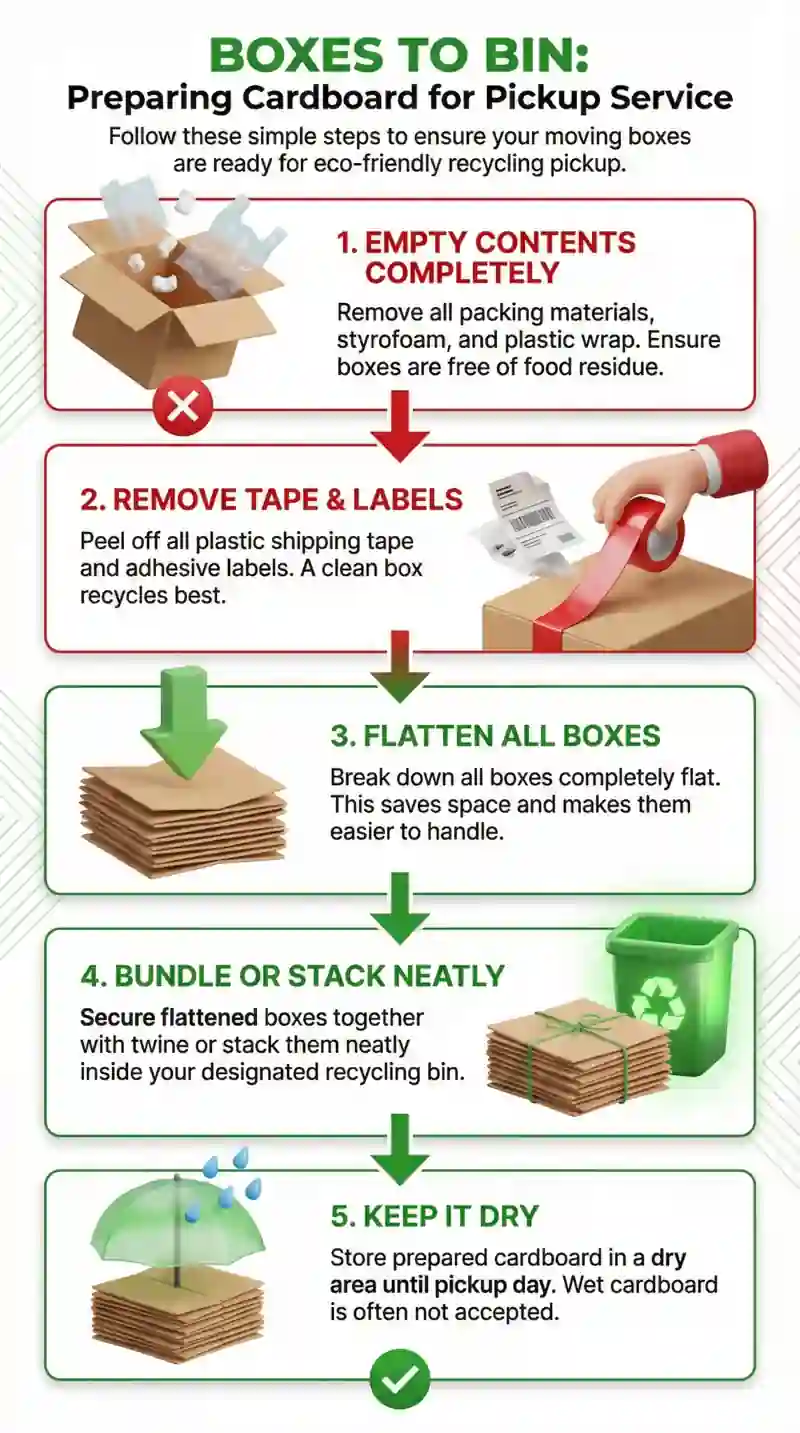
FAQ on Preparing Boxes for Cardboard Pickup Service
Q: Do I really need to flatten my moving boxes before pickup?
A: No. But flattening saves money with 30+ boxes.
Savings by volume (from 8,000+ jobs):
Under 20 boxes: saves $30-40 (skip it)
30-60 boxes: saves $70-120 (worth 30 minutes)
60+ boxes: saves $120-180 (worth effort)
Flatten boxes if:
Physically able without injury risk
Have 30-45 minutes available
30+ boxes where savings matter
Skip flattening if:
Over 50 with back history
Under 20 boxes
Exhausted from moving
Time constraints
Pattern we see: Customer saves $100, injures back, pays $250 urgent care + $299 full-service = $549 total.
Q: What materials do I need to remove from boxes before pickup?
A: Remove foam and plastic. Leave tape. It takes 5 minutes.
Must remove:
Foam corner protectors
Bubble wrap sheets
Packing peanuts
Plastic film
Air pillows
Leave on boxes:
Packing tape
Shipping labels
Cardboard inserts
Recycling rates we see:
Clean cardboard: 95-97% recycled
Mixed loads: 40-60% recycled, rest → landfill
From our facility partners:
Under 5% contamination: 30 minutes processing
Over 15% contamination: 2+ hours or rejected
Peak season: dirty loads turned away, sent to landfill
Five minutes = 20-year difference (recycling vs. landfill).
Q: Where should I stack my boxes for fastest pickup?
A: Single location. Ground level. Clear path.
Loading times by location:
Driveway/curbside: 8-12 minutes
Back truck to pile
Zero obstacles
Same-day service likely
Garage with access: 12-18 minutes
Open door before arrival
Clear path
Inside front door: 18-25 minutes
Minimize carrying distance
Basement/upstairs: 30-45 minutes
Major labor increase
Higher pricing tier
Real example last week:
Boxes in 3 rooms
Customer moved to garage (30 minutes work)
We re-quoted $100 lower
Loaded in 15 minutes vs. 45
Saved $100 with half hour effort
Key point: Accessible matters. Pretty doesn't.
Q: What photos do I need to send for an accurate quote?
A: Three photos. We quote 90% of jobs from photos alone.
Required photos:
1. Wide angle (8-10 feet back)
Shows full volume
Captures everything
2. Side angle (perpendicular)
Shows depth
Prevents volume surprises
3. Close-up
Box sizes
Flattened vs. assembled
Include with photos:
Approximate count
Location (garage, driveway, basement)
Access notes (stairs, elevator)
Preferred pickup date
Without photos:
We quote high for protection: $299
With photos: same job = $199
Pro tip from 10 years: Multiple angles beat one perfect shot. Show the mess. We've seen everything.
Response time: 30 minutes during business hours.
Q: What if I physically can't prepare my boxes?
A: Full-service removal. We handle unprepared boxes daily. 30% of our jobs.
When we recommend full-service:
Mobility limitations
Injury recovery
Over 60 with back concerns
Exhausted from moving
Time constraints
Don't want to deal with it
Pricing difference:
Prepared rate: $199
Full-service: $349
Difference: $150
Real customer:
Elderly couple, 40 boxes, two floors
Husband recovering hip surgery
Chose full-service immediately
"Worth every penny for peace of mind"
Our take: Don't risk injury saving $100-150.
We have hand trucks, technique, 20-year-olds
You have boxes and body that needs protection
Zero judgment. Be honest about the situation. We'll handle it.