If you’re searching for ways to save money on junk removal services, you’re really asking one question: “How do I lower my junk removal cost without ending up with surprise fees?” At Jiffy Junk, we’ve learned that most pricing isn’t random—it’s driven by measurable job factors we see on pickups every day, like how much truck space your items take up, how long the crew spends loading, and how difficult the access is (stairs, basements, long carries, tight hallways). That’s why the cheapest junk removal isn’t always the lowest advertised rate—it’s the job that’s planned correctly. In this guide, you’ll get a practical, step-by-step breakdown of the smartest ways to cut junk removal cost, including what to do before booking, how to reduce labor time, and how to structure your load so you pay for less truck space—not more.
TL;DR Quick Answers
junk removal cost
Junk removal cost is usually based on truck space (volume) and labor time, not just the number of items.
To estimate cost fast, focus on:
Load size (¼, ½, full truck)
Bulky items (couches, mattresses, appliances)
Access difficulty (stairs, basement, long carry)
In our experience, the best way to avoid surprise pricing is to round up your load estimate and include access details upfront—because that’s what most often changes the final quote.
Top Takeaways
Junk removal cost is mostly volume + labor.
Pricing is typically based on how much truck space your junk takes up and how long the crew needs to load it.Accessibility can raise (or lower) your final quote fast.
Stairs, basements, tight hallways, and long carry distances increase labor time and can push pricing higher.Reducing load size is the quickest way to save money.
Breaking down bulky items, bundling debris, and consolidating junk can lower your pickup into a smaller pricing tier.Prep work is a real discount.
Staging items in one area and clearing pathways helps crews work faster, which often keeps pricing more predictable.Accuracy prevents surprise charges.
Listing everything upfront and rounding up volume estimates reduces last-minute quote changes and keeps your booking smoother.
Why Junk Removal Costs More Than People Expect
In our experience at Jiffy Junk, most customers don’t overpay because they booked the “wrong” company—they overpay because the pickup takes more time and more truck space than expected. Junk removal pricing is usually based on volume (how much room your items take in the truck), plus labor factors like stairs, long carries, and loading time, which can directly impact the cost of a bathroom remodel when demolition debris and bulky materials add extra volume. The goal isn’t just finding the lowest rate—it’s making your pickup faster, easier, and more efficient.
Understand What Drives Junk Removal Cost
Before you try to save money, it helps to know what you’re paying for. The biggest cost drivers are:
Load size (volume): ¼ truck vs. ½ vs. full load
Labor time: how long it takes to remove and load items
Accessibility: stairs, basements, elevators, long carry distances
Item type: bulky furniture, heavy appliances, mixed debris
Disposal fees: some materials cost more to recycle or dump
When you control the first three, you can usually reduce the total cost significantly.
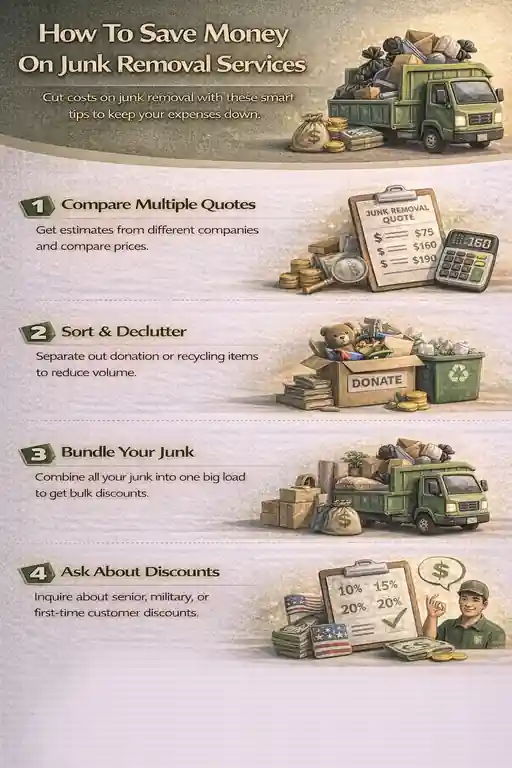
The Best Ways to Save Money on Junk Removal Services
Reduce the load size (volume) before booking
Truck space is one of the biggest pricing factors. To lower cost:
Break down furniture when possible (bed frames, shelves, boxes)
Flatten cardboard and bundle loose debris
Consolidate smaller items into bags or bins
Remove items you can donate or recycle separately
Even reducing your load from “half truck” to “quarter truck” can make a major difference.
Make the pickup faster by improving access
We see this all the time: the same junk costs more when it’s harder to reach. If safe to do so:
Move items to the garage or front entry
Place lighter items near the door for faster loading
Clear pathways (hallways, stairs, gates)
Reserve parking close to the pickup area
Less walking and fewer obstacles often means less labor time—which helps reduce cost.
Book everything in one pickup
Multiple smaller pickups usually cost more than one well-planned load. If you’re already scheduling service:
Combine rooms (garage + attic + backyard)
Add bulky items you’ve been postponing
Include leftover renovation debris if allowed
In many cases, maximizing a single pickup improves the cost-per-item.
Avoid last-minute add-ons that increase pricing
One of the fastest ways to raise cost is adding items after the quote is set. To keep pricing consistent:
Create a complete item list before booking
Group everything into one area
Don’t forget “hidden junk” (basement corners, shed piles, side yard debris)
The more accurate your original estimate, the fewer surprises later.
Use a cost calculator before scheduling
A junk removal cost calculator helps you estimate pricing based on:
Item type
Load size
Pickup difficulty
The key is entering details the way a crew would price it in real life—especially volume and access.
When DIY Disposal Is (and Isn’t) Cheaper
DIY can save money for small loads, but it’s not always the best deal once you factor in:
Truck rental costs
Fuel and mileage
Landfill fees
Your time and labor
For heavy, bulky, or high-volume cleanouts, professional junk removal is often more efficient—and can be more cost-effective when planned correctly.
Final Tip: The Cheapest Junk Removal Is the Most Efficient Pickup
If you want the lowest junk removal cost, focus on what actually reduces pricing:
Less volume
Less labor time
Easier access
When the job is easier to load and takes up less truck space, you don’t just save money—you also get a smoother booking, faster pickup, and fewer pricing surprises.
“After thousands of pickups, we’ve learned that junk removal cost isn’t really about the number of items—it’s about truck space and labor time. When customers reduce volume, clear access, and stage everything in one area, the job moves faster and the price stays more predictable. That’s the simplest way to save money without sacrificing convenience, and it also helps when comparing junk hauling to valet trash service for smaller, ongoing waste removal.”
Essential Resources
1) Junk Removal Cost Guide — Wastedoor Cost Guide
A practical breakdown of typical junk removal prices and how volume, access, and disposal affect cost. Great for setting expectations before you shop around.
https://wastedoor.com/article/junk-removal-cost-guide
2) Pricing Factors Explained — Junk Commandos Guide
Explains the key pricing drivers like truck space and labor—insights that mirror how pros like us at Jiffy Junk estimate jobs in the field.
https://junk-commandos.com/how-much-does-junk-removal-cost-a-complete-pricing-guide/
3) National Cost Benchmarks — HomeGuide Junk Removal Prices
Provides national average cost ranges by load size and job type, helping you judge if a quote you receive is fair, realistic, or out of line.
https://homeguide.com/costs/junk-removal-prices
4) Quick Cost Estimator — BusinessReverb Junk Removal Calculator
A useful tool to get a rough estimate based on volume and item type before you book. Enter details the way a crew would see them for a more realistic number.
https://www.businessreverb.com/junk-removal-cost-calculator/
5) Updated Pricing & Cost-Saving Tips — FindTrustedHelp Guide
Outlines current junk removal cost drivers and practical tips to save money—similar to the real-world cost advice we share with customers.
https://www.findtrustedhelp.com/articles/cost-junk-removal-cost-guide
6) Official Waste Context — U.S. EPA Facts & Figures
Government data on waste generation helps you understand why junk removal pricing is volume-based and tied to disposal realities—not arbitrary numbers.
https://www.epa.gov/facts-and-figures-about-materials-waste-and-recycling/national-overview-facts-and-figures-materials
7) Bulky Item Handling Insights — EPA Bulky Items Guide (PDF)
Explains how large items like furniture and appliances are handled by waste systems, which is the same complexity that often affects removal quotes.
https://www.epa.gov/system/files/documents/2025-06/bulky-items_v7_508.pdf
These resources help you understand how junk removal costs compare to dumpster rental pricing, so you can judge which option gives you the best value based on volume, access, labor, and disposal needs.
Supporting Statistics
1) Junk removal cost is volume-driven (because waste volume is massive)
In our experience, the biggest pricing surprises happen when load size is underestimated.
The U.S. generated 292.4 million tons of municipal solid waste (MSW) in 2018
Source (EPA): https://www.epa.gov/facts-and-figures-about-materials-waste-and-recycling/national-overview-facts-and-figures-materials
2) Bulky items raise cost quickly (they fill truck space fast)
We often see “just a few items” turn into a larger pricing tier because of furniture and appliances.
37.4 million tons of durable goods (including furniture/appliances) were landfilled in 2018
Source (EPA): https://www.epa.gov/facts-and-figures-about-materials-waste-and-recycling/durable-goods-product-specific-data
3) Construction debris is priced differently (because volumes are huge)
Renovation debris usually means heavier loads, more labor, and different disposal planning.
The U.S. generated 600 million tons of construction & demolition debris in 2018
That’s more than twice the amount of MSW
Source (EPA): https://www.epa.gov/smm/sustainable-management-construction-and-demolition-materials
4) Disposal fees affect quotes (and vary by region)
In real hauling, disposal isn’t a flat cost—fees change by location.
Average landfill tipping fees were $56.80 per ton in 2023 (342 facilities)
Source (EREF): https://erefdn.org/analyzing-municipal-solid-waste-landfill-tipping-fees/
Final Thought & Opinion
Saving money on junk removal isn’t about chasing the lowest advertised rate. It’s about lowering the factors that actually drive cost.
Most junk removal pricing comes down to:
Truck space (volume)
Labor time
Accessibility (stairs, basements, long carries)
Our opinion from real pickups at Jiffy Junk: the cheapest junk removal is usually the most organized pickup.
To save the most:
Stage items in one area
Improve access (clear paths, reserve parking)
Avoid last-minute add-ons
Round up volume estimates
Efficiency is the real discount—and it’s what keeps pricing predictable.
FAQ on Junk Removal Cost
Q: How is junk removal cost calculated?
A: In our experience, pricing is based on:
Truck space (volume)
Labor time
More stairs, basements, or long carries usually increases cost.
Q: What’s the quickest way to lower junk removal cost?
A: Reduce volume and speed up loading:
Break down bulky items
Bundle loose debris
Stage everything in one area
Q: Why do junk removal quotes vary between companies?
A: Quotes vary because companies price differently for:
Volume measurement
Labor time
Access difficulty
Disposal fees
Q: Does curbside pickup save money?
A: Usually, yes.
Faster loading
Less labor time
Lower total cost
Q: How do I avoid surprise charges?
A: Give accurate details upfront:
List items clearly
Include access info (stairs, basement, long carry)
Round up if unsure about load size