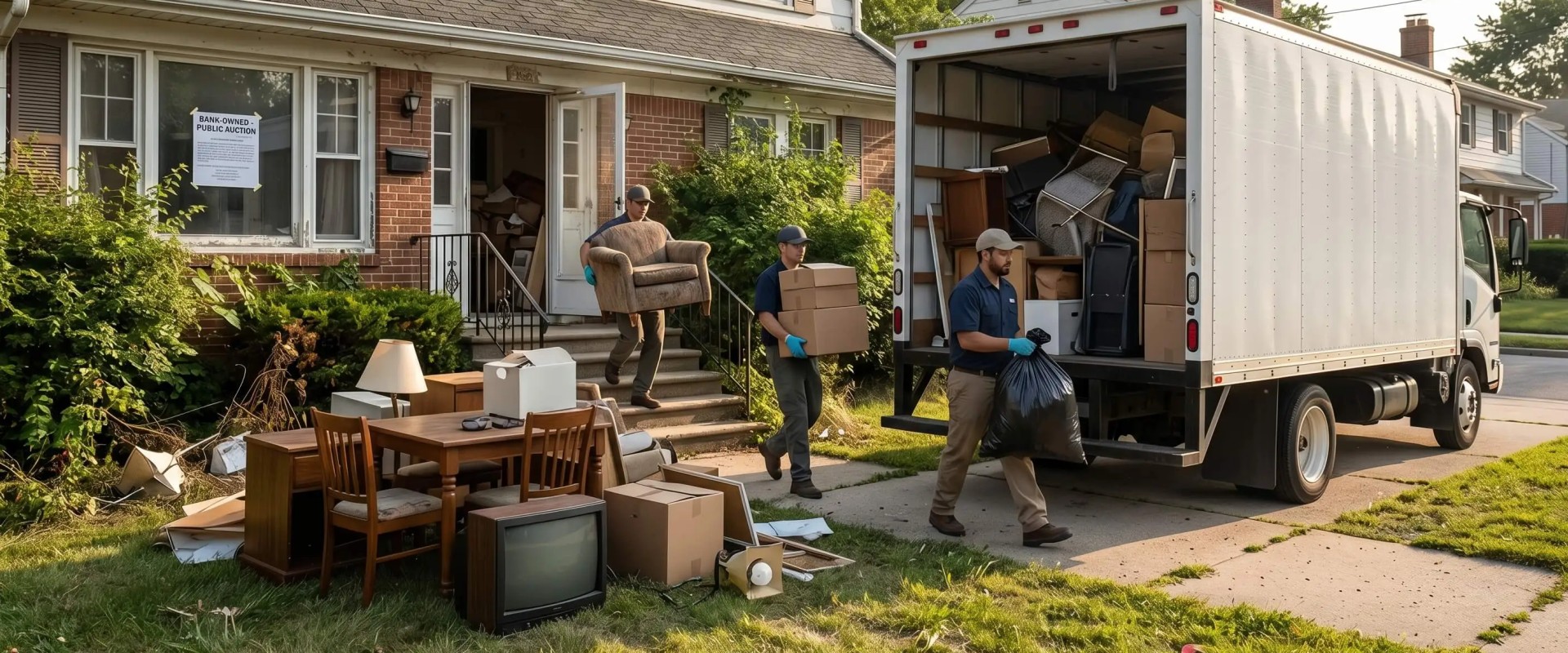
At Jiffy Junk, we've cleared thousands of foreclosed properties, and the bids that hold up are the ones that price the workload, not the floor plan. Most foreclosure cleanouts run $1,500 to $10,000, with typical jobs landing between $3,000 and $6,500. The gap between two quotes on the same address usually comes down to three variables: occupant residue, the lender's broom-clean requirements, and whose deadline is on the bid.
If you're an investor closing on an REO, a real estate agent prepping a listing, or a family caught in probate that overlapped with foreclosure, understanding estate foreclosure cleanouts pricing helps you plan the job with fewer surprises. This page covers the cost drivers specific to foreclosed homes, the hidden fees worth questioning, and the lender requirements that quietly raise the bid before anyone walks through the door.
TL;DR Quick Answers
estate foreclosure cleanouts pricing
Most foreclosure cleanouts cost $1,500 to $10,000, with typical bids landing between $3,000 and $6,500. Pricing runs on workload, not floor plan. Five drivers move the bid:
Truckloads: volume of items, measured in full truck loads
Lender broom-clean standards: add roughly 10–25% over a standard estate cleanout
Hazardous materials: paint, fridge contents, chemicals trigger per-item disposal fees
Access: stairs, narrow hallways, and long carry distances add labor time
Timeline pressure: rush jobs (under 5 days' notice) add 15–30%
Book a video walk-through quote within the first week of taking possession for the best pricing.
Top Takeaways
• Foreclosure cleanouts typically run $1,500 to $10,000+, with most jobs falling between $3,000 and $6,500
• Volume and truckloads, not square footage, drive the quote.
• Lender broom-clean standards add roughly 10 to 25 percent over a standard estate cleanout, mostly to cover photo documentation, appliance interiors, and asset-manager checklists.
• Hazardous materials (paint, fridge contents, chemicals) need specialty disposal fees and should appear as line items, not buried in a "miscellaneous" bucket.
• Tight lender or listing-agent timelines can add a 15 to 30 percent rush surcharge that is almost entirely avoidable with two weeks' notice.
• Get three written quotes from licensed, insured cleanout companies, not one.
What You're Actually Paying For in a Foreclosure Cleanout
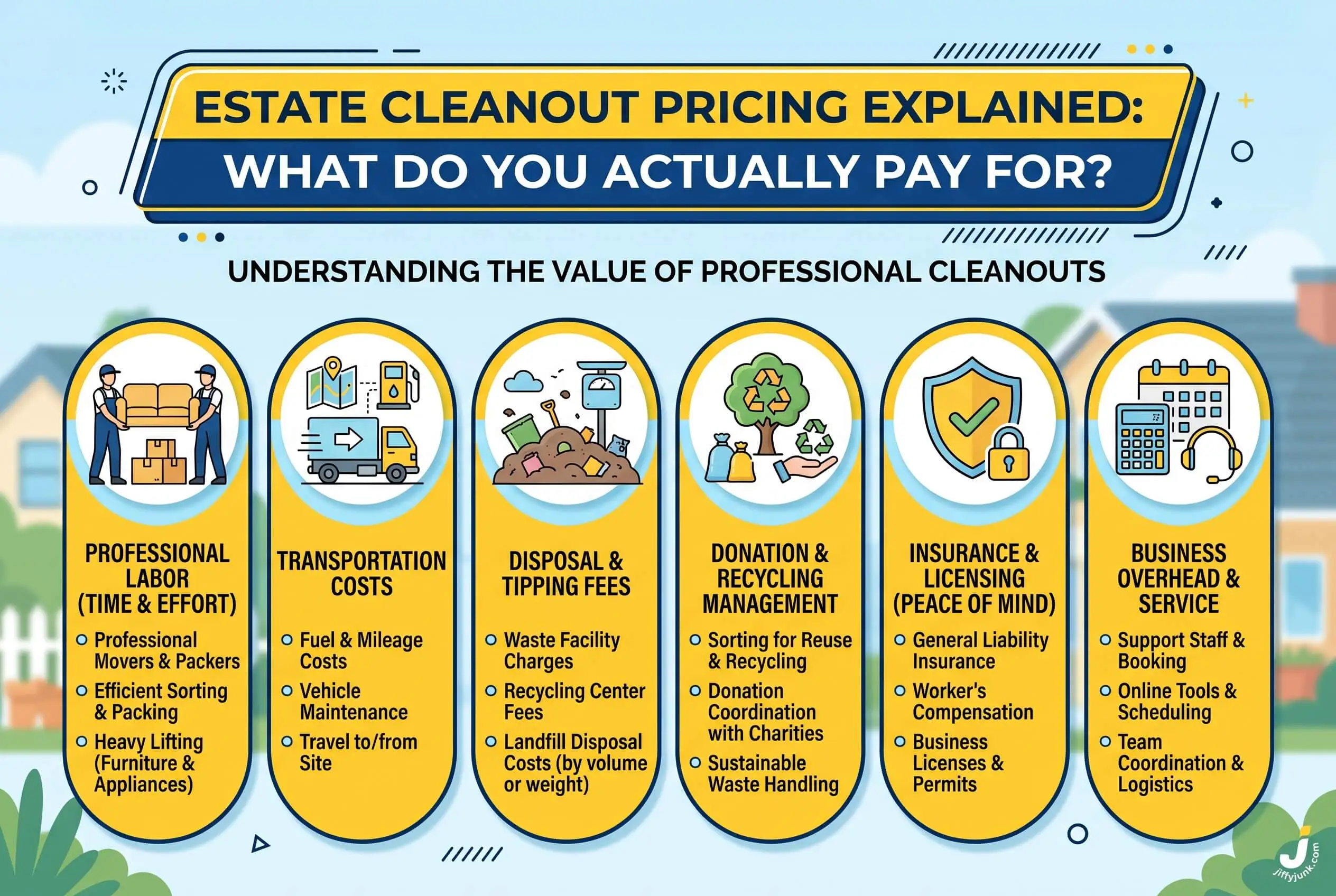
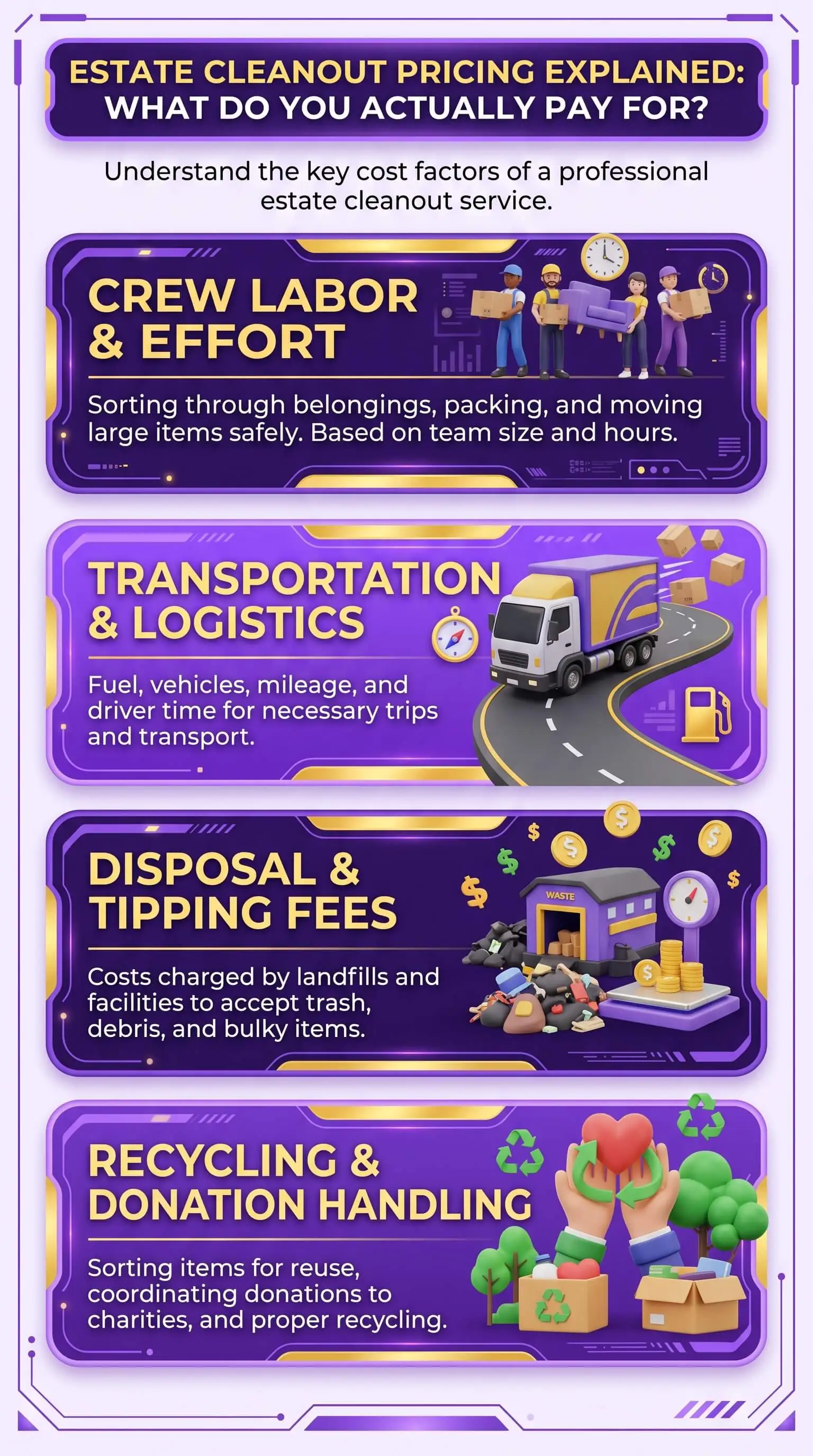
Five drivers shape almost every foreclosure cleanout bid. They don't move the price equally, and each one is worth questioning out loud when you're comparing quotes.
Volume and Truckloads — Why Foreclosed Homes Often Need More Than You'd Guess
Cleanout pricing runs on truckloads, not square footage. A 2,000-square-foot foreclosed home that sat empty for nine months can fill three trucks once the crew sorts through what the previous owner left, what the bank's preservation contractor dropped in the garage, and what neighbors quietly added after the property went vacant. Every extra truckload adds disposal fees, drive time, and crew hours to the bid. For the same math without the lender variables on top, our breakdown of general estate cleanout cost factors covers the underlying logic.
Lender-Required Broom-Clean Standard vs. Standard Cleanout
An REO cleanout has to clear the lender's broom-clean specification, which is stricter than the finish on a regular estate cleanout. That usually means appliance interiors wiped, drains cleared of debris, no scraps left in closets, no marks on baseboards, and photo documentation sent to the asset manager. The extra crew time adds roughly 10 to 25 percent to the bid. Ask any company quoting the job which standard they're bidding to. A quote written for swept floors won't pass an asset manager's checklist, and you'll pay for the second trip out of pocket. For a baseline of what full-service junk removal usually covers, see what professional junk removal includes.
Hazardous Materials Left Behind (Paint, Chemicals, Spoiled Refrigerator Contents)
Foreclosed homes are unusually likely to contain materials that can't ride to the landfill on a standard truck. Half-empty paint cans, motor oil, lawn chemicals, lithium batteries, and spoiled refrigerator contents all need separate disposal channels and per-item handling fees. A single chest freezer full of meat that's been off for six months can add $150 to $300 to a bid before the truck leaves the driveway. We identify these items during the walk-through and price them as line items, not as a fuzzy "miscellaneous" charge. That way you can see what each disposal stream actually costs. Our full whole-house cleanout cost per square foot breakdown shows how special-handling categories should appear on a transparent quote.
Access and Eviction-Era Damage (Forced-Entry Repairs, Boarded Windows, Removed Appliances)
Eviction wear changes how a cleanout crew works the property. Locks may have been re-keyed by the lender's preservation contractor, doors may be boarded, exterior padlocks may need to be cut, and copper plumbing, HVAC condensers, bathroom remodeling debris, or appliances may already have been stripped before the bank took possession. None of that is the cleanout company's job to repair, but every barrier between the truck and the front door costs labor minutes that stack up across a full job. If a long carry distance, a third-floor walkup, or a boarded basement door is part of the property, the bid should reflect it on day one, not when the crew shows up and adjusts the price on the spot.
Timeline Pressure from the Lender or Listing Agent
The single largest avoidable cost on a foreclosure cleanout is rush pricing. Lenders and listing agents both work to closing dates that don't move, and a request to clear a property in 48 hours instead of the typical 5 to 7 day scheduling window can add a 15 to 30 percent rush surcharge. The cleanout itself takes the same crew the same number of hours. What's actually being priced is the disruption to the company's existing schedule. If the closing date is known, get the quote on the calendar two weeks out. The pricing math improves the moment the calendar stops fighting you.
"The price of a foreclosure cleanout is mostly locked in by the day the eviction notice is served. By the time our truck pulls up, the volume is what it is, the fridge has been off for whatever months it's been off, and the lender's broom-clean checklist is already running on someone else's clock. The owners who pay the least are the ones who book a walk-through quote inside the first week of taking possession, ahead of rush fees, ahead of secondary illegal dumping, and ahead of the moment someone else's deadline turns into a line item on the bid."
7 Essential Resources
These seven sources cover the regulatory backdrop, the vendor-vetting tools, and the disposal context that shape a fair foreclosure cleanout bid. Each one is worth bookmarking before you sign anything.
1. ATTOM Year-End 2025 U.S. Foreclosure Market Report
ATTOM's annual report is the most-cited source on foreclosure volume and where it's concentrated. If your property sits in a state seeing a large year-over-year increase, crews book up faster and pricing firms up across the regional market.
Source: attomdata.com – 2025 Year-End Foreclosure Market Report
2. HUD REO (Real Estate Owned) Property Information
HUD's official guidance on REO inventory and property condition standards explains what a federally backed lender expects when a property is conveyed back. The same standards leak into private-lender REO checklists, so the document is useful even outside HUD-insured transactions.
Source: hud.gov – Single Family Real Estate Owned
3. FTC Consumer Advice on Hiring Contractors
Cleanout companies fall under the FTC's broader contractor-hiring guidance. The red-flag list (vague written quotes, large upfront cash deposits, no insurance proof) is the single best 5-minute pre-hire check before signing anything.
Source: consumer.ftc.gov – How to Avoid a Home Improvement Scam
4. EPA Household Hazardous Waste Guide
If the property contains paint cans, motor oil, batteries, pesticides, or other regulated materials, the EPA guide identifies them and points to local disposal programs. Crews that ignore these categories shift the liability onto you.
Source: epa.gov – Household Hazardous Waste
5. CFPB Mortgage Servicing Rules
The CFPB's mortgage servicing rules outline what lenders can and can't require during the foreclosure process. Useful context for understanding why a lender's cleanout deadline lands where it does and how much flexibility is realistic to ask for.
Source: consumerfinance.gov – Regulation X (Part 1024)
6. Better Business Bureau Junk Removal Directory
The BBB's junk removal directory lets you check accreditation status, complaint history, and customer feedback for any cleanout company bidding on your property. Five minutes spent here saves hours of regret later.
Source: bbb.org – Junk Removal Near Me
7. Habitat for Humanity ReStore Donation Program
ReStore accepts furniture, appliances, and building materials in usable condition, often with free pickup. Routing items to ReStore reduces the landfill volume on your bill and may produce a tax-deductible receipt for the estate.
Source: habitat.org – Donate Goods to ReStore
3 Statistics
These figures are the backdrop against which any specific cleanout bid should be evaluated. They explain why pricing has firmed up across 2025 and why some markets cost more than others.
Statistic 1: Foreclosure volume is up, raising regional demand
Figure: 367,460 U.S. properties had foreclosure filings in 2025, up 14 percent from 2024 (ATTOM Year-End 2025 U.S. Foreclosure Market Report, released January 15, 2026).
Source: attomdata.com – 2025 Year-End Foreclosure Market Report
What this means for your quote: Higher regional foreclosure volume means more competition for cleanout crews. In high-volume metros (Texas, Florida, and California led 2025 starts), book your walk-through quote at least two weeks before your closing date.
Statistic 2: Bank repossessions surged
Figure: Lenders repossessed 46,439 properties through foreclosure (REO) in 2025, up 27 percent from 2024.
Source: attomdata.com – 2025 Year-End Foreclosure Market Report
What this means for your quote: REO inventory growth means more lender-required broom-clean cleanouts, which carry stricter standards than a standard estate cleanout. Factor specialty cleaning, photo documentation, and asset-manager checklists into the bid scope.
Statistic 3: Top REO state concentration
Figure: Texas (5,147), California (4,030), Pennsylvania (2,975), Florida (2,869), and Illinois (2,768) led 2025 REO counts.
Source: attomdata.com – 2025 Year-End Foreclosure Market Report
What this means for your quote: Pricing benchmarks should be regionalized. Landfill tipping fees, labor rates, and crew availability in Texas differ materially from Pennsylvania or Illinois. National averages won't tell you what your specific market looks like.
Final Thought & Opinion
Get a video walkthrough quote, not a phone-square-footage quote
Phone quotes priced off square footage are wrong in both directions. We've found that a modest 1,200-square-foot home packed floor-to-ceiling can cost more than the phone quote suggests, while a stripped 3,000-square-foot home often comes in lower. A 10-minute video walk-through with a flashlight gives the crew enough to bid accurately, and saves you from the change-order conversation halfway through the job.
Skip the "labor only" quote. Disposal belongs in the bid.
A labor-only quote sounds cheaper until the separate disposal invoice arrives. Landfill tipping fees, recycling charges, hazardous-material handling, and donation transport are costs that get recovered somewhere on the bill. An all-inclusive bid is almost always cheaper than a labor-only quote plus disposal extras, even when the headline number looks higher. Our breakdown of ways to lower junk removal costs covers more places where line items quietly move.
Lender deadlines should not become the contractor's pricing leverage
The advice that saves the most money is also the simplest: get the quote before the deadline pressure starts. If you know the closing date, the lender's conveyance deadline, or the listing date, the time to call is the day after, not the week before. Rush surcharges of 15 to 30 percent are almost entirely avoidable, and they vanish the moment the calendar stops fighting you.
A foreclosure cleanout bid should answer the same three questions every time: how many truckloads, against what cleanliness standard, and on whose timeline.
Frequently Asked Questions
Q: How much does a foreclosure cleanout typically cost?
A: Most foreclosure cleanouts cost between $1,500 and $10,000, with the average bid landing between $3,000 and $6,500. Volume, lender cleanliness standards, hazardous materials, accessibility, and timeline pressure are the five biggest cost drivers. Phone quotes priced off square footage alone are unreliable. An in-person or video walk-through gives the most accurate number.
Q: What's the difference between a foreclosure cleanout and a regular estate cleanout?
A: A regular estate cleanout finishes with swept floors and empty rooms. A foreclosure cleanout has to clear a lender's broom-clean specification on top of that: appliance interiors wiped, drains cleared, photo documentation submitted, and an asset-manager sign-off recorded. The extra scope typically adds 10 to 25 percent to the bid, and it's the single biggest reason foreclosure pricing diverges from standard estate cleanout pricing.
Q: Who pays for the cleanout — the lender, the buyer, or the previous owner?
A: In most REO sales, the buyer inherits cleanout responsibility unless the bank pre-clears the property. Some lenders pay for a basic trash-out before listing. Others sell the property as-is and discount accordingly. The exact answer depends on the sale contract and the state's foreclosure rules. Talk to a real estate attorney, not a cleanout company, for the legal allocation on your specific transaction.
Q: Can I do a foreclosure cleanout myself to save money?
A: Sometimes. Small properties without hazardous materials are doable solo. For most foreclosed homes, the math is closer than people expect once you factor in dump-run fees ($50 to $150 each), truck rental, time off work, and physical labor risk. In our experience, families who start the cleanout themselves usually call a crew in by the second weekend. The time off work and the physical toll add up faster than the headline savings suggest. If the property fills more than two truckloads, a roll-off dumpster is often the better middle path. Here are the dumpster rental pricing factors worth understanding before committing.
Q: How fast can a foreclosure cleanout be completed?
A: Most single-family foreclosure cleanouts wrap up in 1 to 2 days once a crew is on site. Larger properties or hoarding-condition homes can take 3 to 5 days. Scheduling lead time is usually 5 to 7 days for non-rush bookings. Rush jobs of 24 to 72 hours carry a 15 to 30 percent surcharge.
Get Pricing Clarity Before You Sign
If you're staring down a closing date, a lender deadline, or a listing date, get a transparent quote on the calendar this week, not next. A 10-minute video walk-through gives an accurate bid, locks the scope, and saves you from rush pricing later.
Request a transparent foreclosure cleanout quote at jiffyjunk.com/booking, or read more about the general estate cleanout cost factors that shape every cleanout bid before you start collecting estimates.