The cost question is real. At $500 to $900 per rental, the 40-yarder is the most expensive standard container on the market. What rarely gets discussed is the cost of getting the size wrong. A second haul ordered mid-project, a stalled contractor schedule, a permit window that closes while you wait for a swap — those outcomes cost more than the upgrade would have.
This page gives you the field-tested framework our team uses every day to answer this exact question: what your renovation scope actually generates, where the 40-yard container earns its price, and where a smaller container saves you money without slowing the job down. No guesswork. No upsell. Just the honest breakdown — because we are not happy until you are.
TL;DR Quick Answers
Is Renting a 40 Cubic Yard Dumpster Worth the Cost for Home Renovation?
Based on thousands of renovation hauls, here is the honest answer:
Worth it: Yes — for the right project. Not worth it: For most single-room or light renovation scopes.
The short answer by project type:
Worth renting a 40-yarder for:
Whole-house gut renovations across multiple rooms
Full roof tear-offs on homes over 3,000 square feet
Estate cleanouts with entire households of belongings
Multi-room demolitions with continuous debris generation
Commercial buildouts and tenant improvements
Not worth the cost for:
Single-room kitchen or bathroom remodels
Flooring replacement across one or two rooms
Garage or basement cleanouts without structural removal
Light exterior work — siding, windows, or deck replacement
The numbers:
Rental cost: $500 to $900 all-in for most markets
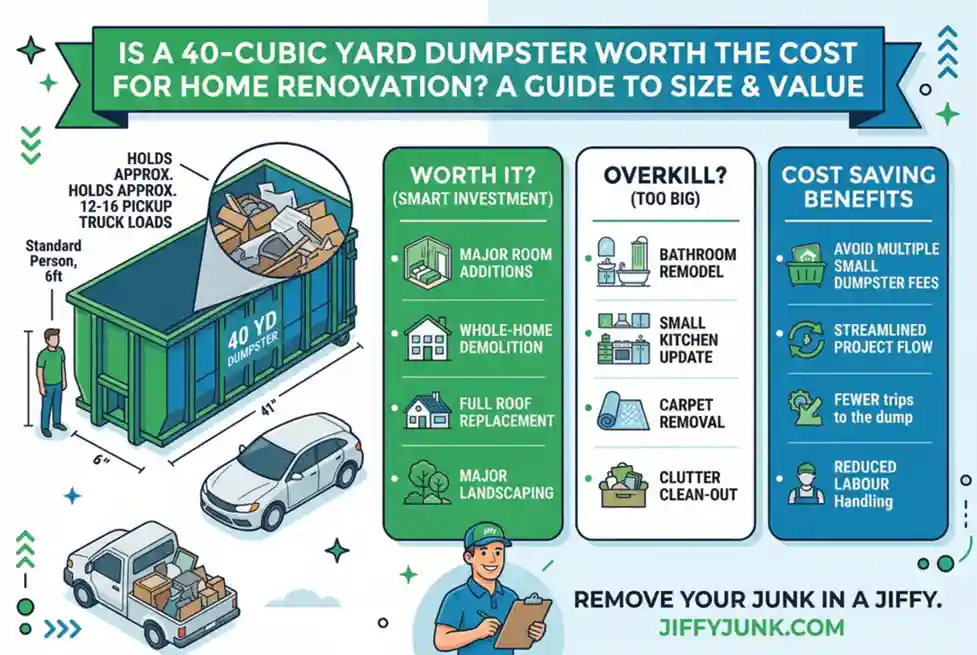
Dimensions: 22 feet long, 8 feet wide, 8 feet tall
Capacity: 12 to 15 pickup truck loads
Weight allowance: 4 to 6 tons
Rental period: 7 to 14 days standard
The cost comparison most homeowners miss:
Two 20-yard rentals back to back: $600 to $1,000 combined
One 40-yard rental: $500 to $900 all-in
Contractor crew idled by a mid-project swap: often exceeds the price difference several times over
From the Jiffy Junk team: the customers who regret the 40-yarder are rare. The ones who regret not booking it — mid-project, with a contractor crew standing idle and a subcontractor waiting to start the next phase — call us every week. Size to the full scope of what you are removing. Not just the first room you plan to start in.
Top Takeaways
The dumpster decision is a project management decision. An undersized container mid-renovation does not just create a waste problem. It creates:
Idle contractor crews
Backed-up subcontractors
Compressed schedules with no room to recover
The container choice sets the pace for everything downstream. Treat it that way before you book.
Volume — not weight — is the constraint on most renovation jobs. Wood, drywall, and cardboard make up 60 to 80% of residential renovation waste. Key facts:
These materials are bulky and light
They fill cubic yards fast without approaching weight limits
The 40-yarder's 8-foot wall height is the margin that keeps multi-room projects moving
The 40-yarder earns its price on specific jobs — and is unnecessary on others. Right for:
Debris generating continuously over multiple days
Scopes spanning multiple rooms or the full property
Jobs where a mid-project swap is not an option
Wrong for: single-room remodels, garage cleanouts, and light exterior work.
New homeowners consistently underestimate renovation debris volume. Buyers of existing homes spend nearly $7,400 on renovations in year one — usually across multiple rooms at once. Two rules we share with every first-year homeowner:
Book to the full scope — not just the first room you plan to start in
Projects always expand. Timelines rarely do.
Choosing too small almost always costs more than sizing up. What a second haul mid-project actually triggers:
Contractor crew standing idle
Subcontractor delays that push back the full schedule
Permit windows that do not wait
The $200 to $400 difference between a 30-yard and a 40-yard rental is not a premium. On large renovation jobs it is the cheapest insurance on the job site.
What Does a 40 Cubic Yard Dumpster Actually Cost for a Home Renovation?
Rental rates for a 40 cubic yard dumpster typically range from $500 to $900 depending on your location, debris type, rental duration, and local disposal fees. That price generally includes delivery, pickup, and a contracted weight allowance of 4 to 6 tons.
What drives the final number up:
Heavy materials like concrete, roofing shingles, and tile that exceed the base weight allowance
Extended rental periods beyond the standard 7 to 14 day window
Permits required for street placement in most municipalities
Mixed debris loads that carry higher landfill tipping fees than clean, separated materials
What our team tells every customer before they book: the quoted rental price is rarely the number that surprises people. The overage fees are. Clarify weight limits and prohibited materials upfront — it is the single most effective way to control your total cost.
What Renovation Scopes Actually Justify a 40-Yarder?
This is the question we field more than any other — and the answer is more specific than most rental guides suggest. Based on the jobs our team completes daily, a 40 cubic yard dumpster earns its cost when a renovation meets at least three of the following conditions:
The project spans multiple rooms or the entire property
Debris generates continuously over a week or more
Structural materials are involved — framing, drywall, flooring, fixtures
Stopping to swap containers would stall contractors or subcontractors on-site
The scope includes a full kitchen or bathroom gut, whole-floor demolition, or complete roof tear-off
Projects that consistently fill a 40-yarder in our experience:
Whole-house gut renovations across multiple rooms and floors
Full roof replacements on homes over 3,000 square feet
Kitchen and bathroom demolitions combined with flooring removal across the entire property
Complete interior clearances ahead of a major structural remodel
Multi-unit residential renovation projects running on tight contractor timelines
When all of those variables are present, the 40-yard container does not just hold more debris. It keeps the job moving without waste management becoming the reason everything else slows down.
Where a Smaller Container Is the Smarter Call
The 40-yarder is not the right answer for every renovation — and recommending it when it is not needed is something we actively avoid. In our experience, the following projects are consistently better served by a 20 or 30-yard container:
Single-room kitchen or bathroom remodels
Flooring replacement across one or two rooms
Garage cleanouts combined with light demolition
Attic or basement clearances without structural removal
Exterior renovations limited to siding, windows, or deck replacement
The math we share with customers considering an oversized container: when evaluating dumpster rental prices, a 30-yard rental often delivers better upfront value, and even if the project generates more debris than expected, a second pickup can still keep overall costs efficient compared to booking a 40-yarder from the start. The exception is when project continuity is non-negotiable — because mid-project swaps cost time, not just money.
How Material Type Changes the Equation
Volume and weight behave very differently depending on what a renovation generates. This is the variable most customers underestimate — and the one that has the biggest impact on whether a 40-yard container is actually worth the cost.
Here is how the most common renovation materials break down:
Drywall, insulation, and lumber — fill volume fast, stay well within weight limits
Hardwood and tile flooring — moderate volume, heavier than expected per square foot
Concrete, brick, and masonry — hit weight limits at a fraction of total capacity
Roofing shingles — one of the densest common renovation materials; a full tear-off can max out weight before the container is half full
Furniture and bulk household items — high volume, low weight; the 40-yarder handles these efficiently
Our field recommendation: if your renovation involves any significant masonry, concrete, or roofing materials, discuss weight limits with your provider before booking. The container size matters less than the weight cap when dense materials are involved.
Site Requirements That Affect Whether a 40-Yarder Makes Sense for Your Property
Even when the project scope justifies the 40 cubic yard container, the site has to be able to accommodate it. This is the step most homeowners skip — and it is the one our drivers troubleshoot most often on delivery day.
Before booking, confirm the following:
Driveway length: a minimum 60-foot clear approach is required for safe delivery
Overhead clearance: 8 feet of vertical height plus additional clearance for the truck boom during placement
Surface stability: asphalt and soft ground require plywood boards under the container wheels to prevent surface damage
Street permit: if the driveway cannot accommodate the container, street placement requires a municipal permit with one to two weeks processing time
HOA restrictions: some communities limit container placement duration, visibility, or require specific positioning on the property
In our experience, the properties most likely to have placement challenges are older homes with shorter driveways, tree-lined approaches with low-hanging branches, and urban or suburban lots with limited setback. If your site has any of those characteristics, contact your provider before booking rather than on delivery day.
The Total Cost Comparison: 40-Yard vs. Multiple Smaller Hauls
This is the calculation most homeowners never run — and it is the one that most clearly answers whether the 40-yarder is worth it for a home renovation.
Here is how the numbers typically break down:
Single 40-yard rental: $500 to $900 all-in for most markets
Single 20-yard rental: $300 to $500 for most markets
Two 20-yard rentals back to back: $600 to $1,000 combined — often matching or exceeding the 40-yard price
The break-even point arrives faster than most customers expect. When a renovation generates enough debris to require more than one smaller container, the 40-yarder becomes the more cost-effective option — not the more expensive one.
The hidden cost that does not appear in rental quotes: contractor downtime during a container swap. On an active renovation site, waiting for a pickup and redelivery can idle a crew for half a day. At contractor labor rates, that delay can exceed the price difference between container sizes several times over.
"The customers who come to us most frustrated are never the ones who rented too large — they are the ones who rented too small and paid for it mid-project. A second haul sounds like a minor inconvenience until you factor in the contractor crew standing idle, the subcontractor who cannot start their phase until debris clears, and the permit window that does not wait for your swap to arrive. In fifteen years of hauling from active renovation sites, we have never had a customer regret having enough capacity. We have had plenty of regrets not having it. The 40-yard dumpster is not a luxury for the projects that need it — it is the cheapest insurance on the job site."
Essential Resources
We have worked alongside homeowners and contractors on thousands of renovation projects. The customers who plan ahead — and review these resources before booking — avoid the surprises that derail timelines and inflate costs. Here are the seven guides our team recommends most.
1. 2023 Home Improvement Statistics — U.S. Census Bureau & HUD See How Your Renovation Compares to What Homeowners Are Actually Spending Nationally
Before deciding whether a 40-yarder is worth the cost, it helps to know where your project stands relative to national benchmarks. This Census Bureau and HUD infographic provides current data on home improvement activity and spending patterns across U.S. households — useful context for understanding whether your renovation scope is typical or firmly in large-container territory. https://www.census.gov/library/visualizations/2024/demo/home-improvements.html
2. Best Practices for Reducing, Reusing, and Recycling C&D Materials — U.S. EPA Reduce What Goes in the Dumpster Before It Arrives — and Lower Your Total Cost
One thing we tell every customer before a large renovation rental: the less you load, the less you pay. This EPA resource outlines which renovation materials can be recycled, salvaged, or diverted before they ever reach the container — directly reducing the volume you need to haul and the disposal fees that follow. https://www.epa.gov/smm/best-practices-reducing-reusing-and-recycling-construction-and-demolition-materials
3. Sustainable Management of Construction and Demolition Materials — U.S. EPA Understand What a Major Renovation Actually Generates — Before You Underestimate It
The single most common mistake we see on large renovation jobs is underestimating debris volume. This comprehensive EPA resource covers C&D debris management from renovation through disposal — including material recovery options and recycling pathways that affect both your container size decision and your bottom line. https://www.epa.gov/smm/sustainable-management-construction-and-demolition-materials
4. Lead-Safe Renovations for DIYers — U.S. EPA Know What Your Renovation Waste Can — and Cannot — Go Into a Standard Dumpster
On older home renovations, our teams regularly encounter materials that cannot go into a standard container. This EPA guide covers lead-safe work practices, waste containment requirements, and disposal protocols for pre-1978 homes — the information you need to avoid container rejections, unexpected fees, and compliance issues before loading begins. https://www.epa.gov/lead/lead-safe-renovations-diyers
5. Construction and Demolition Debris Material-Specific Data — U.S. EPA Put Real Numbers Behind How Fast Renovation Debris Adds Up
We see the national debris statistics play out one project at a time. This EPA data resource breaks down the volume, composition, and disposal destinations of C&D debris generated through renovation and demolition — giving you the real-world context to understand why large renovation scopes consistently require more container capacity than most homeowners expect. https://www.epa.gov/facts-and-figures-about-materials-waste-and-recycling/construction-and-demolition-debris-material
6. Remodeling Market Index — National Association of Home Builders Use Industry Data to Confirm Whether Your Project Scope Justifies the Largest Container
Not every renovation needs a 40-yarder — and we will tell you that directly. This quarterly NAHB index tracks current conditions for large, moderate, and small renovation projects nationwide — providing the industry benchmarks that help homeowners and contractors determine which project categories consistently generate the debris volume that makes a 40-yard rental the most cost-effective choice. https://www.nahb.org/news-and-economics/housing-economics/indices/remodeling-market-index
7. Household Hazardous Waste Guide — U.S. EPA Pacific Southwest Region Find the Restricted Materials Hiding in Your Home Before Your Container Arrives
On virtually every whole-house renovation we complete, our crews find the same prohibited items — old paint, batteries, solvents, and chemicals that have accumulated in garages and storage areas for years. This EPA resource identifies the hazardous materials most commonly uncovered during home renovations and outlines proper disposal protocols that prevent container rejections, overage fees, and the project delays that follow. https://19january2017snapshot.epa.gov/www3/region9/waste/solid/house.html
Supporting Statistics
Every large renovation job tells the same story. Customers who planned their waste management around actual project scale finished on time. The ones who did not pay twice. Here is what the data confirms — and what our team has learned hauling debris from thousands of home renovation sites.
U.S. Homeowners Spent $503 Billion on Renovations and Repairs in 2024
Most customers frame the dumpster decision as a cost question. We frame it as a project efficiency question — because at renovation spending levels this large, getting the container wrong can make it feel like the most expensive decision on the job.
According to the Joint Center for Housing Studies of Harvard University, remodeling activity reached $503 billion in 2024, with spending projected to reach $509 billion in 2025. Harvard Joint Center for Housing Studies
What our team reads into that number:
Renovation scopes are growing — not shrinking
Homeowners investing at this scale are not doing single-room refreshes
Larger scopes mean longer project durations and more continuous debris generation
What a container swap mid-project actually costs:
Price of a second haul
Contractor hours lost waiting for pickup and redelivery
Subcontractor delays that compress the rest of the schedule
Permit windows that do not wait for waste management logistics
We have watched $500 dumpster decisions become $2,000 problems on active renovation sites. Customers who right-size from the start treat waste management as part of the project plan — not an afterthought.
Source: Joint Center for Housing Studies of Harvard University — Leading Indicator of Remodeling Activity https://www.jchs.harvard.edu/benchmark-update-lifts-remodeling-market-size-projections
Wood, Drywall, and Cardboard Make Up 60 to 80% of Residential Renovation Waste
This is the statistic we reference most when a customer is deciding between a 30-yard and a 40-yard container. It completely reframes how they think about what they are actually loading.
According to EPA regional data, wood, drywall, and cardboard make up 60 to 80% of jobsite waste on residential renovation projects. EPA
What that composition profile means in real-world loading terms:
Drywall sheets, lumber cutoffs, and subfloor panels are bulky but light
They fill cubic yards fast without pushing weight limits
A whole-floor renovation can load 15 to 20 cubic yards before the container looks half full from a distance
By day three of a multi-room gut, customers who booked a 30-yarder are calling us for an emergency swap
The insight most rental guides miss entirely:
For residential renovation debris, volume is almost always the constraint — not weight
The 40-yarder's 8-foot wall height is not excess capacity on these jobs
It is the margin that keeps the project moving without interruption
Source: U.S. Environmental Protection Agency — Pacific Southwest Region, Construction and Demolition Debris Composition Analysis https://19january2017snapshot.epa.gov/www3/region9/waste/solid/pdf/cd1.pdf
Buyers of Existing Homes Spend Nearly $7,400 on Renovation Projects in Their First Year
New homeowners are among the customers most likely to underestimate container needs — and most likely to feel the consequences mid-project when timelines are compressed and contractor schedules leave no room for delays.
According to the National Association of Home Builders, buyers of existing homes spend close to $7,400 on property repairs, alterations, and remodeling projects in the first year after closing — compared to $4,282 for homeowners who do not move. NAHB
What our team consistently sees behind that spending gap:
New homeowners rarely tackle one project at a time
Kitchen demo, flooring replacement, bathroom gut, and painting across multiple rooms happen simultaneously
Combined multi-room scope compresses a gradual debris stream into a concentrated high-volume surge
That surge is exactly what the 40-yard container was designed to absorb without a mid-project interruption
The perspective we share with every first-year homeowner who calls us:
Book the container to fit the full scope — not just the first room you plan to start in
Projects always expand
Timelines rarely do
Source: National Association of Home Builders — Home Purchases Trigger Big Spending on Remodeling, Appliances and Furnishings https://www.nahb.org/blog/2022/06/home-buyers-spend-big
These supporting statistics highlight how factoring in dumpster rental cost upfront allows you to plan more efficiently, avoid unexpected expenses, and keep your renovation project running smoothly from start to finish.
Final Thoughts
After thousands of renovation hauls, our team has reached a conclusion that does not appear in any rental guide: the dumpster decision is not a waste management decision. It is a project management decision — and the customers who treat it that way finish on time and on budget far more consistently than the ones who do not.
The Question Is Never Just About the Container
When customers ask whether a 40-yarder is worth the cost for their renovation, they are really asking: can I afford for this project to stop mid-stream?
That is the actual risk on the table:
A second haul is not just a line item — it is a scheduling event
A delayed pickup idles a contractor crew at labor rates that dwarf the rental price difference
An undersized container that fills on day two of a ten-day renovation creates a project-wide bottleneck — not just a waste problem
The container choice sets the pace for everything downstream. That is the framing most homeowners never hear before they book.
What the Numbers Actually Tell You
Three data points from this page tell the complete story:
U.S. homeowners spent $503 billion on renovations in 2024 — projects at this scale generate debris volumes that demand advance planning, not reactive container swaps
Wood, drywall, and cardboard make up 60 to 80% of residential renovation waste — volume, not weight, is the constraint on most home renovation jobs
New homeowners spend nearly $7,400 on renovation projects in their first year — multi-room simultaneous scopes compress debris generation into a concentrated surge
Each statistic points to the same conclusion: the projects most likely to need a 40-yarder are also the ones where getting the size wrong costs the most.
Our Honest Opinion
Most residential renovation projects do not need the largest container available. We say that directly — and we mean it.
But here is what only comes from watching this decision play out across thousands of job sites: the homeowners who suffer most are not the ones who rented too large. They are the ones who rented too small because the price difference felt significant before the project started.
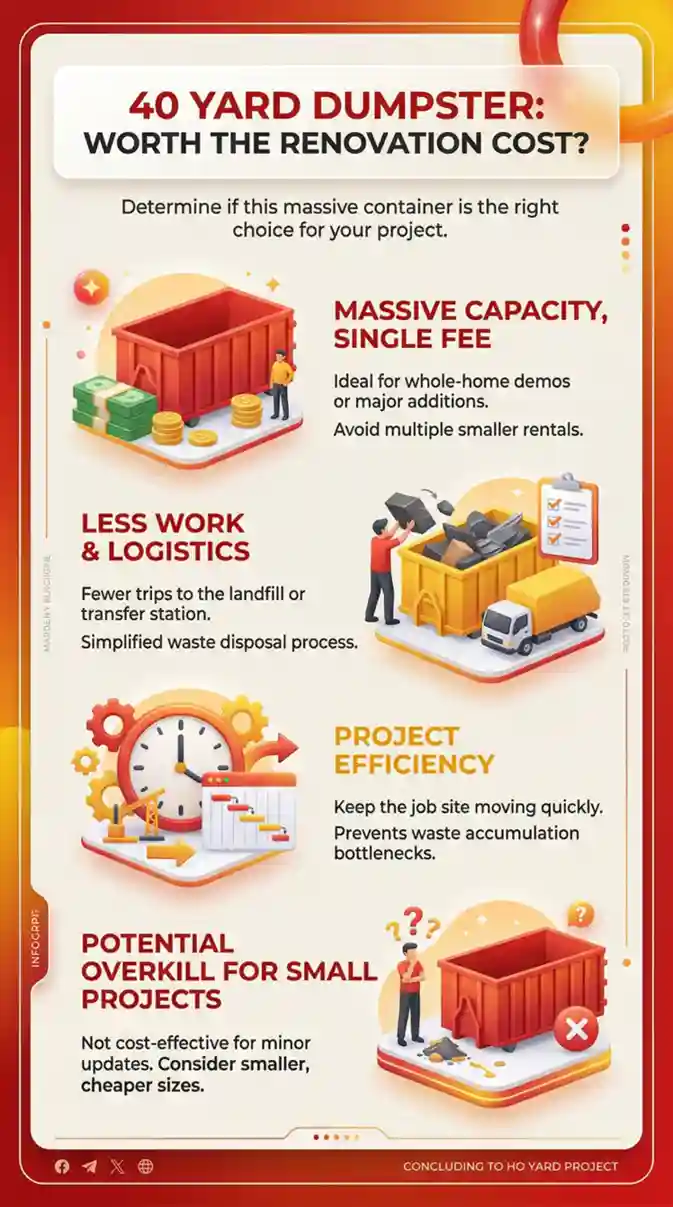
The 40-yarder earns its price when a renovation:
Generates debris continuously over multiple days
Spans multiple rooms or the entire property
Involves structural materials that cannot be compressed or stacked efficiently
Cannot absorb a mid-project container swap without consequences that ripple through the entire schedule
On those jobs, the $200 to $400 difference between a 30-yard and a 40-yard rental is not a premium. It is the cheapest insurance on the job site.
What We Tell Every Customer Before They Book
Scope the full project — not just the first phase — before choosing a container size
Identify your debris type first — volume jobs and weight jobs require different planning
Walk your placement area before booking — site logistics determine what is physically possible
Pull restricted materials before the container arrives — one hour of sorting prevents days of delays
When the scope is genuinely large, size up — the rental cost is a fraction of what a mid-project stall will cost you
Not sure where your renovation falls? Send us photos of what you are removing. We have completed enough similar jobs to give you a straight answer — and we are not happy until you are.
FAQ on Is Renting a 40 Cubic Yard Dumpster Worth the Cost for Home Renovation?
Q: How much does it cost to rent a 40 cubic yard dumpster for a home renovation?
A: Rental rates: $500 to $900 depending on location, debris type, duration, and local disposal fees.
What is typically included:
Delivery and pickup
4 to 6 ton weight allowance
Standard 7 to 14 day rental period
What drives the final cost up:
Heavy materials exceeding the base weight allowance
Extended rental periods beyond the standard window
Street placement permits required by most municipalities
Mixed debris loads with higher landfill tipping fees
What surprises customers most: never the quoted price — always the overage fees. One conversation about weight limits and prohibited materials before loading starts prevents almost all of them.
Q: Is a 40 cubic yard dumpster always worth the cost for a home renovation?
A: No. In our experience, fewer than 20% of residential renovation projects genuinely need the largest container on the market.
The 40-yarder is worth it when the renovation:
Generates debris continuously over multiple days
Spans multiple rooms, floors, or the entire property
Involves structural materials — drywall, framing, flooring, fixtures
Cannot pause for a container swap without stalling contractors or subcontractors
Not worth it for:
Single-room kitchen or bathroom remodels
Flooring replacement across one or two rooms
Garage or basement cleanouts without structural removal
Light exterior work — windows, siding, or deck replacement
Bottom line: when the scope is genuinely large, the 40-yarder pays for itself in uninterrupted project momentum. When it is not, a 20 or 30-yard container saves money without slowing the job.
Q: How does material type affect whether a 40 cubic yard dumpster is worth renting?
A: More than most customers realize. Material type determines which limit you hit first — volume or weight. This is the conversation we have on almost every large renovation booking.
How common renovation materials behave in a container:
Drywall, lumber, insulation — fill volume fast, stay within weight limits. These make the 40-yarder's wall height most valuable.
Hardwood and tile flooring — moderate volume, heavier per square foot than expected
Concrete, brick, masonry — hit weight limits before the container looks full. A smaller container with a higher weight allowance is often smarter here.
Roofing shingles — densest material we haul. A full tear-off on a home over 3,000 sq. ft. can max the weight cap before the bin looks half full.
Furniture and bulk household items — high volume, low weight. The 40-yarder handles these most efficiently.
Our field recommendation: identify your primary debris type before booking. For most residential renovation debris — drywall, lumber, and mixed household items — volume is the constraint. The 40-yarder is built for that load profile.
Q: How does renting a 40 cubic yard dumpster compare to scheduling multiple smaller hauls?
A: This is the calculation most homeowners never run. We walk through it on every large renovation call.
How the numbers typically break down:
Single 40-yard rental: $500 to $900 all-in
Single 20-yard rental: $300 to $500
Two 20-yard rentals back to back: $600 to $1,000 combined
The break-even arrives faster than most expect. When the project fills more than one smaller container, the 40-yarder becomes the more cost-effective option — not the more expensive one.
Hidden costs that never appear in rental quotes:
Contractor crew idle time during a container swap
Subcontractor delays while the site waits to clear
Schedule compression that pushes back every phase that follows
What we see on active renovation sites: waiting for a pickup and redelivery idles a crew for half a day. At current contractor labor rates, that delay frequently costs more than the price difference between container sizes — sometimes several times over.
Q: What site requirements should homeowners confirm before renting a 40 cubic yard dumpster?
A: Site logistics are the step most homeowners skip. They are also what our drivers troubleshoot most on delivery day.
Confirm these before booking:
Driveway length: minimum 60-foot clear approach required
Overhead clearance: 8 feet vertical height plus truck boom clearance — branches, utility lines, and garage overhangs are the most common obstacles
Surface stability: plywood boards under wheels prevent damage to asphalt and soft ground
Street permit: 1 to 2 weeks processing time, $25 to $150 in fees — required for most street placements
HOA restrictions: placement duration, positioning, and visibility rules vary by community
Properties our drivers flag most often:
Older homes with short driveways
Tree-lined approaches with low-hanging branches
Urban and suburban lots with limited street setback
Gated communities with delivery truck turn radius restrictions
Our standing advice:
Identify potential placement issues before booking
Call your provider if your site has any of the above characteristics
Never wait until delivery day to raise site concerns
A placement issue discovered at drop-off does not just delay the container. It delays the entire project start.