After helping homeowners coordinate hundreds of post-renovation cleanouts, I can tell you that there is a real difference between people who successfully handle a cleanout in a single weekend and people who let unwanted furniture sit in the garage for six months. The difference is not strength, vehicle access, or budget. The difference is a plan.
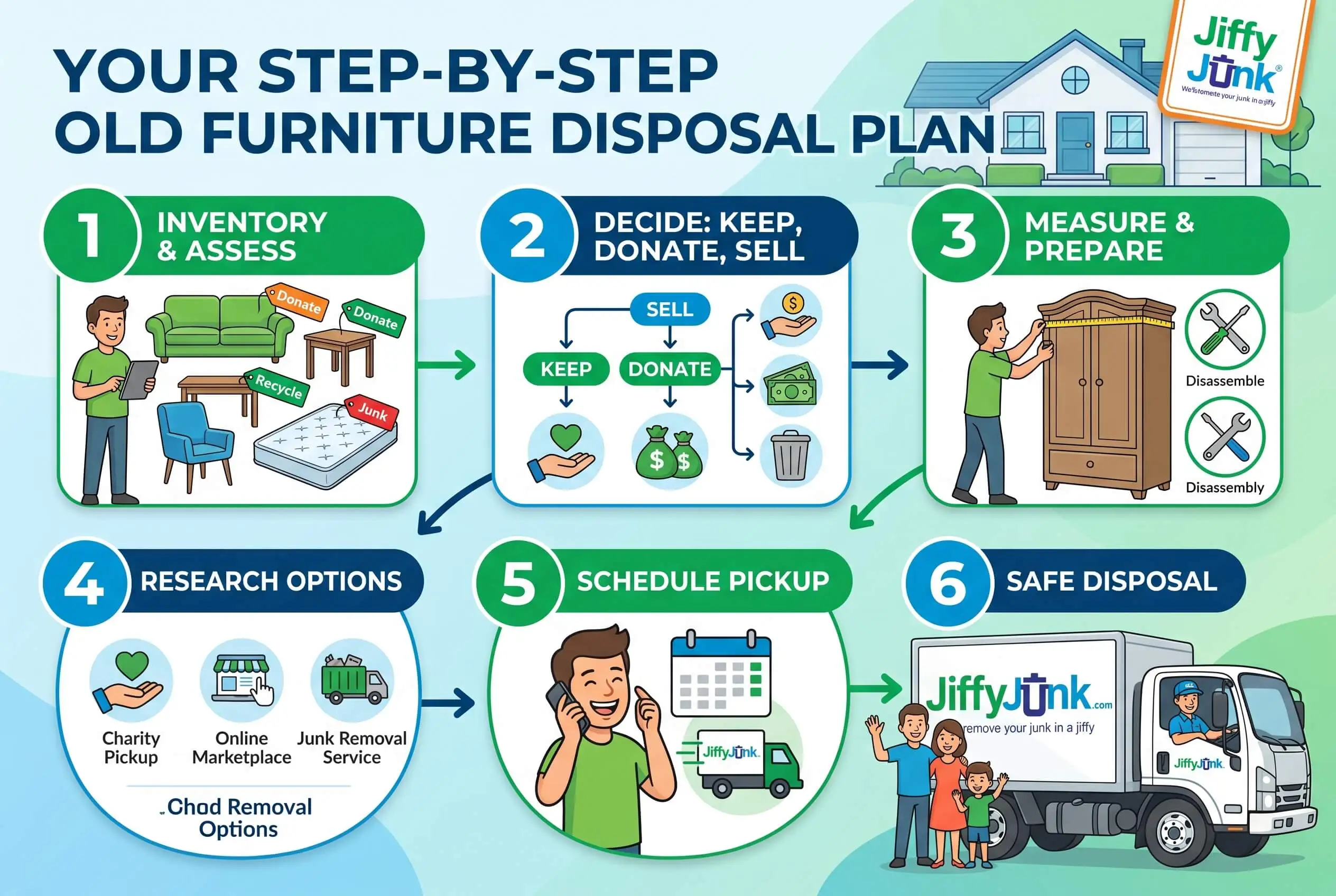
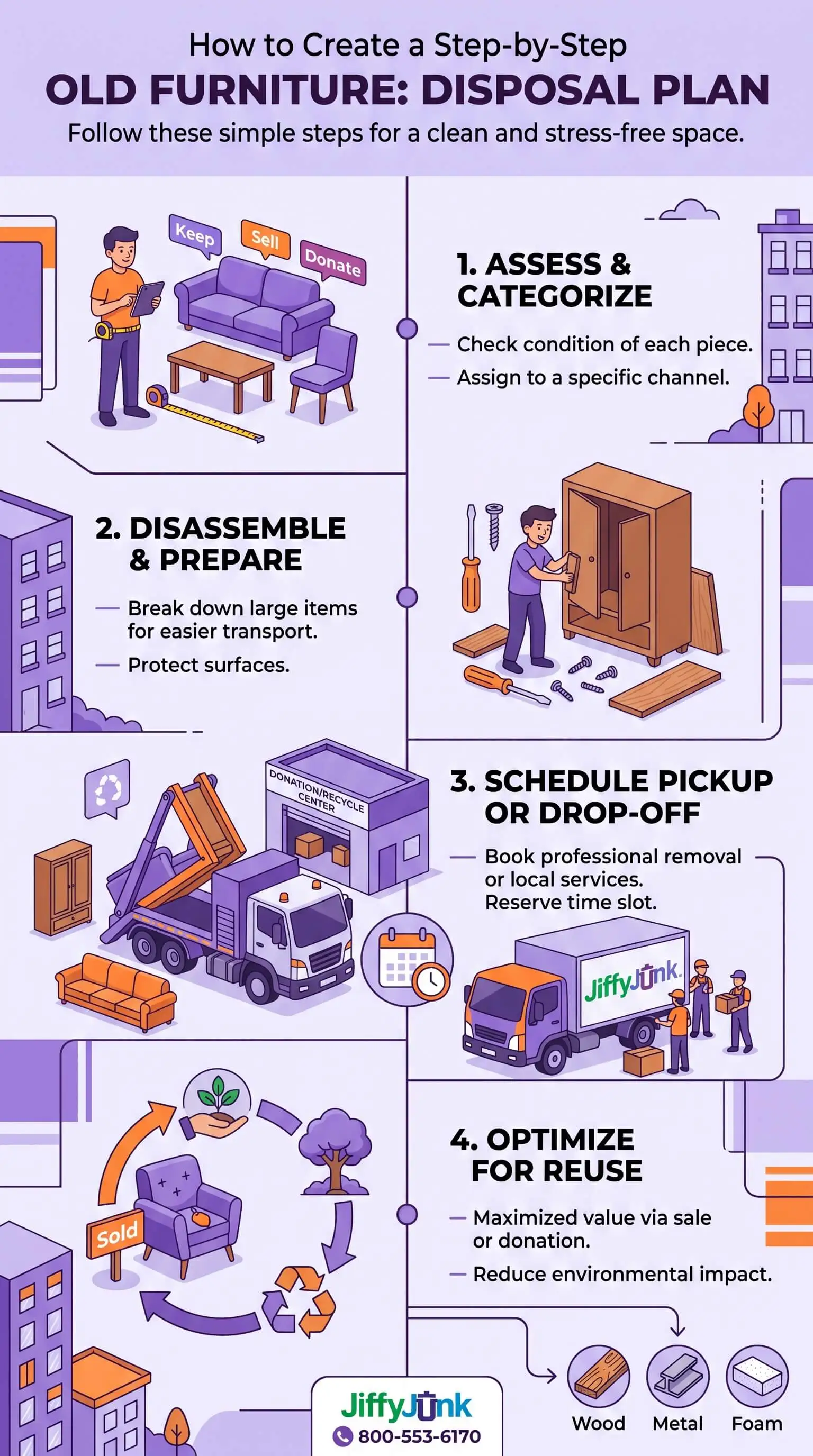
This guide walks through a structured, six-step approach to getting rid of old furniture the right way — sorting, assessing, choosing the correct disposal route, prepping each item, scheduling pickup, and executing without surprises. By the time you finish reading, you will know exactly what to do with every chair, sofa, dresser, and mattress in your house that no longer earns its place.
TL;DR Quick Answers
Getting Rid of Old Furniture
The fastest path to clearing old furniture is sorting it into four routes before you move a single piece: donate, resell, recycle, or haul. Condition decides the route — and decision delay is what fills landfills, not bad intent.
Match each item to its right route:
Excellent or gently used → Donate. Goodwill, Salvation Army, and Habitat ReStore offer free pickup for eligible pieces in many areas.
Mid-to-high resale value → List on Facebook Marketplace, OfferUp, or Craigslist. Real-wood dressers, leather sofas, and dining sets tend to move.
Damaged but recyclable materials → Drop off at a transfer station that accepts wood, metal, or mattresses.
Stained, broken, mixed-condition, or oversized → Professional junk removal. Same-day to 48-hour service in most metros.
Three rules that save time and money:
Inventory every piece with dimensions, weight, and condition before you call anyone. The list runs the cleanout, not the other way around.
Check your city's bulky item rules before staging at the curb. Unscheduled drop-offs draw fines in most municipalities.
Move sooner, not later. A donatable sofa loses donatability every week it sits in the garage.
The single biggest mistake: treating furniture removal as one decision. It's four. Sort first, then act.
Top Takeaways
A disposal plan beats raw effort every time. Sorting before lifting saves trips, money, and back injuries.
Condition determines route. Excellent and usable items go to donation or resale; damaged items go to recycling or junk haul; unsafe items go to professional disposal only.
Local rules are non-negotiable. Check your municipality's bulky item rules before placing anything at the curb.
Prep work earns better outcomes. A clean, photographed donation is far more likely to be accepted than the same piece dropped off uncleaned.
Decision delay is what fills landfills. The longer an unwanted item sits, the more likely it is to be downgraded from donation-eligible to junk-only.
Professional pickup is worth the cost when items are damaged, oversized, mixed-condition, or located behind stairs and tight access points.
Stage everything the night before pickup day. Execution failures almost always trace back to skipped prep.
A disposal plan replaces guesswork with a sequence. Each step builds on the previous one, and skipping any of them is what turns a one-weekend project into a months-long stalemate.
Step 1 — Inventory Every Piece
Walk every room with a notes app. For each item you intend to remove, capture five things: what it is, its rough dimensions, an honest weight estimate, its condition, and what it is made of. Condition determines disposal route. Dimensions determine vehicle and access requirements. Weight determines whether you can DIY-haul it without injuring yourself.
Use a simple condition rubric:
Excellent — no tears, stains, or structural damage. Donation-eligible.
Usable — minor cosmetic issues. Donation- or resale-eligible.
Damaged — torn upholstery, broken parts, deep stains. Recycling or junk haul only.
Unsafe — bedbugs, mold, smoke damage. Professional disposal only.
Step 2 — Sort by Disposal Route
Group every item into one of four buckets: donation, resale, recycling, or junk haul. Most cleanouts include items across at least three of these categories, which is exactly why an unsorted pile at the curb is the wrong move. Donation centers will reject damaged items. Recyclers want clean materials. Resale buyers want photographs and dimensions. Each route has its own preparation requirements, and mixing them up wastes trips.
Step 3 — Check Local Rules
Most cities cap the number of bulky items per pickup window, and many require pre-scheduled appointments through their sanitation portal or 311 line. Curb-out timing windows are real, and unscheduled curb dumping carries fines that can reach several hundred dollars. Ten minutes spent on your municipality's website saves a citation and a headache.
Step 4 — Prep Each Item
Donation prep means wiping down surfaces, vacuuming upholstery, and photographing the item for the donation center's records. Resale prep means cleaning thoroughly and writing accurate dimensions in the listing. Recycling prep usually means disassembly. Junk haul typically requires no prep beyond moving the item closer to access points to reduce labor charges. Always check drawers, cushions, and the underside of furniture for hidden items before anything leaves your home.
Step 5 — Choose Your Pickup or Haul-Away Method
This is the decision that determines how long the cleanout takes. The four main options are: DIY haul to a transfer station (cheapest, most labor-intensive), municipal bulky item pickup (often free but slow), donation-center pickup (free for eligible items, scheduling delays common), and professional junk removal (fastest, handles damaged or oversized items).
For homeowners weighing the professional service route — particularly when items are damaged, mixed-conditioned, or in hard-to-access spaces — this practical guide on getting rid of old furniture walks through the donate, throw away, and haul-away decision in detail.
Step 6 — Execute Pickup Day Like a Project
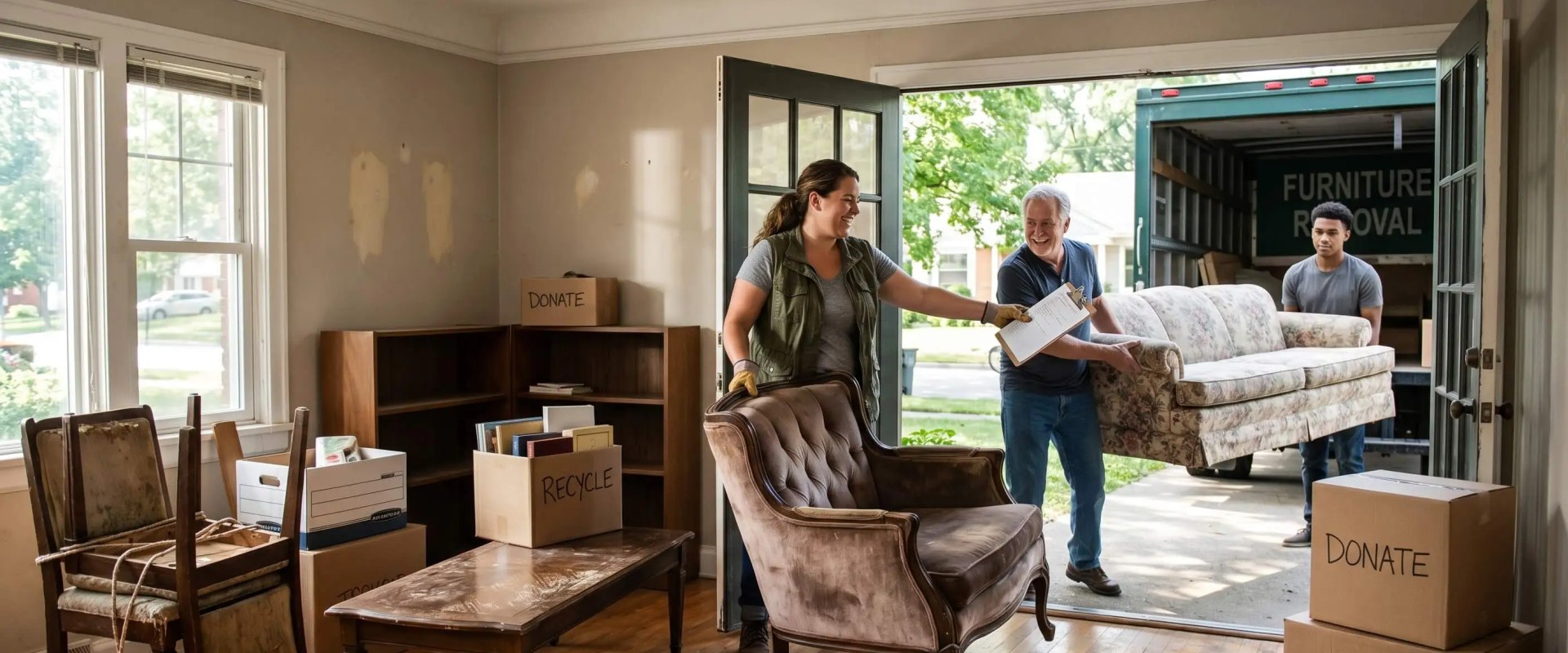
Stage items by destination the night before. Confirm pickup windows. Clear paths from the item to the exit, especially for narrow stairwells. Have payment ready for paid services. The execution phase is where most plans either succeed cleanly or fall apart, and the difference is almost always preparation the day before.
"The single biggest mistake I see homeowners make is treating furniture disposal as one decision instead of four. They look at a room full of old pieces and ask, 'How do I get rid of this stuff?' — but each item has its own answer. The mid-century dresser your grandmother gave you might be worth $400 on Facebook Marketplace. The IKEA bookshelf you bought in 2018 is probably going to a recycling facility, no matter how clean you make it. The stained sofa from the basement is a junk haul, full stop. When I walk a job site, I sort items into four piles within the first ten minutes — donation, resale, recycle, junk — and the homeowner is almost always surprised by which pile their pieces end up in. After roughly 200 cleanouts, here's the pattern I trust: the longer a piece has been in storage waiting for a 'someday' use, the more likely it is to land in the junk pile when we finally make the call. Decision delay is what fills landfills, not bad intent. A working plan removes the delay."
7 Essential Resources
These are the references I send to homeowners and clients when they begin a furniture cleanout. Each one is a primary source, not an aggregator, and each one will save you a trip, a fee, or a wrong decision.
Wikipedia: Furniture — A comprehensive overview of furniture as a category, including material types, manufacturing methods, and historical context. Useful background for understanding what your items are made of and why certain disposal routes apply.
EPA Durable Goods Product-Specific Data — The federal data set on furniture and furnishings waste, recycling rates, and landfill volumes. The most authoritative source on what actually happens to discarded furniture in the United States.
Goodwill Donation Guidelines — National donation acceptance criteria, store locator, and information on which Goodwill locations offer furniture pickup. Each regional Goodwill operates independently, so confirm with your local store before scheduling.
Salvation Army Donation Pickup (SATruck.org) — The Salvation Army's national pickup scheduling portal. Free pickup for eligible furniture in most service areas; you can also schedule via phone at 1-800-SA-TRUCK.
Habitat for Humanity ReStore Donations — ReStores accept new and gently used furniture, appliances, building materials, and home goods. Many locations offer free pickup for large items; proceeds fund Habitat for Humanity housing projects.
Furniture Bank Network — A North American directory of furniture banks — nonprofit organizations that redistribute donated furniture to families experiencing furniture poverty. Use the directory to find a bank near you.
EPA Sustainable Materials Management Overview — Federal guidance on the broader waste hierarchy: source reduction, reuse, recycling, and proper disposal. Useful context for understanding where your items fit in the waste stream.
3 Statistics
Numbers force clarity. These three figures, drawn from federal and industry data, capture why a disposal plan is no longer optional for the average homeowner.
Americans generated 12.1 million tons of furniture and furnishings waste in 2018, and roughly 80.1 percent of it was sent to landfill. Only a fraction was recycled. (U.S. EPA — Durable Goods Product-Specific Data)
Furniture waste has grown more than fivefold in six decades — from approximately 2.2 million tons in 1960 to 12.1 million tons in 2018. This growth far outpaces population growth and reflects the rise of low-cost, short-lifespan furniture. (U.S. EPA — Durable Goods Product-Specific Data)
The U.S. junk removal industry generated approximately $10.4 billion in revenue in 2023, reflecting how many households now outsource bulky item disposal rather than DIY-haul it. (IBISWorld — Waste Collection Services in the US)
Final Thoughts and Opinion
Here is what I have come to believe after enough cleanouts to fill a small landfill myself: the furniture disposal problem in this country is not really a furniture problem. It is a decision-making problem, whether you are moving, downsizing, or clearing space before a bathroom remodel. Most of the items that end up needlessly landfilled were donatable, recyclable, or even resellable at the moment they left the home. They got downgraded to junk because the homeowner waited too long, didn't know which donation centers accepted what, or piled them in a garage where moisture and pests finished the job.
If you take only one thing from this guide, take this: do not wait. The day you decide a piece is leaving your home is the day you should start its disposal plan. Photograph it. Decide its route. Schedule the pickup. Old furniture loses value, donatability, and resale appeal every single week it sits unused. A six-step plan executed in seven days yields completely different outcomes than the same plan executed over six months.
The good news is that the infrastructure exists. Goodwill, Salvation Army, Habitat ReStore, furniture banks, municipal bulky pickup programs, and professional junk haulers form a layered system that can absorb almost anything you need to remove. You just have to engage with it intentionally.
Frequently Asked Questions
What is the cheapest way of getting rid of old furniture? The cheapest route is a DIY haul to your local transfer station, where tipping fees typically run $25 to $80 per load. Free donation pickup from Goodwill, Salvation Army, or Habitat ReStore is the next-cheapest option for items in good condition. Municipal bulky item pickup is free or low-cost in many cities but often has multi-week scheduling delays.
Will donation centers pick up furniture for free? Yes — most national donation organizations, including Salvation Army, Habitat ReStore, and many regional Goodwill chapters, offer free pickup for eligible items in good or better condition. Eligibility varies by location, so confirm with your local center before scheduling. Some donation centers have moved to fee-based pickup partners for priority or in-home retrieval.
How do I dispose of a couch that is damaged or stained? Damaged upholstery generally cannot be donated for hygiene and resale reasons. Your options are municipal bulky item pickup (if your city accepts upholstered furniture), recycling at a transfer station that handles mixed materials, or professional junk removal. Most homeowners with a damaged couch find professional pickup the most practical route.
Can I just leave old furniture at the curb? Only during scheduled bulky item windows defined by your municipality. Unscheduled curb dumping carries fines in most cities, and the item may sit untouched for weeks. Always check your sanitation department's website or call 311 before placing anything at the curb.
How long does professional furniture pickup usually take? Same-day to 48-hour service is typical in most metropolitan areas. On-site time for a standard two-to-four piece load runs 30 to 60 minutes, depending on access points and stair count.
What furniture items can be recycled? Solid wood, metal frames, and many mattresses are recyclable through specialized facilities. Particleboard, MDF, and most upholstered items are not — they are usually landfilled even when dropped off at a recycling center. Mattress recycling programs exist in many states; check the Mattress Recycling Council for participating locations.
Should I disassemble furniture before pickup? For donation pickup, light disassembly can improve eligibility and reduce the chance of refusal. For professional junk removal, disassembly is optional but can lower your quoted price since it reduces the crew's time on-site. For curbside municipal pickup, follow your city's specific size requirements.
Call to Action
Old furniture is not going to leave your home on its own, and it will not get easier to handle six months from now. Start the inventory today, choose a disposal route for each piece by the end of the week, and schedule your pickups for next weekend. If you are dealing with damaged items, oversized pieces, or a tight timeline, professional pickup remains the fastest path from cluttered to clean.
Bookmark this guide, share it with anyone you know in the middle of a cleanout, and check out our related resources on saving money on junk removal services and what junk removal services include to round out your plan.