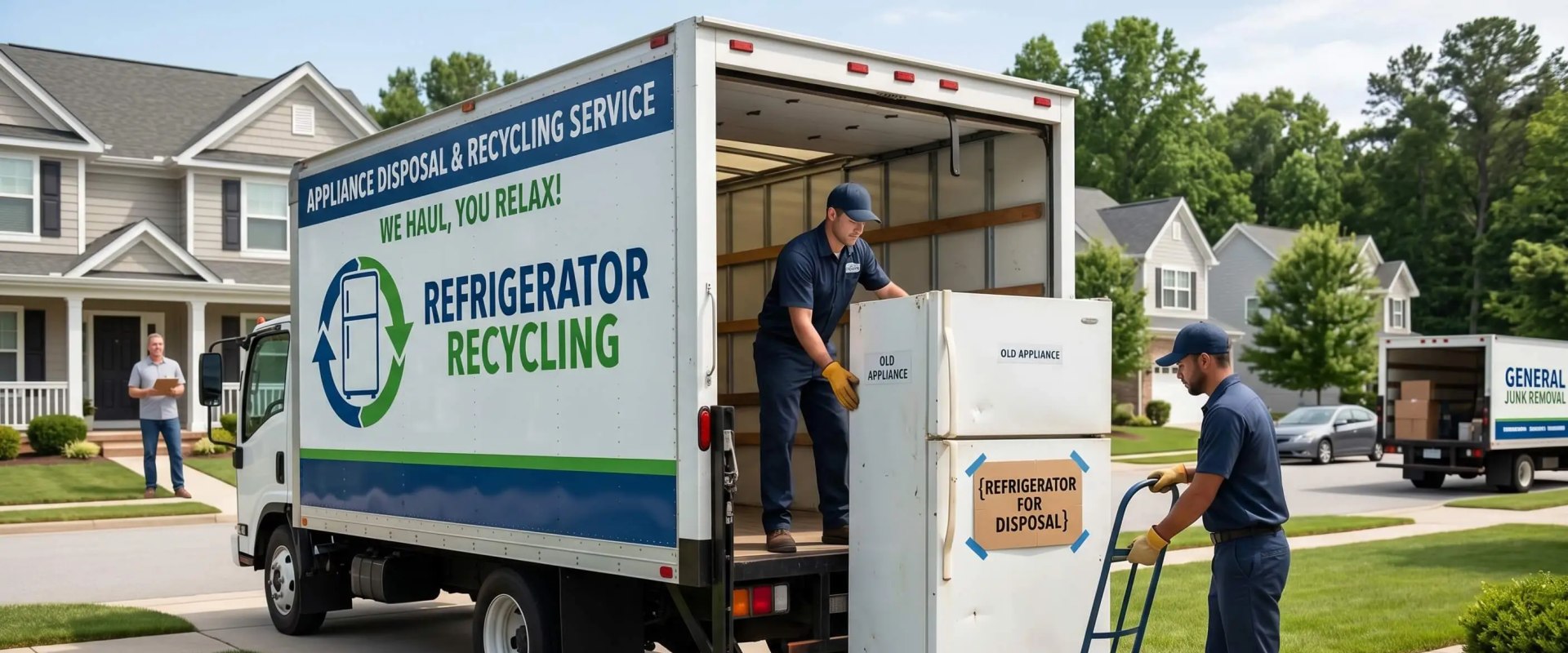
Most homeowners think disposing of an old appliance is straightforward. With refrigerators, that assumption can cost you a closing date. Federal law treats them differently from a couch or a microwave, and most municipalities won’t take them curbside without proof of refrigerant recovery.
Knowing how to dispose of an old refrigerator starts the day your offer gets accepted, giving you plenty of time to choose the easiest pickup, recycling, or haul-away option before your walk-through.
TL;DR Quick Answers
How to dispose an old refrigerator
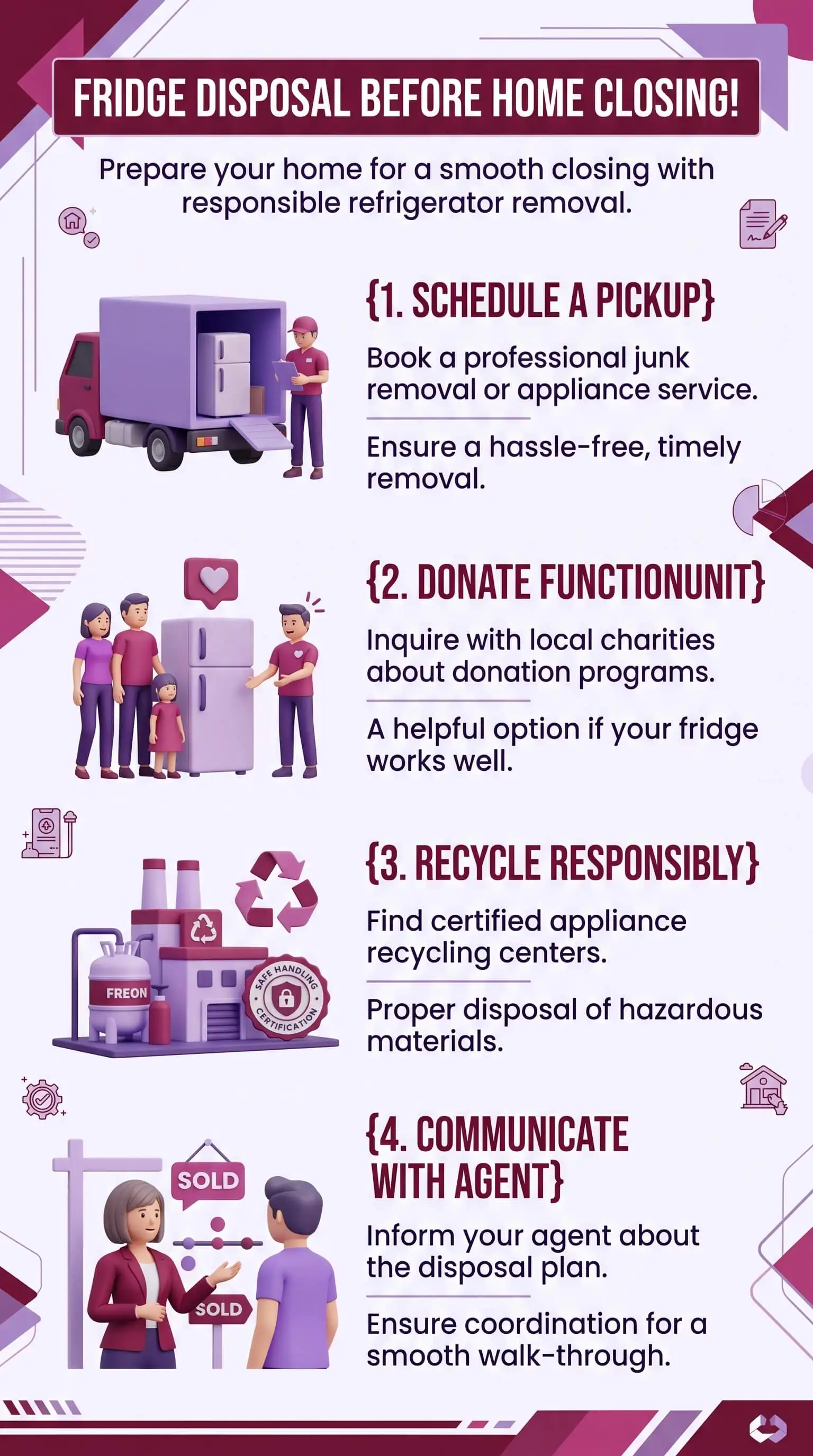
Schedule a professional appliance haul-away service. It's the only disposal method that works on any timeline, handles the federal compliance requirements, and routes the unit to a certified recycler instead of a landfill.
The 4-step process:
Check your timeline first. Closing in under 14 days, replacing the fridge, or have 30+ days? Your timeline determines which option fits.
Confirm refrigerant compliance. EPA Section 608 requires certified recovery before disposal. Curbside dumping isn't legal in most jurisdictions.
Pick the path that matches your window:
Same-day to 48 hours: Professional junk removal (only reliable option under 14 days)
3 to 14 days: Retailer haul-away with new appliance delivery, $25 to $50 fee
1 to 2 weeks: Habitat for Humanity ReStore donation pickup, free, working units only
2 to 6 weeks: Utility rebate program, pays $25 to $75 for working units
Schedule-dependent: Municipal bulk pickup, advance booking required
Document the empty space. Photograph the spot at removal. It protects you against post-closing disputes if a buyer claims something was left behind.
The shortcut answer: If you're under deadline pressure, call a professional same-day removal service. Free options exist, but they need 1 to 6 weeks of lead time. A fridge that doesn't get removed on schedule can delay a closing, fail a final walk-through, or trigger a contract dispute.
Top Takeaways
Yes, the fridge typically must go before closing unless your contract specifically says otherwise.
Federal law (EPA Section 608) requires certified refrigerant recovery before disposal. Curbside dumping isn’t legal.
Closing in under 14 days? Professional same-day junk removal is the only method that reliably hits the deadline.
Closing in 14 to 30 days? Donation pickup or retailer haul-away can work if you schedule immediately.
Closing in 30+ days? Every option sits on the table, including paid utility rebate programs.
Read your contract first. Appliances are usually personal property unless itemized as included.
Document the empty space with photos at removal. It’s your insurance against post-closing disputes.
Why the Fridge Has to Go Before Closing
Sellers in nearly every standard residential purchase contract agree to deliver the property in “broom-clean” condition with all personal property removed. Unless your contract specifically lists the refrigerator as part of the sale, that fridge counts as personal property. Leaving it for the buyer isn’t a courtesy. It’s a contract problem that surfaces at the worst possible moment, which is the final walk-through.
I’ve watched closings stall over exactly this. The seller figured the basement fridge would be fine. The buyer’s agent flagged it. The buyer’s attorney pushed for an escrow holdback, and closing slid by a week. None of that had to happen.
A standard refrigerator also can’t legally go to the curb the way an old couch can. Federal law under EPA Clean Air Act Section 608 requires certified refrigerant recovery before disposal. Most municipalities won’t accept a fridge in their normal trash stream, and many won’t accept it for bulk pickup either, not without documentation that the refrigerant has been professionally pulled.
That leaves sellers with five realistic disposal paths. Each one has a different speed and a different cost profile.
Disposal Options Ranked by Speed
1. Professional junk removal. Same-day to 48-hour pickup is the only method that reliably hits a tight closing deadline. A licensed crew handles disconnection, removal from any floor of the house, refrigerant recovery through certified partners, and recycling or donation routing. You’re paying for speed and compliance handling. If your closing is in under two weeks, this is almost always the right call. For a deeper breakdown of what actually happens during disconnection, transport, and certified disposal, this guide on how to get rid of an old refrigerator covers the full White Glove Treatment from start to finish.
2. Retailer haul-away. If you’re buying a new fridge for your next home, most retailers will haul the old one away when they deliver the replacement. Typical fee runs $25 to $50. The catch is timing. Delivery schedules don’t always align with closing dates.
3. Donation pickup. Habitat for Humanity ReStores and some Goodwill locations accept working refrigerators in good condition, typically under 10 years old. Most offer free pickup. Lead time runs 1 to 2 weeks. Donation routes fill up fast, and your unit has to pass an inspection at pickup, so it’s not a guaranteed exit if your closing is close.
4. Utility rebate program. Many electric utilities pay $25 to $75 to recycle a working refrigerator as part of their efficiency programs. It’s the highest-paying option. The 2- to 6-week lead time rules it out for most closing-pressured sellers.
5. Municipal bulk pickup. Some cities offer scheduled appliance collections. Most require advance booking, a separate fee in some jurisdictions, and proof of refrigerant recovery before they’ll accept the unit. Plan on at least a week, often more.
Reading the Contract Before You Spend Anything
Pull out your purchase agreement before you call anyone. Most standard contracts treat appliances as personal property unless they’re explicitly itemized as included. Look for language like “all appliances currently on the property” or “refrigerator excluded.” If the buyer wants the fridge gone, removing it falls on the seller’s bill. If the buyer is willing to take it, get that in writing as a contract amendment. A verbal agreement at the walk-through binds nobody.
This isn’t legal advice. For your specific contract, talk to your real estate agent or attorney.
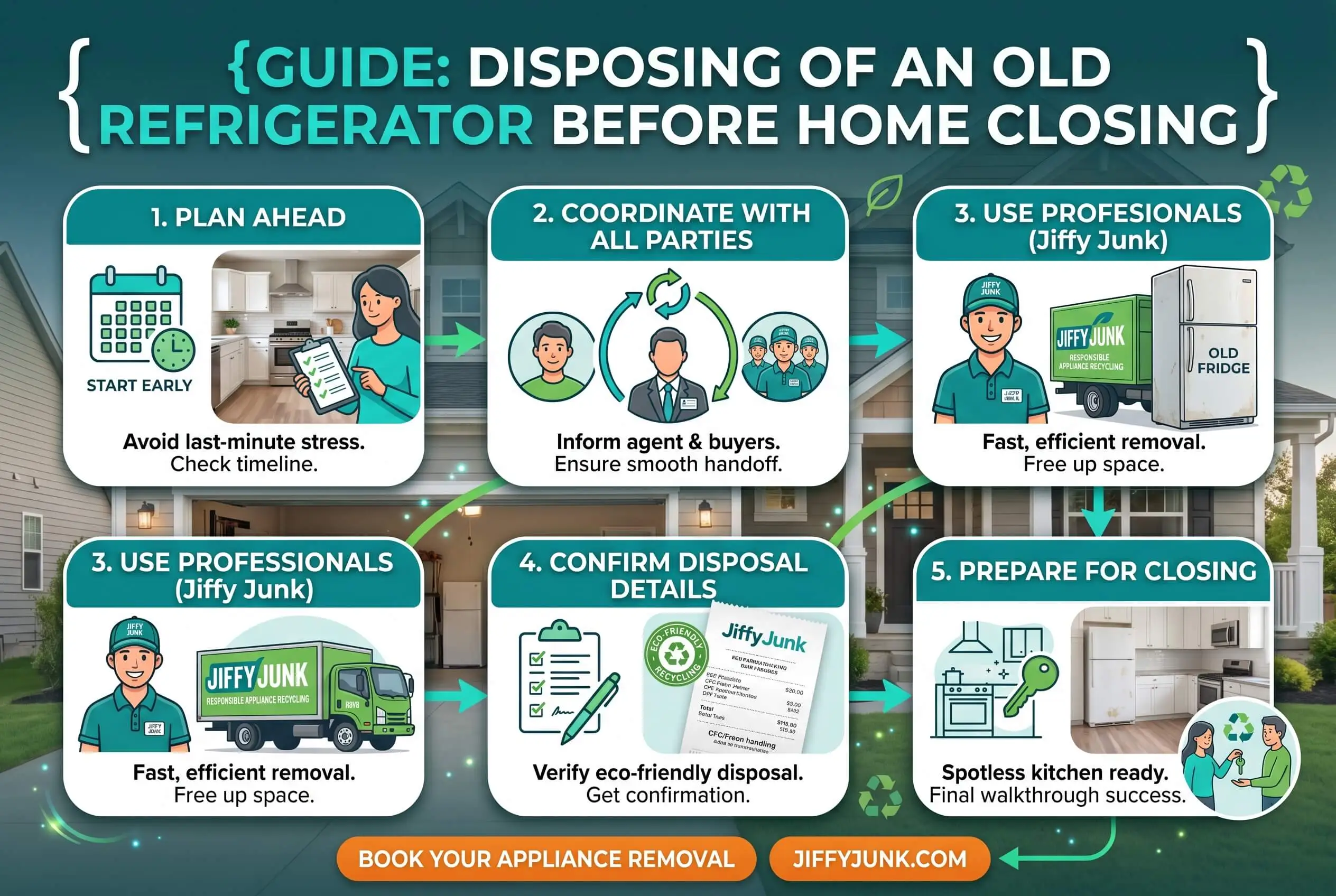
“After years of helping sellers prep properties for closing, the single biggest mistake I see is treating the old refrigerator as a problem for next week. People focus on staging, paint touch-ups, and landscaping. The appliance in the basement gets pushed to ‘I’ll deal with it later.’ Then later becomes the day before the walk-through, and the donation slots are all booked, the utility pickup window opens too late, and the only option left is paying a premium for same-day removal. I’ve watched a $300 problem turn into a delayed closing because a seller waited eleven days too long. Start the disposal the day your offer gets accepted. Every option sits on the table when you have 30 days. By day seven, half of them are off it.”
7 Essential Resources
These are the resources I send sellers to when they ask where to start. Each one is free, current, and from an authoritative source.
1. Confirm What Federal Law Actually Requires
Before you call anyone, read what the Clean Air Act Section 608 says about refrigerator disposal. The EPA’s appliance disposal page covers refrigerant recovery rules, technician certification requirements, and what the “final disposer” is responsible for documenting. Five minutes here saves hours of back-and-forth later.
Source: U.S. Environmental Protection Agency. https://www.epa.gov/section608/appliance-disposal
2. Find Out What Your Old Fridge Is Costing the Next Owner
Buyers increasingly factor energy costs into their decision. ENERGY STAR’s Flip Your Fridge Calculator shows the annual operating cost of an older refrigerator and the savings from upgrading. If the buyer is on the fence about whether they want the fridge included, this number often makes the decision for them.
Source: U.S. Department of Energy / ENERGY STAR. https://www.energystar.gov/products/refrigerators/flip-your-fridge
3. Search for Local Pickup and Rebate Programs
ENERGY STAR maintains a directory of utility-sponsored refrigerator and freezer recycling programs nationwide. Many pay $25 to $75 for working units and include free pickup. Worth checking even on a tight timeline, since some programs are faster than the national average.
Source: U.S. Department of Energy / ENERGY STAR. https://www.energystar.gov/products/recycle/find_fridge_freezer_recycling_program
4. Schedule a Donation Pickup Through Habitat for Humanity ReStore
Habitat ReStores accept working refrigerators in good condition, typically under 10 years old, and many locations offer free pickup. Donations support local Habitat housing builds, and you may qualify for a tax deduction. Lead time is usually 1 to 2 weeks. Use this when your closing date allows.
Source: Habitat for Humanity International. https://www.habitat.org/restores/donate-goods
5. Locate a Certified Recycler in Your ZIP Code
Earth911’s recycling locator searches more than 100,000 listings nationwide for appliance-accepting facilities. Enter your ZIP code, filter for large appliances, and you’ll see your local options: municipal programs, scrap metal recyclers, and certified appliance handlers.
Source: Earth911. https://earth911.com/recycling-guide/how-to-recycle-large-appliances/
6. Verify Your Disposal Partner Follows EPA Standards
The EPA’s Responsible Appliance Disposal (RAD) program identifies utilities, retailers, and recyclers that go beyond the federal minimum. RAD partners recover refrigerants, foam blowing agents, and hazardous components properly. Choosing one is the surest way to know your fridge isn’t getting illegally dumped or vented.
Source: U.S. Environmental Protection Agency. https://www.epa.gov/section608/appliance-disposal
7. Stack State and Utility Incentives Through DSIRE
The Database of State Incentives for Renewables & Efficiency (DSIRE) tracks every state, local, and utility-level rebate program in the country. If you’ve got time on your side, ten minutes here will tell you what’s stackable in your area.
Source: N.C. Clean Energy Technology Center / N.C. State University. https://www.dsireusa.org/
3 Statistics
These three numbers explain why disposal infrastructure runs at capacity and why timeline matters more than budget.
1. 11 to 13 Million Refrigerated Appliances Reach End-of-Life Each Year
The EPA estimates that 11 to 13 million refrigerated household appliances are taken out of service annually in the United States. That’s a massive disposal stream, and it’s why the federal compliance rules exist. It’s also why the disposal infrastructure (donation queues, utility rebate programs, retailer haul-away) runs at capacity. When you’re competing with 12 million other Americans for a pickup slot, lead time matters.
Source: U.S. Environmental Protection Agency. https://www.epa.gov/section608/appliance-disposal
2. Roughly 34% of American Households Run a Second Refrigerator [VERIFY]
Per U.S. Department of Energy and ENERGY STAR data, more than a third of American households operate a secondary refrigerator (basement, garage, or utility room). That share has more than doubled over the last 20 years. For sellers, it explains why so many homes have an “extra” fridge nobody planned to deal with, especially during larger prep projects like bathroom remodeling, and why buyers almost universally want it gone before they take possession.
Source: U.S. Department of Energy / ENERGY STAR. https://www.energystar.gov/products/refrigerators
3. RAD Partners Have Diverted Nearly 1.5 Billion Pounds of Material from Landfills
Since 2006, the EPA’s Responsible Appliance Disposal (RAD) program has prevented nearly 1.5 billion pounds of metal, plastic, and glass from entering landfills, while reducing emissions by approximately 39.9 million metric tons of CO2 equivalent. That’s the difference between a fridge ending up shredded into landfill and one recovered properly: a real environmental delta that more buyers are paying attention to.
Source: U.S. Environmental Protection Agency. https://www.epa.gov/section608/appliance-disposal
Final Thoughts and Opinion
Selling a home is a thousand small decisions stacked into one big transaction. Most sellers spend their attention where it shows: paint, staging, photography, the offer negotiation. The refrigerator disposal question feels small until it isn’t.
Here’s what I’ve learned watching this play out across years of pre-closing work.
Timeline beats budget every time
A free utility pickup looks great on day 30 and impossible on day 5. Your disposal method choice isn’t really about cost. It’s about how much runway you have. Plan from the offer-accepted date, not the closing date.
The EPA rules are real
I’ve watched sellers try to short-circuit this with curbside dumping. It works until it doesn’t, and “doesn’t” can mean a fine, a refused pickup, or a contract dispute when the buyer’s walk-through agent spots an abandoned fridge in the driveway. The compliance burden is small if you handle it early.
Buyers care more than they used to
Younger buyers in particular pay attention to where appliances end up. RAD-certified disposal isn’t a marketing line, it’s a real differentiator that some buyers ask about during negotiation. If the disposal route matters to you or your buyer, the resources above tell you how to verify it.
Same-day removal is overpriced if you don't need it. It’s a bargain if you did
Know which one you’re in. Don’t hesitate when you’ve waited too long. Eating a $200 service call is cheap insurance against a delayed closing.
Treat refrigerator disposal as a closing checklist item from day one of the contract, the same way you treat mortgage paperwork and title work. The clock started the moment you signed.
Frequently Asked Questions
Q: Can I leave the old refrigerator in the house if I’m selling?
A: Only if the buyer agrees to it in writing as part of the purchase contract. Otherwise, it’s personal property and must come out before closing under standard broom-clean delivery requirements.
Q: How fast can I get a refrigerator removed?
A: Professional junk removal services can usually schedule same-day or next-day pickup. Every other option (donation, utility rebate, municipal bulk pickup) requires lead times ranging from one to six weeks.
Q: What if I’m at day 5 before closing and just realized the fridge has to go?
A: Call a professional removal service today. Don’t try to find a free option at this point. The timeline doesn’t allow it, and a delayed closing costs far more than a same-day haul-away.
Q: Can the buyer back out of closing because of an old refrigerator?
A: A buyer can dispute closing if the property isn’t delivered in the condition specified by the contract. Standard contracts include a broom-clean clause that an abandoned appliance can violate. It’s a real risk, not a theoretical one.
Q: Is it illegal to put an old refrigerator at the curb?
A: In most jurisdictions, yes. Federal EPA rules require certified refrigerant recovery before disposal, and most municipal collection services won’t accept a refrigerator without documentation that recovery has been performed.
Q: Who pays to remove the refrigerator, buyer or seller?
A: The seller, unless the contract explicitly assigns it to the buyer. If the appliance was listed as included in the sale and you remove it anyway, you may be liable for replacement value.
Q: What happens if my donation pickup is scheduled but the unit fails inspection at pickup?
A: It happens. Donation organizations have working-condition standards that older units sometimes fail. If your donation falls through close to your closing date, your fallback is professional removal. Have a backup plan in mind.
Don’t Let an Old Refrigerator Delay Your Closing
If your closing date is locked in and the fridge isn’t going to move itself, the smartest move is the fastest one. Schedule a professional same-day or next-day appliance haul-away that handles disconnection, removal from any floor, EPA-compliant refrigerant recovery, and eco-responsible disposal. You walk into the final walk-through with one less thing on the list.
Tap here to plan fast refrigerator disposal before your closing date.