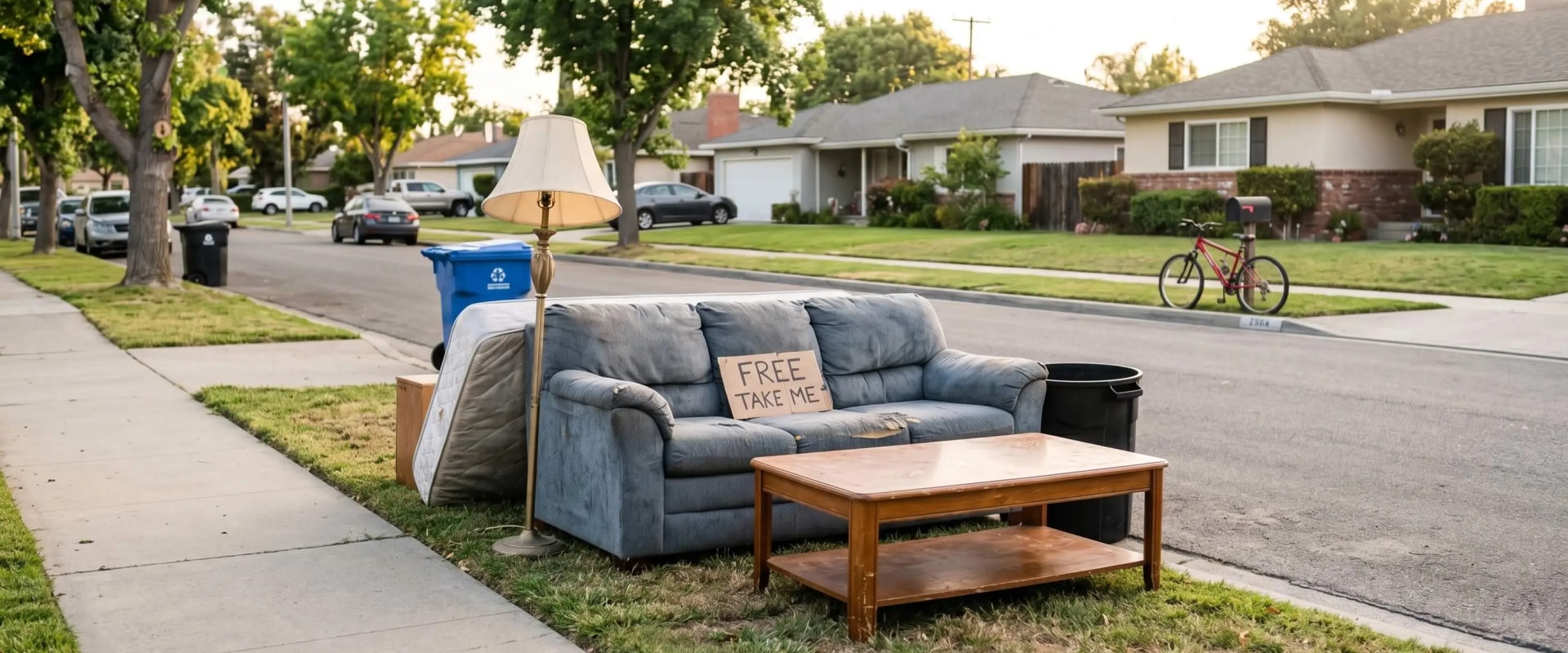
I have coordinated dozens of post-renovation cleanouts over the years, and the timing question comes up on almost every project. People assume bulk pickup is forgiving. It is not. Cities have specific rules about when household furniture — sofas, dressers, tables, chairs, mattresses — can sit at the curb, and those rules exist for reasons that range from sanitation to public safety to the city's own collection logistics.
This guide walks through the timing rules, the fines you can avoid, what to do when bulk pickup day is weeks away, and the alternatives worth considering when the city schedule does not fit yours.
TL;DR Quick Answers
Leaving furniture on curb
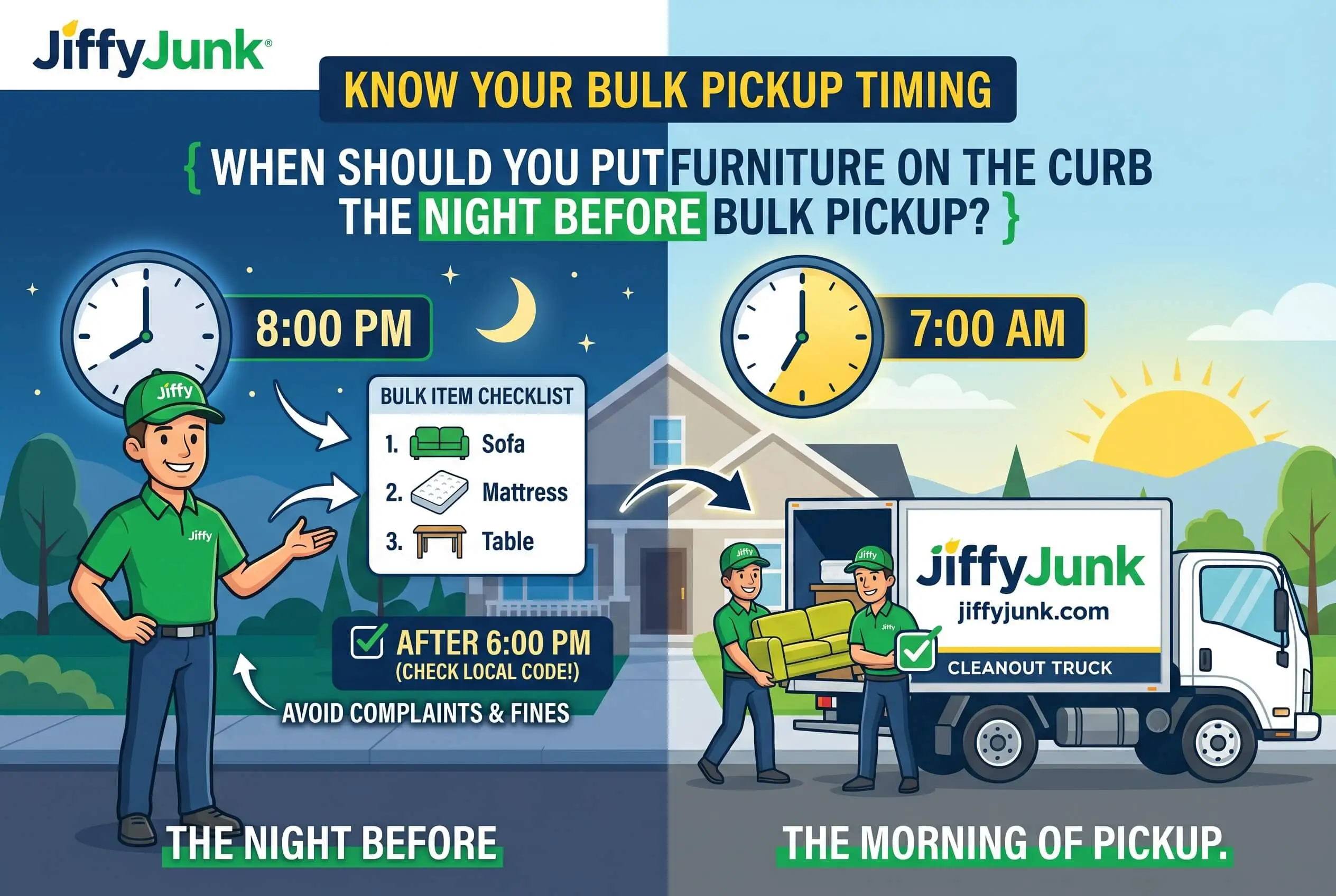
You can leave furniture on the curb the night before your scheduled bulk pickup, but only after the hour your city allows. New York opens the window at 6 p.m. Los Angeles allows it the evening before, but only with a scheduled 311 appointment. Chicago expects items at the curb by 7 a.m. on collection day. Miss the window and you'll pay a fine. Hit it and the truck takes it for free.
The basics that hold in most U.S. cities:
Most cities allow set-out 12 to 24 hours before pickup
Mattresses and box springs must be sealed in plastic, no exceptions
Refrigerators, ACs, and TVs need separate handling. Never assume.
Items left more than 24 hours past pickup become an illegal-dumping issue
Confirm your specific window with 311 or your city's sanitation page
If your timing doesn't fit, donate it, list it on Buy Nothing, or book a private haul-away. Don't improvise. That's how a free service turns into a $100 to $300 fine.
Top Takeaways
Place furniture at the curb the night before pickup, not earlier. Most U.S. cities require items out within 12 to 24 hours of scheduled collection.
Know your city's specific window. New York: 6 p.m. to midnight. Los Angeles: evening before, by appointment. Chicago: 7 a.m. on collection day.
Seal mattresses and box springs in plastic. It is a legal requirement in most major cities. Failure is a $100+ fine.
Refrigerators, ACs, and TVs need special handling. Never assume bulk pickup will take them.
If your timing does not fit, do not improvise. Donate, schedule a private haul-away, or wait for the next legitimate window.
Bring uncollected items back within 24 hours. Items left at the curb after the pickup window become an illegal-dumping issue.
The General Rule
Across most cities with municipal bulk collection, you can place furniture at the curb between 12 and 24 hours before your scheduled pickup. The most common framework is a hard cutoff after a specific evening hour — usually 4 p.m., 6 p.m., or 8 p.m. the night before — with everything required to be out by midnight or by 7 a.m. the day of collection.
There are three regulatory patterns in play across the country. The first is the night-before placement window, used by New York City, Los Angeles, and many mid-size cities. The second is the day-of placement rule used by Chicago, where items should be next to your refuse cart by 7 a.m. on your scheduled day. The third is the appointment-only model, increasingly common in cities like Phoenix, where you cannot place anything curbside until your scheduled appointment date.
If you do not know which system your city uses, check the local sanitation website before you move a single piece of furniture.
How City Timing Rules Compare
Rules vary widely by city. Below is a snapshot of how five major U.S. cities handle bulk furniture placement:
New York City
Set-out window: 6 p.m. to midnight the night before scheduled collection
Appointment required: No (eliminated in 2020 for most items)
Item limit per collection: 6 large items
Los Angeles
Set-out window: Evening before scheduled collection, no earlier than the night before
Appointment required: Yes — call 311 or use MyLA311
Item limit per collection: 10 items per appointment, up to 10 collections per year
Chicago
Set-out window: By 7 a.m. on scheduled collection day
Appointment required: Yes for appliances and large piles; one large item per regular day allowed without one
Item limit per collection: Generally five items or fewer per request
Houston
Set-out window: After 6 p.m. the day before junk waste week
Appointment required: No
Item limit per collection: No strict limit — bi-monthly junk waste week
Philadelphia
Set-out window: After 7 p.m. the night before regular trash day
Appointment required: No for most items
Item limit per collection: Standard household quantities
Always verify with your city's sanitation department before placing items at the curb. Rules change, and several cities have updated bulk collection policies within the past two years.
Why Timing Matters
There are real consequences to setting items out too early. The most immediate is a sanitation fine, which can run anywhere from $50 to several hundred dollars depending on your city. In New York, an unsealed mattress alone is a $100 violation, and you can be cited if items remain at the curb for days. In Chicago, leaving furniture in an alley without a scheduled appointment can be classified as illegal dumping, which carries far steeper penalties.
Beyond the fines, there is the simple practical problem: a couch sitting outside through three days of weather will not be picked up at all. Sanitation crews routinely tag and skip items that are waterlogged, infested, or otherwise compromised. You are then stuck dragging a now-ruined sofa back into the garage, which is the kind of small home-services mistake that becomes a much larger headache, even when you are focused on the benefits of bathroom remodel planning elsewhere in the home.
How to Prepare Furniture for Curbside Pickup
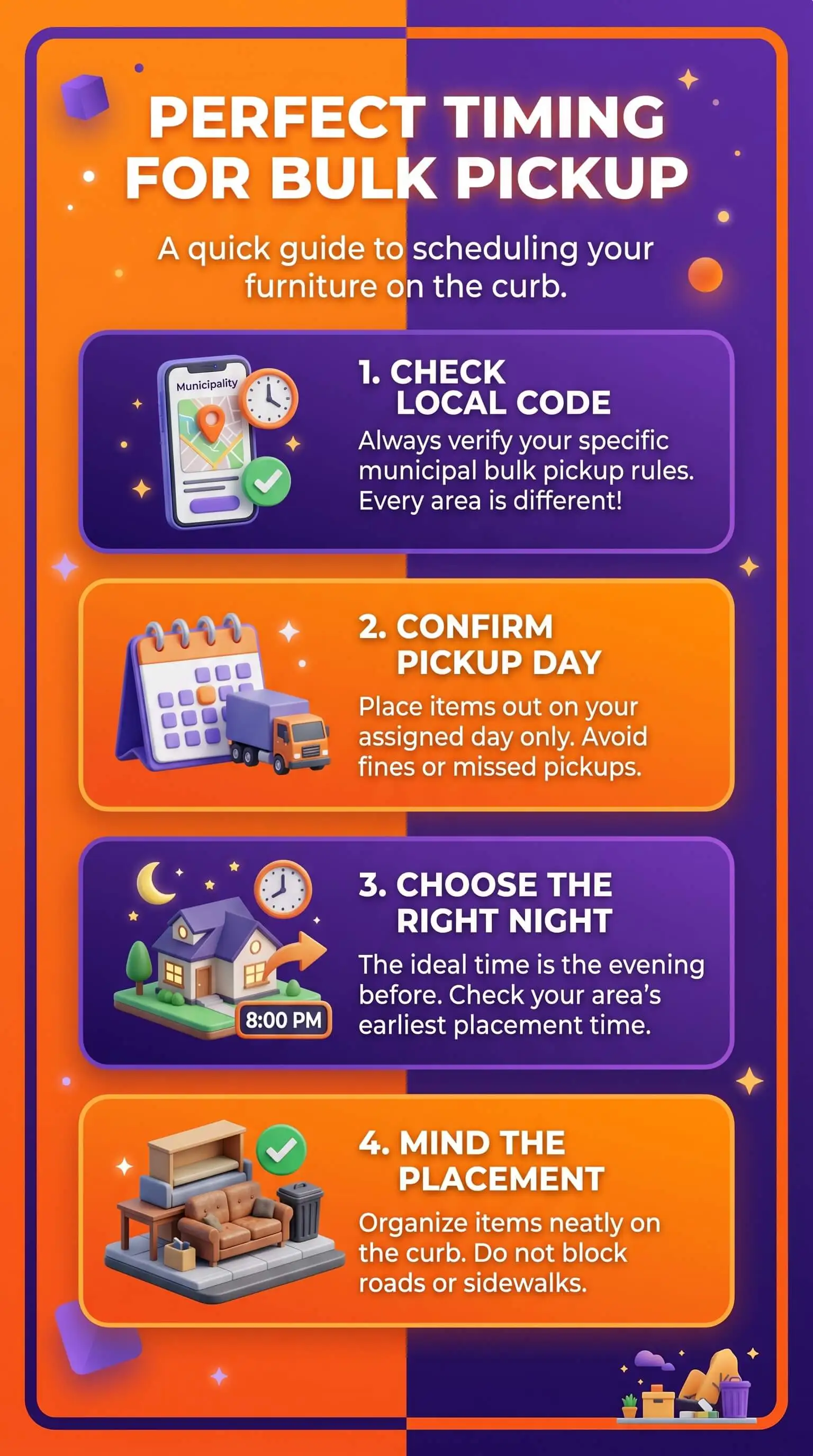
Confirm your pickup date. Use your city's sanitation lookup tool or call 311. Bulk days do not always match regular trash days.
Check item-type restrictions. Refrigerators, freezers, air conditioners, and televisions almost always require special handling. Standard furniture usually does not.
Disassemble where required. Some cities require bed frames broken down. Others require carpets bundled to specific dimensions.
Bag any mattress or box spring. New York, Chicago, and many other cities now require sealed plastic bags on mattresses and box springs. This is a bedbug-prevention rule, not an optional courtesy.
Place items at the curb during the legal window. Not on the lawn. Not in the street. The curb.
Keep items clear of fire hydrants, storm drains, bus stops, and bike lanes. Blocking any of these is a separate citation in most cities.
Bring anything in that was not collected within 24 hours of pickup. Most cities require this. Leaving an uncollected item out is its own violation.
What Happens If Your Furniture Is Not Picked Up
Sometimes the truck rolls past. It happens. The reasons usually fall into one of three buckets: the item violates a rule (an unsealed mattress, a refrigerator with refrigerant still inside, a sectional that exceeds the size limit), the route was modified, or your city requires an appointment you did not actually schedule.
Re-scheduling is straightforward in most cities — call 311 or use the city's app. But if the missed collection was due to a rule violation, the item will be tagged with a notice telling you why, and you will need to fix the issue before it gets picked up. A surprising number of homeowners do not realize the tag is there, drag the item back inside, and skip the actual pickup window altogether.
What If You Cannot Wait For Bulk Pickup Day
Bulk pickup is free in most cities, but the schedule is rarely convenient. If you are mid-move, finishing a renovation, or dealing with an estate cleanout, waiting two or three weeks for the next collection day is not realistic. Donation is one alternative — Habitat for Humanity ReStore, Salvation Army, and the Furniture Bank Network will pick up items in good condition, often within a week. For items that are too damaged to donate, a scheduled curbside furniture and couch disposal service can pick up on a day you choose, often within 24 to 48 hours, and handle the lifting and disposal for you. The cost varies by item count and region, but for a single sofa or a small load it usually beats the time-and-truck math of doing it yourself.
“The single biggest mistake I see homeowners make with bulk pickup is treating it like a yard sale — they put the couch out on a Saturday hoping someone will grab it before Monday's truck. Two days later it is rain-soaked, the truck won't take it, and now they are calling me. The cities that work well, like New York's six-to-midnight window, work because the rule is specific and predictable. Treat your sanitation schedule the way you would treat a contractor's appointment: it is a window, not a suggestion. Get the item out at the start of that window and you will rarely have a problem.”
7 Essential Resources
These are the official and authoritative sources I rely on when advising clients on bulk furniture disposal. Bookmark whichever applies to your city.
1. NYC Department of Sanitation — Large Items
The official DSNY page covers bulk item rules for New York City. Confirms the 6 p.m. to midnight set-out window, the six-item per collection day limit, and the rules for mattresses, appliances, and electronics. The most authoritative reference for any New York reader.
2. LA Sanitation & Environment — Bulky Item Collection
The City of Los Angeles bulky item pickup page. Walks through the appointment process via 311 or MyLA311, accepted item types, and the at-least-one-business-day-in-advance scheduling requirement.
3. City of Chicago — Sanitation Code & Bulk Item Guidance
The City of Chicago's official sanitation ordinance page. Covers the requirements around removing doors from refrigerators, ward superintendent coordination for large pickups, and the rules that distinguish legal bulk placement from illegal dumping.
4. EPA — Durable Goods Product-Specific Data
The U.S. Environmental Protection Agency's data on durable goods, which includes furniture and furnishings. Useful context on how much furniture Americans generate, recycle, and landfill each year, and why curbside pickup volume is what it is.
5. EPA — National Overview: Facts and Figures on Materials, Wastes and Recycling
The broader national picture of municipal solid waste in the U.S., including landfilling, combustion, and recycling rates. Useful if you want to understand where your bulk-pickup couch actually ends up.
6. Bye Bye Mattress — Mattress Recycling Council
If you live in California, Connecticut, Oregon, or Rhode Island, this is the official program for free mattress recycling. The locator tool finds drop-off sites and collection events, and the program has recycled over 15 million mattresses to date.
7. Habitat for Humanity ReStore
The fastest path to keeping a usable piece of furniture out of the landfill. Most ReStore locations offer free or low-cost pickup of donated furniture and appliances in good condition, and the proceeds fund affordable housing.
3 Statistics
These three numbers reframe how I think about bulk furniture pickup, and they should reframe yours too.
1. Americans generate over 12 million tons of furniture and furnishings waste each year, and roughly 80% of it ends up in landfills.
Furniture is one of the least-recycled categories in the entire municipal solid waste stream — a single sofa typically contains wood, metal, foam, fabric, and adhesive that are extremely difficult to separate. (Source: U.S. EPA, Durable Goods Product-Specific Data)
2. New York City residents can set out up to 6 large items per collection day, with set-out beginning at 6:00 p.m. the evening before — and an unsealed mattress at the curb is a $100 fine.
DSNY no longer offers scheduled bulk appointments for most items, which makes the timing window the only thing standing between you and a clean pickup. (Source: NYC Department of Sanitation, Large Items)
3. The U.S. generated 292.4 million tons of municipal solid waste in 2018, with roughly half — 146.1 million tons — landfilled.
Bulk furniture pickup represents a small but growing slice of that total. The single best thing a homeowner can do to reduce their share is to donate or recycle anything still functional before considering the curb. (Source: U.S. EPA, National Overview: Facts and Figures on Materials, Wastes and Recycling)
Final Thoughts and Opinion
Most of the curbside furniture problems I have watched homeowners run into are timing problems, and timing problems are entirely preventable. The cities that have moved away from scheduled appointments — New York being the obvious example — have made the system simpler in one sense and stricter in another. There is no one to call to confirm your slot. The rule is the rule. Six p.m. to midnight, six items, mattresses sealed.
My honest opinion: if you are inside that window, the system works fine. If you are outside it, do not try to bend the rule by half a day or hope the truck will be charitable. It will not. Either wait for the next legitimate window, donate the item, or pay for a private haul-away. Trying to split the difference is how a $0 free service becomes a $300 fine plus a couch you still own.
The other thing I will say plainly: stop using the curb as a free yard sale. The instinct is generous — someone will take it. In practice, what happens is the item sits there for two days, the weather gets it, and then it is the city's problem and the city makes it your problem. If you genuinely want the piece to find a new home, post it on Buy Nothing or Facebook Marketplace and let someone come pick it up. The curb is a disposal channel, not a giveaway shelf.
Frequently Asked Questions
Can I put furniture out the night before pickup?
Yes, in most U.S. cities — but only after the specific evening hour your city allows. New York City permits set-out from 6 p.m. to midnight the night before. Los Angeles allows the evening before, no earlier. Chicago expects items at the curb by 7 a.m. on the day of collection. Always verify with your local sanitation department before placing items out.
How early is too early to put furniture on the curb?
Anything earlier than the start of your city's posted set-out window is too early. Putting a couch out two or three days ahead of pickup is almost universally a violation, and it is the single most common reason homeowners get fined for bulk waste.
Is it illegal to leave furniture on the curb?
Not by itself — most U.S. cities provide free or low-cost curbside bulk pickup. It becomes illegal when you place items outside the legal window, in violation of size or item-type rules, or in alleys, lots, or areas not designated for collection. That last category is classified as illegal dumping and carries the steepest penalties.
How much is the fine for putting bulk trash out early?
Fines vary widely by city. New York's unsealed-mattress violation alone is $100. General sanitation violations across major cities typically fall between $50 and $500 for first offenses. Repeat offenses, items left for extended periods, or anything classified as illegal dumping can run into the thousands.
Do I have to schedule a bulk pickup?
It depends on your city. New York eliminated scheduled appointments in 2020 — bulk items go out on regular collection days, no booking required. Los Angeles still requires scheduling through 311 or MyLA311. Chicago handles most bulk via 311 requests, with one large item per regular day allowed without a special request.
Can people take furniture left on the curb?
Legally and practically, yes. Once an item is at the curb for collection, anyone can take it. This is one of the upsides of the system — usable furniture often finds a new home before the truck arrives. That said, if you actually want the item to be reused rather than landfilled, listing it on Buy Nothing or Facebook Marketplace works far better than hoping a passerby picks it up.
What time do bulk pickup trucks usually come?
Most cities run bulk routes during standard collection hours, typically between 6 a.m. and 4 p.m. on your scheduled day. Items must be at the curb before the truck arrives, which is why most set-out windows close at midnight or 7 a.m.
Call to Action
Before you move that sofa to the curb, take five minutes to confirm your city's bulk collection window. Search your city name plus “bulk pickup” or call 311 to verify your set-out time and any item restrictions. If your timing does not line up with the city's schedule — or if your city does not offer free bulk pickup at all — a scheduled curbside furniture pickup service can usually have the item gone within 24 to 48 hours, with no risk of fines, weather damage, or angry neighbors.
Have a city quirk worth knowing about? Drop it in the comments below — your local rule could save someone else a $100 ticket.