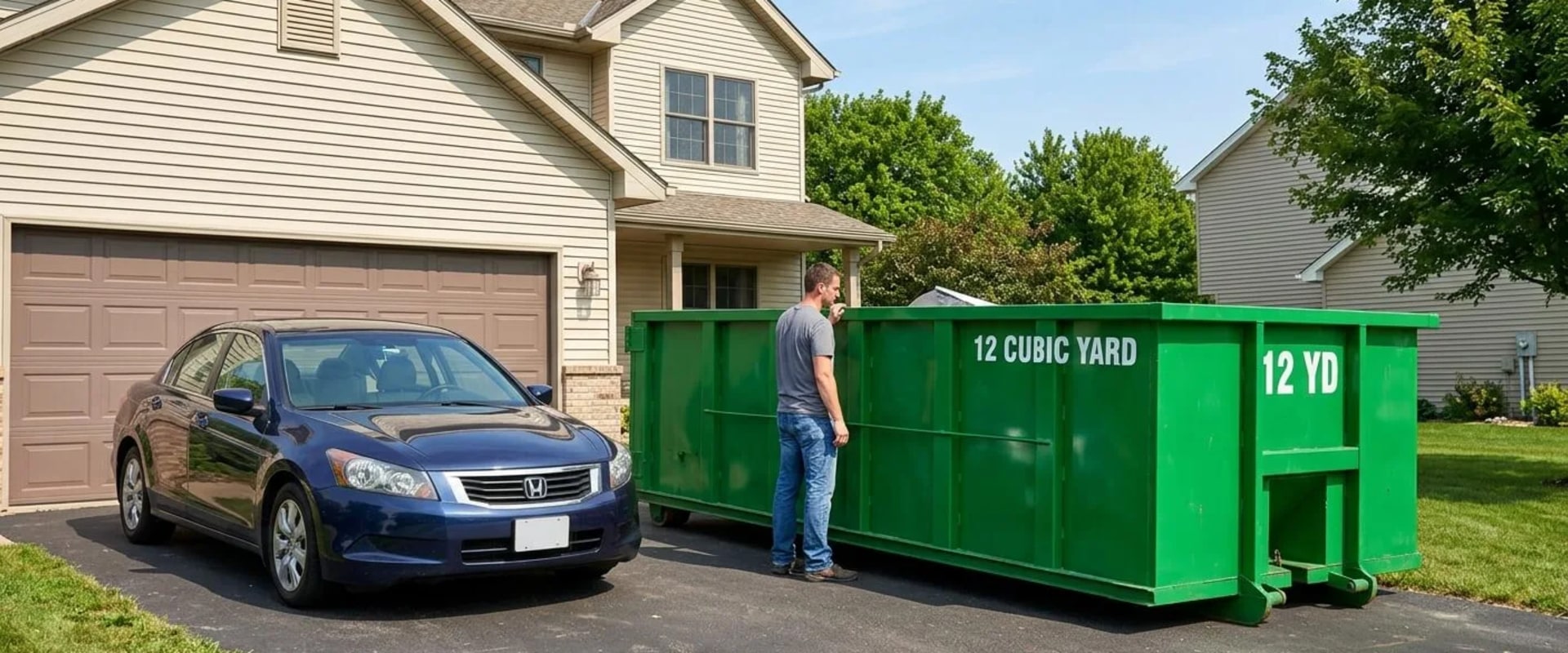
I've worked with homeowners on enough mid-size renovations and cleanouts to spot a pattern that costs them money: they pick a 12 yard size based on volume, then load it with material that hits the weight cap before the box is half full. This guide covers what a 12 yard dumpster size actually delivers in real-world capacity, what you'll pay in 2026, the fees that catch homeowners off guard, and the moves that keep your total cost honest.
TL;DR Quick Answers
12 yard dumpster size
A 12 yard dumpster measures roughly 14 feet long, 7.5 feet wide, and 4 feet high, with 12 cubic yards (324 cubic feet) of internal capacity — enough space for about 3 to 4 pickup-truck loads of debris or 80 to 100 thirty-gallon trash bags.
Length: about 14 feet
Width: about 7.5 feet
Height: about 4 feet
Volume: 12 cubic yards (324 cubic feet)
Capacity: 3 to 4 pickup-truck loads, or 80 to 100 thirty-gallon trash bags
Weight limit: typically 1 to 2 tons included. Overages run $50 to $100 per additional ton
Footprint: about one standard parking space
Best for: single-bathroom or small-kitchen remodels, garage cleanouts, small roof tear-offs, mid-size estate cleanouts
One thing most spec sheets miss: the 12 yard size is governed by weight, not volume. Heavy debris (tile, concrete, plaster, shingles) hits the tonnage cap long before the box looks full. Estimate your load by weight first, dimensions second.
Top Takeaways
12 yard dumpster size: roughly 14 ft long × 7.5 ft wide × 4 ft high, with 12 cubic yards of internal capacity (about 3 to 4 pickup-truck loads).
Average 2026 cost: $360 to $590 for most homeowners. National averages cluster around $480 to $580.
Standard weight limit: 1 to 2 tons included. Overages run $50 to $100 per additional ton.
Standard rental period: 7 to 10 days. Extensions cost $5 to $15 per day.
Best fit: single-bathroom or small-kitchen remodels, garage cleanouts, small roof tear-offs, mid-size estate cleanouts.
Biggest cost trap: treating the dumpster as volume-limited when heavy debris (tile, concrete, shingles) makes it tonnage-limited.
Single biggest savings move: get three local quotes and confirm the flat rate, weight cap, rental period, and prohibited items list in writing.
What Is a 12 Yard Dumpster?
A 12 yard dumpster is a roll-off container with 12 cubic yards of internal volume — that's 324 cubic feet of usable space. The word dumpster refers to a movable waste container hoisted and emptied by a specialized truck, and the roll-off variety is what shows up at most residential projects. Standard exterior dimensions run roughly 14 feet long, 7.5 feet wide, and 4 feet high, though specs vary slightly by hauler.
In numbers homeowners can picture, a 12 yard holds about 3 to 4 pickup-truck loads of debris, or 80 to 100 thirty-gallon trash bags packed efficiently. The footprint takes up roughly one parking space worth of driveway. Most homeowners can place one without needing a public-right-of-way permit.
12 Yard Dumpster Size and Dimensions
Dimensions matter for two reasons: where the unit physically sits, and what fits inside it. A 12 yard dumpster typically handles a single bathroom or small kitchen demo, a one-room cleanout, a small roof tear-off (under about 1,500 square feet of asphalt shingles depending on layer count), or a mid-size garage decluttering. For homeowners who want exact dimensions, fill heights, and item-by-item capacity charts before booking, JiffyJunk publishes a complete 12 cubic yard dumpster size and dimensions guide with photos and load diagrams I recommend reviewing.
Average 12 Yard Dumpster Rental Cost in 2026
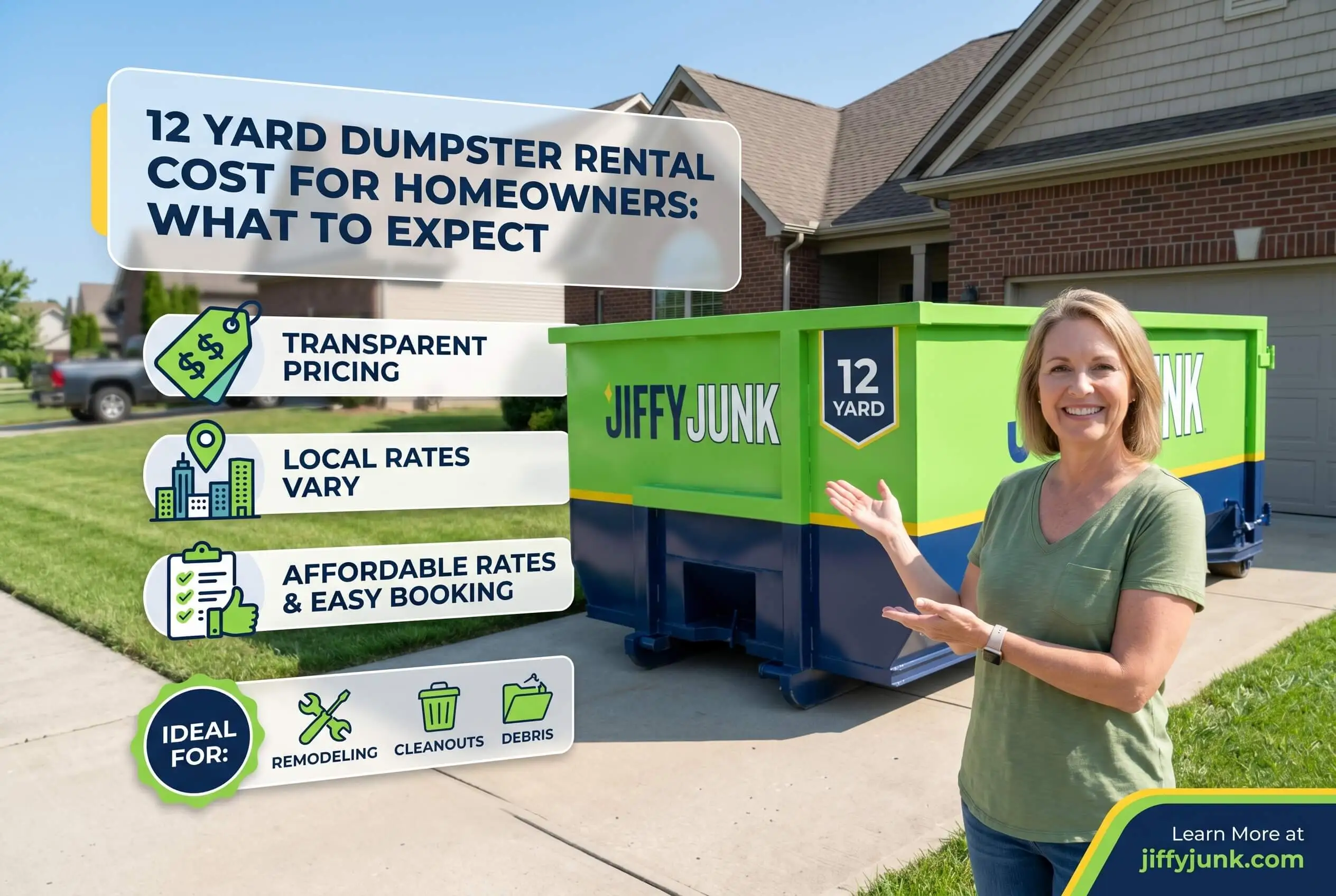
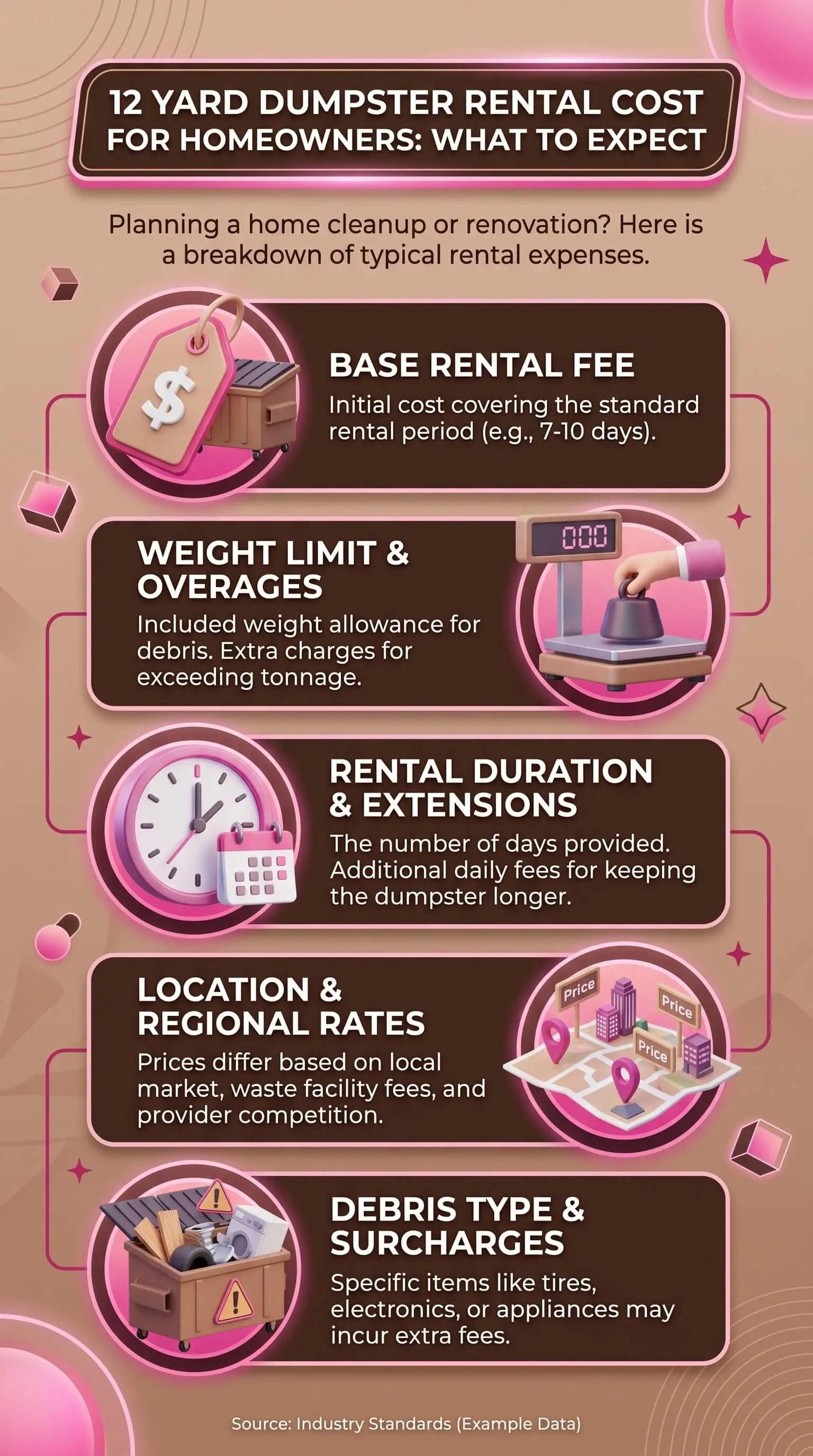
Most homeowners pay between $360 and $590 for a 12 yard rental in 2026. National averages cluster around $480 to $580. The spread comes down to four things: regional landfill fees, local hauler density, the debris you're dumping, and how long you keep the box.
Urban metros (New York, Los Angeles, San Francisco, Boston) run 20 to 40 percent above national. Rural and smaller-metro markets come in below. Most quotes are flat-rate and bundle delivery, pickup, a defined rental period (typically 7 to 10 days), and an included weight allowance (commonly 1 to 2 tons). Anything beyond those parameters becomes an add-on charge, and that's where homeowner budgets quietly inflate.
What Drives the Cost: 7 Key Factors
Geographic location. Urban areas push prices upward through higher landfill tipping fees and tighter hauler competition. Rural areas often see lower base rates but higher fuel surcharges if the hauler covers a long distance.
Rental period. Most rentals include 7 to 10 days. Extensions cost $5 to $15 per additional day at most companies.
Weight limit and overage charges. Standard weight allowances run 1 to 2 tons. Going over usually triggers a prorated charge of $50 to $100 per additional ton, sometimes more in metro markets.
Debris type. Heavy materials (concrete, brick, dirt, roofing shingles) blow past the weight limit fast. Some haulers require a dedicated container for heavy debris.
Permit requirements. If the dumpster sits on a public street rather than your driveway, most municipalities require a permit costing $20 to $150.
Delivery distance. Some haulers add fuel surcharges beyond a defined service radius.
Seasonal demand. Spring and summer renovation peaks push rates 10 to 20 percent higher than the winter off-season.
Hidden Fees Homeowners Should Watch For
In my work with homeowners on renovations, the biggest invoice surprises don't come from the base rate. They come from fees nobody asked about up front. Watch for these on your quote and contract:
Weight overage charges (typically $50 to $100 per extra ton)
Extended rental day fees (commonly $5 to $15 per day)
Prohibited item disposal fees for mattresses, tires, electronics, paint, batteries, refrigerants, and any household hazardous waste
Driveway protection requirements or surcharges
Trip fees for blocked or inaccessible pickups
Fuel and environmental surcharges, sometimes itemized separately
Is a 12 Yard Dumpster the Right Size for Your Project?
Use this quick framework as a starting point:
Choose 12 yards for a single-bathroom or small-kitchen remodel, a one-room cleanout, a garage decluttering, a small roof tear-off, or a mid-size estate cleanout.
Size up to 15 or 20 yards for a full-floor renovation, multi-room demolition, large landscaping job, or roofing on a 2,000+ square-foot home.
Size down to a 10 yard or use junk removal when the project is a single-room declutter under about 1.5 tons of waste.
How to Save Money on a 12 Yard Dumpster Rental
Get three quotes from local haulers, not just national booking platforms.
Ask about flat-rate vs. variable pricing. Flat-rate quotes protect you against tonnage surprises.
Donate before you dump. Cabinets, vanities, doors, fixtures, and working appliances often go to Habitat for Humanity ReStores. That's debris that never enters your dumpster.
Time for the rental. Consolidate debris generation so the dumpster sits full, not waiting.
Separate scrap metal. Copper pipe, aluminum, and steel can be sold by weight at scrap yards instead of landfilled.
Verify the prohibited items list before loading to avoid surcharges.
Negotiate the rental window when your timeline is uncertain. Many haulers extend to 14 days at booking for little or no extra cost.
"The biggest mistake homeowners make with a 12 yard dumpster is treating the cubic-yard number as the only variable that matters. The weight limit decides whether you walk away on budget. I watched a homeowner fill a 12 yarder less than halfway with old tile, mortar, and a cast iron tub and still get hit with a $180 overage charge because density caught them off guard. The rule I give every homeowner I work with: estimate by weight first, volume second. If your debris is heavy (tile, concrete, plaster, shingles), assume you'll hit the tonnage cap before you fill the box."
7 Essential Resources
These are the resources I send homeowners to most often when they're planning a renovation, scoping debris, or trying to keep waste out of the landfill. Every link is current and verified.
EPA Sustainable Management of Construction and Demolition Materials. Overview of how C&D debris gets generated, managed, and recycled in the United States. Useful baseline reading before any major project. https://www.epa.gov/smm/sustainable-management-construction-and-demolition-materials
EPA Construction & Demolition Debris Material-Specific Data. The official source for U.S. C&D debris generation statistics, broken down by material type. The data behind most of the industry numbers you'll see quoted. https://www.epa.gov/facts-and-figures-about-materials-waste-and-recycling/construction-and-demolition-debris-material
EPA Household Hazardous Waste (HHW) Information. A clear list of items that should never go into a residential dumpster: paints, solvents, batteries, pesticides, fluorescent bulbs, and other household chemicals. Read this before you fill the bin. https://www.epa.gov/hw/household-hazardous-waste-hhw
EPA Best Practices for Reducing, Reusing, and Recycling C&D Materials. Practical guidance on cutting renovation waste through deconstruction, salvage, and material reuse. Cuts your dumpster cost and your landfill footprint. https://www.epa.gov/smm/best-practices-reducing-reusing-and-recycling-construction-and-demolition-materials
Habitat for Humanity ReStore Locator. Find your nearest ReStore to donate cabinets, vanities, doors, working appliances, fixtures, and surplus building materials. Most stores offer free pickup of large items, and donations are tax-deductible. https://www.habitat.org/restores
Earth911 Recycling Center Search. Free database of more than 100,000 recycling locations across North America. Type in your ZIP code and a material (paint, electronics, scrap metal, mattresses) to find the closest legal disposal option. https://search.earth911.com/
EPA Reduce, Reuse, Recycle Hub. Top-level homeowner resource for waste-reduction strategies, recycling guides, and information on circular-economy programs. Useful for homeowners who want to reduce what hits the dumpster in the first place. https://www.epa.gov/recycle
3 Statistics
Three numbers that put the scale of construction and demolition debris in context, plus the homeowner role within it:
600 million tons of construction and demolition debris were generated in the United States in 2018, more than twice the volume of municipal solid waste. Published by the EPA, this captures the sheer scale of the C&D waste stream and helps explain why landfill tipping fees and dumpster rental costs continue to climb. Source: EPA Construction and Demolition Debris: Material-Specific Data
Demolition accounts for more than 90 percent of total C&D debris generation, while new construction accounts for less than 10 percent. Renovation and teardown projects drive most dumpster demand, and that's why right-sizing your container matters more than most homeowners assume. Source: EPA Sustainable Management of Construction and Demolition Materials
455 million tons of C&D debris were directed to next use in 2018, while just under 145 million tons went to landfills. Most construction and demolition material in the U.S. gets recovered, recycled, or repurposed. Homeowners who sort and divert before filling a dumpster are tapping into an established system, not blazing a trail. Source: EPA Sustainable Management of Construction and Demolition Materials
Final Thoughts and Opinion
Here's the honest opinion I share with every homeowner who asks me about a 12 yard dumpster: it's the most under-rated size in the residential roll-off market, and it's also the easiest size to get wrong. The 12 yard sits in a sweet spot for single-bathroom remodels, garage cleanouts, and small roof jobs. Get it right, and you've made the cheapest, most flexible choice on the price sheet. Get it wrong, and you're staring at an overage line for material that should have gone in a 20.
Spend the 30 minutes it takes to get three local quotes before booking. Ask each hauler the same five questions: What's the included weight limit? What's the per-ton overage rate? How many days come with the base rental? What's the prohibited items list? Are delivery, pickup, and disposal all bundled into the flat rate? Whichever hauler answers those five questions clearly and in writing is the one I'd book. The companies that hedge their answers are the ones whose final invoices tend to surprise people.
One more thing. Donate or sell what you can before the dumpster arrives. Every old vanity, working appliance, intact door, and cabinet that goes to a Habitat ReStore stays out of the bin, keeps you under the weight cap, and may even earn you a tax-deductible receipt.
Frequently Asked Questions
How much weight can a 12 yard dumpster hold?
Most residential 12 yard dumpsters include a weight allowance of 1 to 2 tons (2,000 to 4,000 pounds) in the flat rate. Some haulers accept up to 10 tons total based on truck-lift capacity, but anything beyond the included allowance triggers a prorated overage at roughly $50 to $100 per additional ton.
How long does a typical 12 yard dumpster rental last?
Standard rental periods are 7 to 10 days. If your project runs long, most haulers extend the rental at $5 to $15 per additional day. Confirm the cap when you book. Some companies have a 30-day maximum on residential placements.
Can a 12 yard dumpster fit in a residential driveway?
Yes. A 12 yard dumpster takes up roughly the footprint of one standard parking space, which means it fits in nearly all residential driveways. Place plywood under the rails to protect the surface, and confirm at least 60 feet of straight-line clearance for the delivery truck.
What can I not put in a 12 yard dumpster?
Prohibited items typically include paints, solvents, motor oil, batteries, tires, refrigerants (refrigerators and AC units), electronics, mattresses (in some areas), and any household hazardous waste. The EPA maintains a clear guide to household hazardous waste that should never enter a residential dumpster.
Do I need a permit for a 12 yard dumpster?
If the dumpster sits entirely on private property such as your driveway, most municipalities don't require a permit. If any part of the container blocks a sidewalk or sits on a public street, expect to need one. Permits typically cost $20 to $150, depending on the city.
Is a 12 yard dumpster enough for a bathroom remodel?
For a single-bathroom remodel, a 12 yard dumpster is usually adequate, particularly if you donate fixtures and vanities rather than dumping them. If the project includes tile removal, a cast iron tub, or a full plaster tear-down, expect to come close to the weight cap. Confirm the included tonnage with your hauler.
What's the difference between a 12 yard and a 12 cubic yard dumpster?
There's no difference. They're the same unit. "12 yard" is the industry shorthand for "12 cubic yards," referring to the internal volume of the container. Some haulers list the size one way, some the other.
What happens if I exceed the weight limit?
You pay a prorated overage fee on the additional tonnage, typically $50 to $100 per ton above the included allowance. The hauler weighs the dumpster at the landfill before and after dumping, and the difference is what you're charged.
Ready to Book? Here's Your Next Step
If you're within a week of starting your project, do this today: pull up three local dumpster haulers, request flat-rate quotes for a 12 yard container, and ask each one for the included weight limit, rental period, prohibited items list, and overage rate in writing. The company that answers cleanly is the one to book.
Found this guide useful? Share it with another homeowner planning a renovation, drop a comment below with your own dumpster rental experience, or pass it along to anyone weighing the 12 yard versus 15 or 20 yard decision. Every homeowner who avoids an overage surprise is a small win.