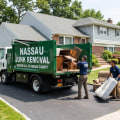
A missed step doesn't just slow things down. It can cost you a rescheduling fee, push your slot to another day, or leave you dealing with an appliance you were counting on getting rid of today.
This appliance pick up checklist covers exactly what to handle the night before and the morning of your appointment. Refrigerator, washing machine, dryer, dishwasher, stove — each type connects differently, and knowing those differences is what keeps the job moving. Home appliances vary more than most people realize until a crew is standing in their kitchen waiting.
TL;DR Quick Answers
Appliance Pick Up
Appliance pick up is a scheduled service where a licensed crew comes to your location, disconnects, lifts, and hauls away old appliances — no heavy lifting or disposal runs required on your end. Most full-service providers like Jiffy Junk handle refrigerators, washers, dryers, dishwashers, stoves, window AC units, and more from any room in the home. Prep your appliance the night before by unplugging it, clearing a path to the door, and disconnecting any water or gas lines. The crew handles the rest.
Top Takeaways
Good prep makes a fast job. Here's what matters most before your home appliance pick up crew arrives:
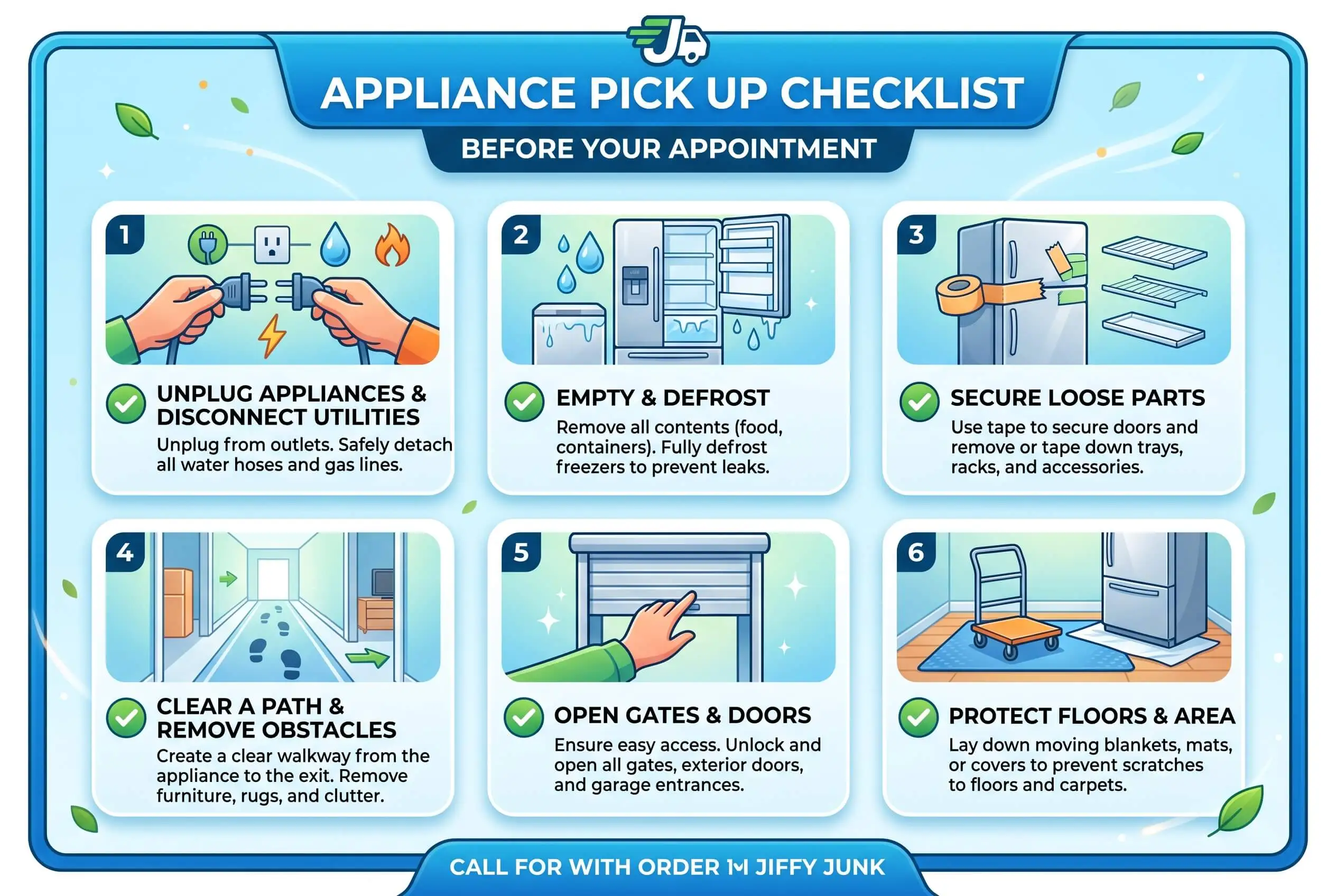
Unplug refrigerators and freezers at least 8 hours before pick up. The compressor needs time to settle. The unit needs time to defrost.
Disconnect water supply lines the night before. Washers, ice maker-connected refrigerators, and dishwashers all have supply lines that need to be off and drained before the crew touches them.
Confirm gas shutoffs before the crew arrives. Gas ranges and dryers need the shutoff valve closed and the flex connector capped. Call the service provider if you're not sure how.
Clear a path from appliance to exit. Measure tight doorways in advance. Move vehicles out of the driveway. Lay floor protection along the route.
Tape power cords, hoses, and doors to the appliance body. Loose cords scratch floors. Open refrigerator doors cause injuries during the move.
Federal law requires certified refrigerant recovery for refrigerators and freezers. Setting them at the curb isn't a legal option in most jurisdictions. Certified disposal is the only compliant route.
More than 13 million refrigerators are disposed of in the U.S. every year. About 20% of large appliances get properly recycled. A reputable removal service handles the rest correctly.
If disconnection feels risky, let the crew handle it. Most full-service removal companies include it in the job. One call before the appointment is all it takes to confirm.
What to Do Before Your Appliance Pick Up
Prep is fast when you know what to tackle and when. Here's the breakdown.
The Night Before Pick Up
Everything on this list takes under 15 minutes total. Doing it the night before means nothing holds up the crew in the morning.
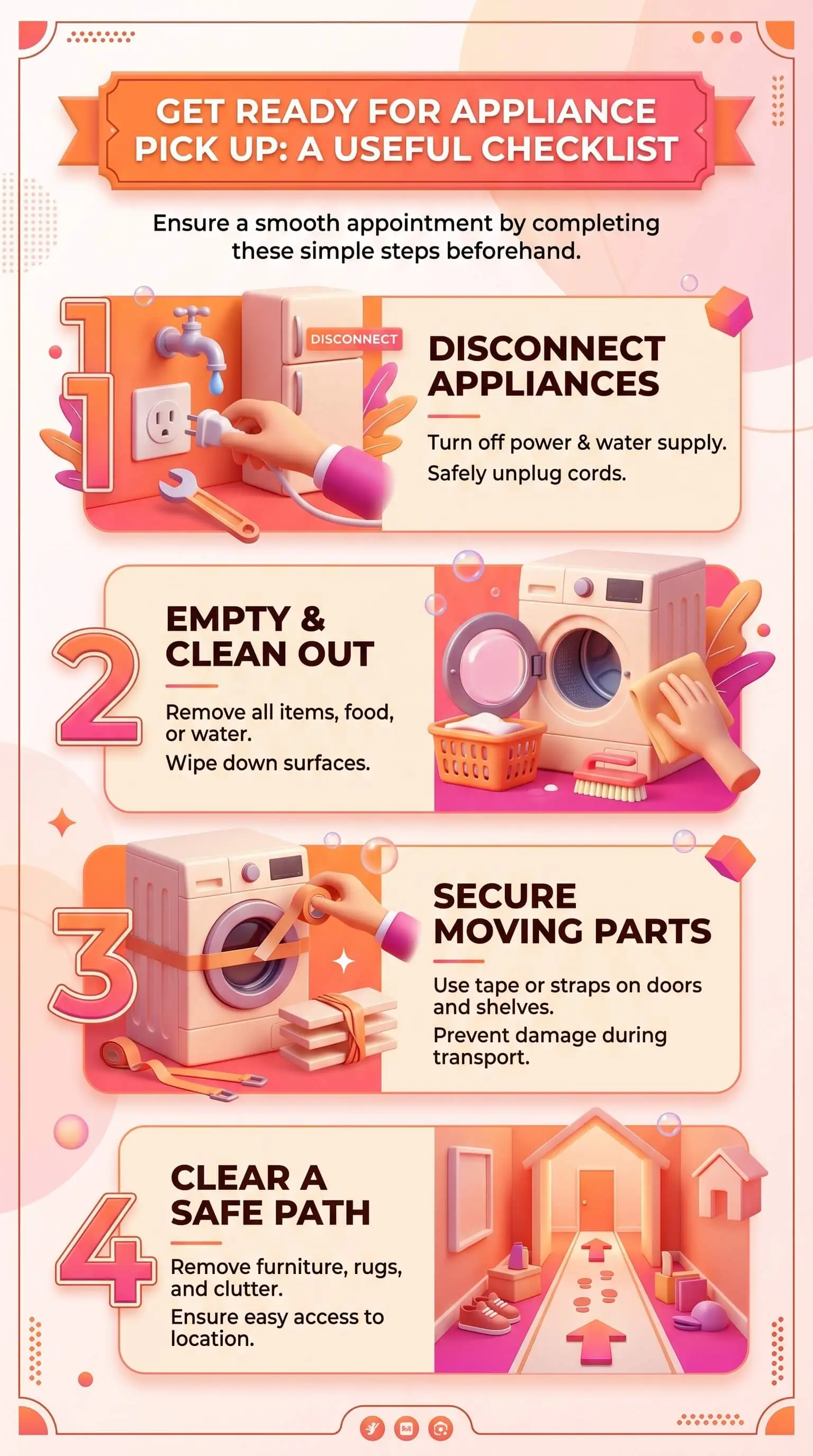
Unplug the appliance. Refrigerators and freezers need at least 8 hours unplugged before moving. The compressor oil has to settle, or you risk damaging the unit during transport.
Defrost if there's ice buildup. Frost-free refrigerators still produce condensation as they warm up. Lay towels underneath before you go to bed so you're not dealing with a puddle in the morning.
Empty it out completely. Food, dishes, detergent bottles, anything stored on top. If it's in or on the appliance, take it out now.
Shut off the water supply. Washing machines, ice maker-connected refrigerators, and dishwashers all have supply lines that need to be turned off at the wall and disconnected. Tuck the hose end into a bucket or zip-tie it to the appliance body so it doesn't drip during the move.
Tape cords and hoses to the appliance body. A loose power cord dragging across a hardwood floor will scratch it. Painter's tape or zip ties take 30 seconds and prevent a repair bill.
Day-of Morning Checklist
Run through these before the crew pulls up. Each one matters.
Clear the path from the appliance to the exit. Standard interior doors are 32 inches wide. Most large appliances need 30 to 33 inches of clearance. If there's any doubt, measure before the crew arrives, not after.
Move vehicles out of the driveway. The truck needs a direct pull-up. A blocked driveway adds 10 to 20 minutes to the job and throws off the rest of the crew's schedule for the day.
Protect the floors along the route. Lay down cardboard or moving blankets. Appliance feet and dolly wheels leave marks on hardwood and tile that are avoidable with five minutes of prep.
Confirm the gas line shutoff. Gas ranges and gas dryers need the shutoff valve in the off position before the crew touches them. If you're not sure how to do it safely, call the service provider ahead of time. Most crews will walk you through it or handle it themselves.
Have your confirmation details ready. Phone or printed, it doesn't matter. Having it in hand speeds up check-in and prevents any back-and-forth about what's going and what's staying.
Check for anything still attached. Ice maker lines, dishwasher drain hoses, anti-tip brackets on ranges — these are the things that get missed and hold up the job. Do a quick walk-around before they arrive.
Tape refrigerator and dishwasher doors shut. Use painter's tape. Doors that swing open during a move cause injuries and damage. This step takes 20 seconds.
Be there when the crew shows up. You don't have to stay. But being on-site for the first few minutes lets you point out exactly what's going on, flag anything nearby that's fragile, and hand off any access information they need.
Appliance-by-Appliance Quick Reference
Here's what each appliance needs before the crew arrives:
Refrigerator / Freezer
Unplug 24 hours prior; defrost; disconnect the ice maker water line; tape the doors shut.
Washing Machine
Run an empty spin cycle to drain; shut off the hot and cold valves; disconnect hoses; stuff the drum with towels to absorb any residual water.
Dryer (Electric)
Unplug the 240V cord; disconnect the vent duct; tape the duct end closed.
Dryer (Gas)
Confirm the gas shutoff valve is closed; disconnect the flex line; cap the line; disconnect the vent duct.
Dishwasher
Shut off the water supply under the sink; disconnect the supply and drain lines; unplug or turn off the breaker; tape the door shut.
Stove / Range (Electric)
Pull the 240V plug; remove the anti-tip bracket from the floor if installed; slide the appliance forward carefully.
Stove / Range (Gas)
Shut off the gas at the wall valve; disconnect the flexible connector; cap the line; remove the anti-tip bracket.
Window AC Unit
Unplug; remove from the window frame before the crew arrives if possible. Do not attempt to drain the refrigerant yourself.
What Can't Be Picked Up
Most appliances are a straightforward haul. A few situations require special handling or rule out same-day service:
Appliances with active refrigerant leaks — EPA-certified recovery has to happen first
Units contaminated with biohazardous material, extreme mold, or active pest infestation
Gas appliances still connected to an unsealed, active gas line
Appliances with shattered glass panels that haven't been secured for transport
Not sure if yours qualifies? Call the service provider before the appointment. That conversation takes two minutes and saves everyone a wasted trip.
“The delays I see most often come down to three things during a bathroom remodel: the refrigerator wasn't unplugged the night before, the washer hose is still connected to the wall, or the path to the door is blocked. None of those fixes take more than 15 minutes — but they happen after the crew is already there, and that turns a 30-minute job into a 90-minute one. The homeowners who have the easiest pick ups are the ones who walked the route the night before. They measured the doorway. They moved the car. That's honestly it.”
7 Essential Resources
These are the most practical references for homeowners planning a pick up, from booking a crew to understanding what federal law requires before a refrigerator can legally leave your property.
1. Jiffy Junk — Appliance Pick Up Service
Licensed, insured crews that handle disconnection, lifting, and responsible disposal. You can schedule an appliance pick up for same-day or next-day service, any appliance type, any size job.
2. U.S. EPA — Responsible Appliance Disposal (RAD) Program
The EPA's RAD program documents the federal requirements for refrigerant recovery before any refrigerated appliance can be dismantled or disposed of. Read this if you want to understand why curbside is not a legal option for most refrigerators.
3. U.S. EPA — Durable Goods Product-Specific Data
The EPA's durable goods data page tracks major appliance generation, recycling rates, and landfill volumes by year. Good reference for understanding where old appliances actually end up when disposal isn't handled correctly.
4. Wikipedia — Home Appliance
A clean overview of home appliance categories, classifications, and basic specifications. Useful for confirming whether your unit counts as a major appliance and what disposal requirements typically follow from that.
5. Whirlpool — How to Recycle Appliances
Whirlpool's appliance recycling guide covers refrigerant handling, transport safety, and retailer haul-away options at the manufacturer level. Worth reading for kitchen appliance prep specifics.
6. Dropcurb — Appliance Preparation by Type
Dropcurb's appliance prep breakdown gives appliance-specific instructions for refrigerators, washers, dryers, and more — written from a removal service perspective, which makes it more practical than most manufacturer guides.
7. Capitol Moving — 6-Step Checklist for Moving Appliances
Written for appliance moves, not removal, but Capitol Moving's checklist covers refrigerator transport orientation, cord securing, leak checks, and door stability in detail. The prep steps carry over directly to pick up day.
3 Statistics
Over 18 million large appliances are discarded in the United States every year.
Refrigerators, washing machines, dryers — and only about 20% get properly recycled. The rest go to landfills or informal disposal channels. Source: scoop.market.us / E-Waste Statistics and Facts
The EPA estimates more than 13 million refrigerators and freezers are disposed of in the U.S. every year.
Federal law requires certified refrigerant recovery before any of them can legally be taken apart or thrown out. You can't haul a fridge to the curb and call it done in most jurisdictions. Source: EPA RAD Program Benefits PDF
Major appliances accounted for 3.1 million tons of recycled material in the U.S. in 2018, ranking among the most-recycled material categories in the country.
That's the steel, copper, and aluminum that gets recovered when disposal goes through certified channels. When it doesn't, those materials go to a landfill instead. Source: EPA National Overview: Facts and Figures on Materials, Wastes and Recycling
Final Thoughts and Opinion
Fifteen minutes the night before is all this takes. Unplug it. Drain it. Disconnect the lines. Move the car. That prep time pays back fast — the crew gets in and out, the floors stay scratch-free, and you're not waiting around for a rescheduled appointment.
One thing worth saying directly: some of these disconnections aren't DIY jobs. Gas line shutoffs, refrigerant-containing units, and hardwired appliances carry real risk if the connections are handled wrong. Skip those steps and let the crew take care of it. Most full-service removal companies include disconnection in the job. One call the day before tells you exactly what they cover.
The homeowners who have the smoothest experience are usually the ones who choose an appliance removal service that communicates clearly before pickup day. A quick conversation with the service provider the day before can confirm the details, prevent confusion, and make the entire removal process feel simple and stress-free.
Frequently Asked Questions
Do I need to be home during the appliance pick up?
You don't have to stay for the whole job. Being there when the crew arrives matters — that's when you confirm what's going, flag anything fragile nearby, and hand off any access details. After that, most removal jobs run fine without you on-site.
Does the appliance need to be empty before pick up?
Yes, and that means everything. Every drawer, shelf, drum, and compartment cleared out before the crew gets there. Anything left inside adds weight, shifts during the move, and can cause damage. For refrigerators, that includes the ice bin and the ice maker line — not just the food.
Can you pick up appliances that still work?
Working appliances are often the easiest to remove because they're in better structural shape. Some removal services will route them to donation or resale channels rather than straight to recycling. Worth asking about when you book.
How do I shut off the water line for a washing machine before picking it up?
The shutoff valves sit on the wall behind or above the unit, one for hot and one for cold. Turn each clockwise until it stops. Run a short spin cycle after to drain any water left in the hoses, then disconnect. Tuck the hose ends into a bucket or tape them to the appliance body so they don't drip during the move.
Is appliance pick up free?
It depends on the service. Some retailers include haul-away at no charge when you buy a new appliance delivered. Some utility rebate programs pick up working refrigerators and freezers for free. Junk removal services charge for labor, usually based on the type and number of appliances. Same-day service, disconnection, and long-distance hauls can add to that. Get a quote before the appointment so there are no surprises.
Ready to Schedule Your Appliance Pick Up?
You've done the prep. Now book the crew.
Jiffy Junk handles appliance pick up for refrigerators, washers, dryers, dishwashers, stoves, and more. Licensed and insured crews disconnect, lift, and haul everything away. Get your free quote and lock in a time that works.
For more home removal and disposal guides, see How to Dispose of an Old Refrigerator Before Closing on a Home Sale and Estate Cleanout Pricing Explained on bathroomremodeling101.com.