Hoarding is a recognized mental health condition, not a housekeeping problem. The items in those rooms carry real emotional weight for the people who kept them. That’s true whether the person is still living there or not. A crew that walks in treating it like a standard haul-out will finish the job and leave something broken behind.
Here’s what the hoarding cleanout process actually looks like when it’s done right — from the first walk-through to the final sweep.
TL;DR Quick Answers
hoarding cleanout
A hoarding cleanout is a professional removal service designed for homes where accumulated possessions have made the space unsafe or unusable. Unlike standard junk removal, a hoarding cleanout starts with an on-site assessment, involves the client or family in sorting decisions, checks for biohazard conditions, and routes items across multiple disposal streams — donation, recycling, and regulated haul-away. Crews work room by room at a pace that respects the occupant. The job is finished when every room is walkable and clear.
What it costs: $1,000 to $10,000+, depending on severity level and volume. Biohazard remediation adds to that.
How long it takes: One day for mild cases. Two to three days for moderate hoarding. Four to seven or more days for severe accumulation.
When you need a professional: Any time rooms are partially or fully unusable, there are sanitation concerns, or animal waste, mold, or sharps are present.
How to get an accurate quote: Book an on-site walk-through. Phone estimates on hoarding jobs are consistently unreliable — the details that move the price only show up in person.
Top Takeaways
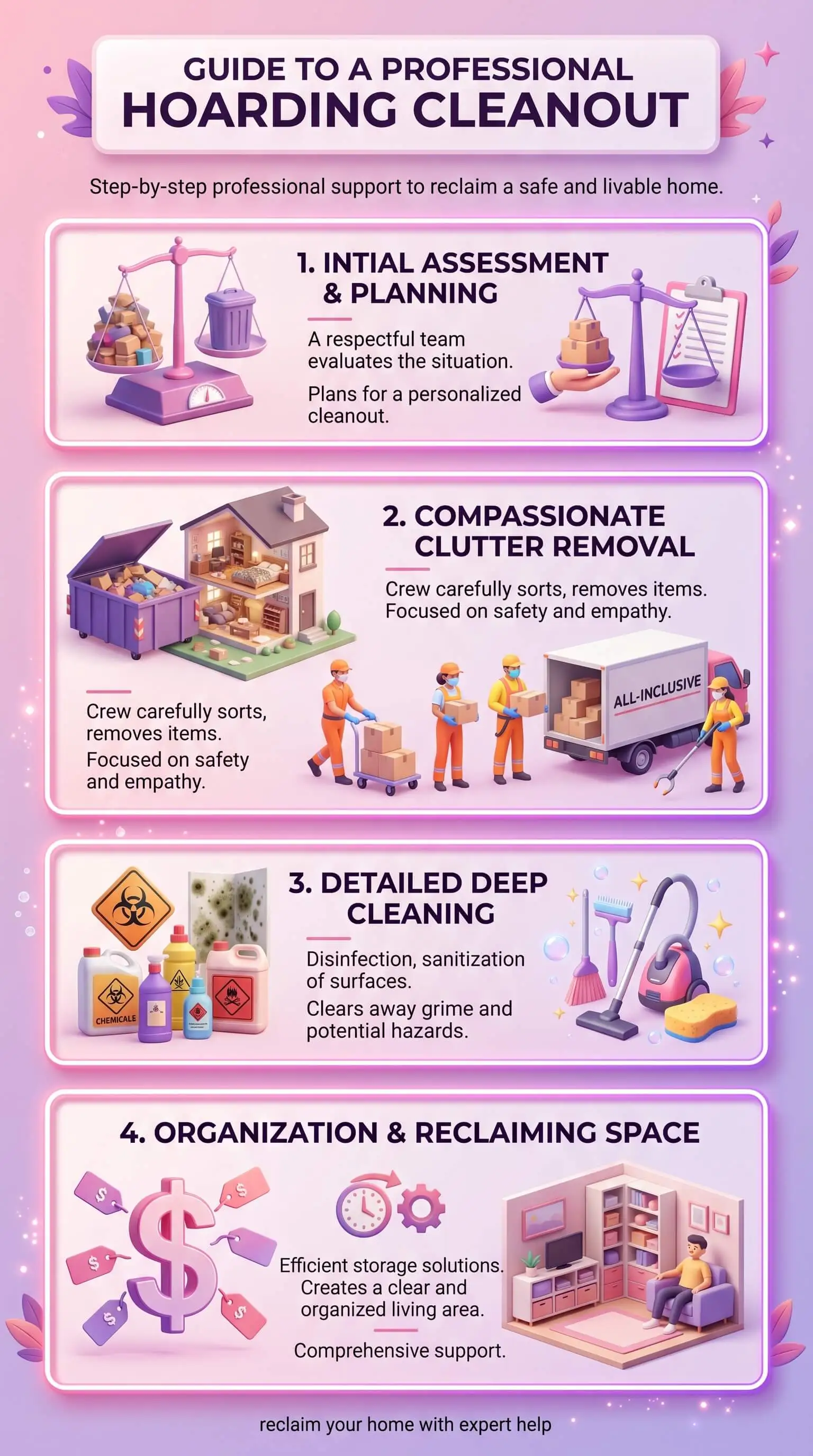
A professional hoarding cleanout follows a set sequence: walk-through, sorting, biohazard check, room-by-room removal, responsible haul-away, and a final sweep. If a service skips steps, ask why.
Biohazard conditions — animal waste, mold, decomposing material, sharps — need separate protocols. Sometimes a licensed remediation crew, not a junk removal team. Identify this before work starts.
Timeline tracks severity. Light hoarding clears in a day. Severe cases run four to seven days or more, sometimes across multiple hauls.
Cost runs $1,000 to $10,000 or more depending on scope. Add biohazard remediation and that range extends further.
A phone estimate on a hoarding job is not reliable. The only accurate quote comes from a site walk-through.
Book the assessment before the timeline gets away from you. The professional hoarding cleanout service you choose should come see the property first.
What Happens During a Professional Hoarding Cleanout?
The Initial Walk-Through
Before anything gets touched, the crew walks the property. They’re looking at how much there is, where the load points are, and whether there’s anything that changes how the job gets worked — blocked exits, structural damage, mold, animal waste, sharps. That assessment drives the quote. Skip it and you’re pricing in the dark.
Most professional services offer this walk-through at no charge. If a company is quoting you over the phone without seeing the property first, that’s worth noting.
Client Sorting and the Keep Conversation
A good crew doesn’t show up and start filling trucks. They check in first. Items go into four categories: keep, donate, recycle, and discard. When the occupant is involved, the crew works at their pace to keep decisions. When it’s a family managing the cleanout for a parent or an estate, family members set the direction.
This step takes more time than people expect. That’s the point. Moving too fast — especially without the person present — creates problems that don’t show up until later. Services that build this time into the job are the ones worth hiring.
Biohazard Identification
Not every hoarding situation involves biohazard conditions. Enough of them do, though, that every crew should be checking. Animal waste, rodent activity, mold, decomposing material, and sharps all require handling protocols that go beyond standard removal. In serious cases, you need a licensed biohazard remediation crew, not a junk removal team.
The time to identify this is during the walk-through — not after the crew has already started working the space. If it comes up later, the scope changes and so does the cost.
Systematic Room-by-Room Removal
Once sorting is done and hazards are flagged, removal starts. Crews work room by room from exit points inward, keeping a clear path out at all times. In severely hoarded spaces that means moving carefully through stacked corridors, staging items in the driveway or garage before loading, and circling back through rooms more than once.
Volume determines how long this takes and what it costs. A two-bedroom home with moderate accumulation might clear in a single day. A full house at a high severity level can run four to seven days and multiple loads.
Haul-Away and Responsible Disposal
Not everything goes to the same place. Items in good shape get routed to donation partners. Electronics, appliances, and hazardous materials go to the right disposal streams. General debris goes to transfer stations or landfills per local regulations. A professional service tracks where each category goes. That matters — both for compliance and for peace of mind.
The Final Sweep
When the main removal wraps up, the crew walks every room again. Small items left under furniture, debris in corners, areas that need light cleaning — all of that gets handled before the crew leaves. By the time the job is done, every room should be walkable.
Ask any service you’re considering whether this step is part of their standard process. It should be.
How Long Does a Hoarding Cleanout Take?
Timeline depends almost entirely on severity level and volume:
Level 1–2 hoarding (light clutter, accessible rooms): typically one full day
Level 3 (moderate clutter, rooms partially unusable): two to three days
Level 4–5 (severe accumulation, safety hazards, possible structural damage): four to seven or more days, sometimes across multiple hauls
Access issues, biohazard conditions, and how quickly decisions get made on-site can all push those estimates out. Get the timeline in writing as part of your quote.
What Does a Hoarding Cleanout Cost?
Costs run from roughly $1,000 for a single room at a low severity level to $10,000 or more for a full house with significant accumulation. Add biohazard remediation and the number can go well beyond that.
Services quote by load, by labor hour, or by square footage. Whichever method they use, a site visit is the only way to get a number that’s actually reliable. A phone estimate on a hoarding job is an educated guess at best.

“The thing families get wrong most often is assuming a hoarding cleanout is just a bigger version of a regular junk removal job. It’s not. Volume is one challenge. The emotional weight of the situation is a separate one entirely. We’ve worked cleanouts where a family member had passed and the home had been accumulating for thirty years. We’ve worked with others where the person was still living there, still attached to everything, and needed the process to move at a pace that respected that. Both situations require a crew that understands they’re not just moving things. They’re stepping into someone’s life at a hard moment.
What catches people off guard is almost always the same: they underestimate the volume, they don’t ask about biohazard protocols until the crew finds something, and they take a phone estimate instead of booking a site walk. Those three things account for most of the budget surprises we see. Book the walk-through first. Everything else follows from what we see when we’re actually there.”
7 Essential Resources
These are worth bookmarking before you make any decisions. They cover the clinical background, fire safety frameworks, and professional networks that matter when you’re sizing up a hoarding cleanout.
International OCD Foundation — Hoarding Disorder Resource HubThe IOCDF maintains the most thorough public resource on hoarding disorder: family guides, a therapist directory, and a task force network by region. Understanding the clinical side helps you work with a cleanout crew more effectively. hoarding.iocdf.org
HelpForHoarding.orgA dedicated resource for individuals and families dealing with hoarding disorder. Local support group search, family guides, and a practitioner directory are all here. Useful before the physical cleanout and after, especially if the occupant is still in the space. helpforhoarding.org
U.S. Fire Administration — Hoarding and Fire SafetyFEMA’s fire safety guidance written specifically for hoarding environments. Covers blocked exit risks, heating and cooking equipment hazards, and practical steps for reducing fire risk in cluttered homes. usfa.fema.gov
NFPA — Hoarding: From Enforcement to EngagementThe National Fire Protection Association’s guide for fire service and community responders working in hoarding situations. Covers risks to occupants and first responders and outlines community task force responses. nfpa.org
Wikipedia — Compulsive HoardingA well-maintained overview of hoarding disorder as a recognized clinical condition. Covers DSM-5 and ICD-11 classification, prevalence data, associated conditions, and treatment approaches. A solid starting point for the medical context. en.wikipedia.org/wiki/Compulsive_hoarding
Psychology Today — Hoarding Disorder Prevalence: A Scientific AssessmentA March 2025 breakdown of the most recent meta-analysis on hoarding disorder prevalence, drawing on 11 peer-reviewed studies. Useful for anyone who wants the actual clinical picture rather than general estimates. psychologytoday.com
Jiffy Junk — Hoarding Cleanout ServicesJiffy Junk’s hoarding cleanout service covers the full job: site assessment, sorting, haul-away, responsible disposal, and team-based removal at every severity level. Start here if you’re ready to schedule a walk-through. jiffyjunk.com/junk-removal-services/hoarding-cleanout/
3 Statistics
2.5% Pooled prevalence of hoarding disorder in adults, drawn from a meta-analysis of 11 peer-reviewed studies. Roughly 1 in 40 people.
Source: Psychology Today / Peer-reviewed meta-analysis, March 2025
6% Estimated prevalence of hoarding disorder in adults over 70 — three times the general population rate. That number is expected to grow as the U.S. population ages.
Source: U.S. Fire Administration / FEMA — Hoarding and Fire Safety and University of Florida Health Research
$1,000–$10,000+ Typical cost range for a professional hoarding cleanout, from a single mild room to a full house at a high severity level. Biohazard remediation can push the total well beyond the upper end.
Source: PuroClean Disaster Restoration — Hoarding Cleanup Cost Guide
Final Thoughts and Opinion
A hoarding cleanout is one of the harder home services to coordinate — not because the logistics are especially complicated, but because the situation is rarely just a logistics problem. Someone’s life accumulated in those rooms. The crew walking through that space is handling more than physical objects, whether they acknowledge it or not.
After seeing how these jobs get done well and how they go wrong, a few things are clear. The walk-through isn’t optional — a phone quote on a hoarding job is guesswork, and you’ll pay for that gap eventually. Biohazard assessment belongs in the initial inspection, not as a surprise mid-job that becomes a change order. And the crew’s approach to the family or the occupant is a real factor. A fast team that treats the space like a demolition site finishes the job and leaves problems that don’t show up on an invoice.
If you’re managing this for a parent or handling an inherited property, book junk removal before anything else tightens. Before the timeline gets urgent, before secondary issues compound the scope, before someone else’s schedule starts costing you money. The cleanout is manageable. Going in without a clear picture of what you’re dealing with is what makes it expensive.
Frequently Asked Questions
What is a hoarding cleanout service?
It’s a professional removal service built specifically for properties affected by hoarding disorder. Unlike a standard junk removal call, it starts with a full assessment, involves the client or family in sorting decisions, checks for biohazard conditions, and handles disposal across multiple streams. The scope and how long it takes depend heavily on the severity level of the accumulation.
How do professionals decide what to keep versus discard?
The crew doesn’t make those calls unilaterally. When the occupant is present, sorting happens at their pace — keep, donate, recycle, discard — with the crew following their lead. For estate or family-managed situations where the occupant isn’t there, family members direct those decisions. A professional crew doesn’t throw out personal items without direction.
Do hoarding cleanout crews work with family members?
Yes, routinely. Family members often manage the logistics, set sorting direction, and handle property access. That works best when there’s a single point of contact on the family side — one person making the keep-or-discard calls rather than multiple people weighing in on every item. It keeps the job moving and reduces stress for everyone involved.
Can I clean out a hoarding home myself?
For mild situations with no safety concerns, it’s possible — though you’ll still need to handle haul-away and disposal. For anything beyond light clutter, the volume alone makes it a hard DIY job, and that’s before factoring in potential biohazard exposure, especially if the space needs to be cleared before a bathroom remodel. Don’t guess at that part. Book a walk-through assessment first, and make the DIY-versus-professional decision with a real picture of what’s in the space.
What level of hoarding requires professional help?
Level 3 is a practical threshold. At that point, rooms are partly unusable, there are often sanitation concerns, and the accumulation is significant enough that safe, responsible removal takes real logistics. Level 4 and 5 involve structural issues, visible pest activity or mold, and conditions that are not safe to work without proper equipment. Even at Level 2, if biohazard conditions are present, bring in a professional.
How much does a hoarding cleanout cost on average?
Small or mild cases typically run $1,000 to $3,000. A full house at a moderate severity level usually lands between $3,000 and $10,000. Severe cases with biohazard remediation or structural complications go well past that. The only number worth trusting is one that came after someone actually saw the property. Phone estimates on hoarding jobs miss the details that move the price.
Ready to Get Started?
Whether it’s your own property, a family member’s home, or an inherited estate, the first step is the same: get a full service junk removal professional in to see it before you commit to anything. A walk-through takes less time than you think and tells you everything a phone call can’t.
Jiffy Junk has handled hoarding cleanouts across the country since 2014 — compassionate, discreet, and built around what each job actually needs. Reach out to schedule your on-site assessment and get a clear picture of what you’re working with.