So finding a good hand soap for eczema only gets you partway. Even the gentlest fragrance-free bottle still sends your hands through the same loop of soaking, rinsing and toweling off, ten or fifteen times before dinner.
Doctors call the underlying problem dermatitis, a family of skin inflammation marked by itching, redness and rash. Eczema is the everyday name for its most common form. On the hands, it flares right where soap, water and friction keep meeting.
Waterless soap cleans your hands without a sink or a towel, so that loop never starts. Here's how it works, where it helps sensitive skin, and where plain soap and water still wins.
TL;DR Quick Answers
Hand soap for eczema
The best hand soap for eczema is truly fragrance-free, free of harsh sulfates, and ideally rinse-free, because the repeated wet-dry cycle of washing damages eczema-prone skin as much as harsh ingredients do.
What to look for:
"Fragrance-free" on the label, since "unscented" products can still hide masking fragrance
No sodium lauryl sulfate (SLS) or sodium laureth sulfate (SLES)
No alcohol, parabens or dyes
Gentle enough to use many times a day
Why rinse-free matters: washing 8 to 10 or more times a day raises hand eczema risk 1.51-fold in a 45-study meta-analysis. A rinse-free cleanser removes dirt and germs without water, so your skin skips the soak, rinse and towel-dry that wear down its barrier.
Bottom line: choose a soap that removes germs physically and leaves nothing irritating behind, keep soap and water for visibly dirty hands, and see a dermatologist if cracking lasts more than a few weeks.
Top Takeaways
Frequent washing damages eczema-prone skin through the soap and through the repeated wet-dry cycle.
Waterless soap binds dirt and germs into clumps you brush off, so your hands skip the rinse and the towel.
It removes contaminants physically rather than killing them chemically, which leaves less on your skin.
Pick fragrance-free over "unscented," and avoid SLS, alcohol, parabens and dyes.
Keep soap and water for visibly dirty hands and after using the bathroom.
Waterless soap cuts irritation exposure but won't treat eczema, so see a dermatologist if cracking, bleeding or weeping lasts more than a few weeks.
Why Hand Washing Can Work Against Eczema-Prone Skin
Frequent washing hurts eczema-prone skin in two ways, because the soap strips protective oils and the constant soaking and drying weakens whatever is left.
A thin layer of fats called the lipid barrier holds your skin together. It keeps moisture in and irritants out. Soap cleans by grabbing onto oil, and it can't tell the grease on your palms from the oils your skin needs to stay sealed.
Water adds its own damage. Each wash softens the outer layer of skin, and each pass of the towel pulls moisture back out. Hot water speeds that up. Hard or chlorinated tap water piles on more irritation. Healthy skin rebuilds between washes, while skin with eczema usually falls behind.
I've walked into plenty of bathrooms where a fragrance-free bottle sat next to the faucet and the person using it still had split knuckles. They'd done the label reading. What kept hurting them was the routine, and a fourth brand of soap wouldn't have changed it. If you're still choosing a regular soap, our guide on frequent hand washing and dry skin covers labels, bar versus liquid, and moisturizing.
How Waterless Soap Technology Works
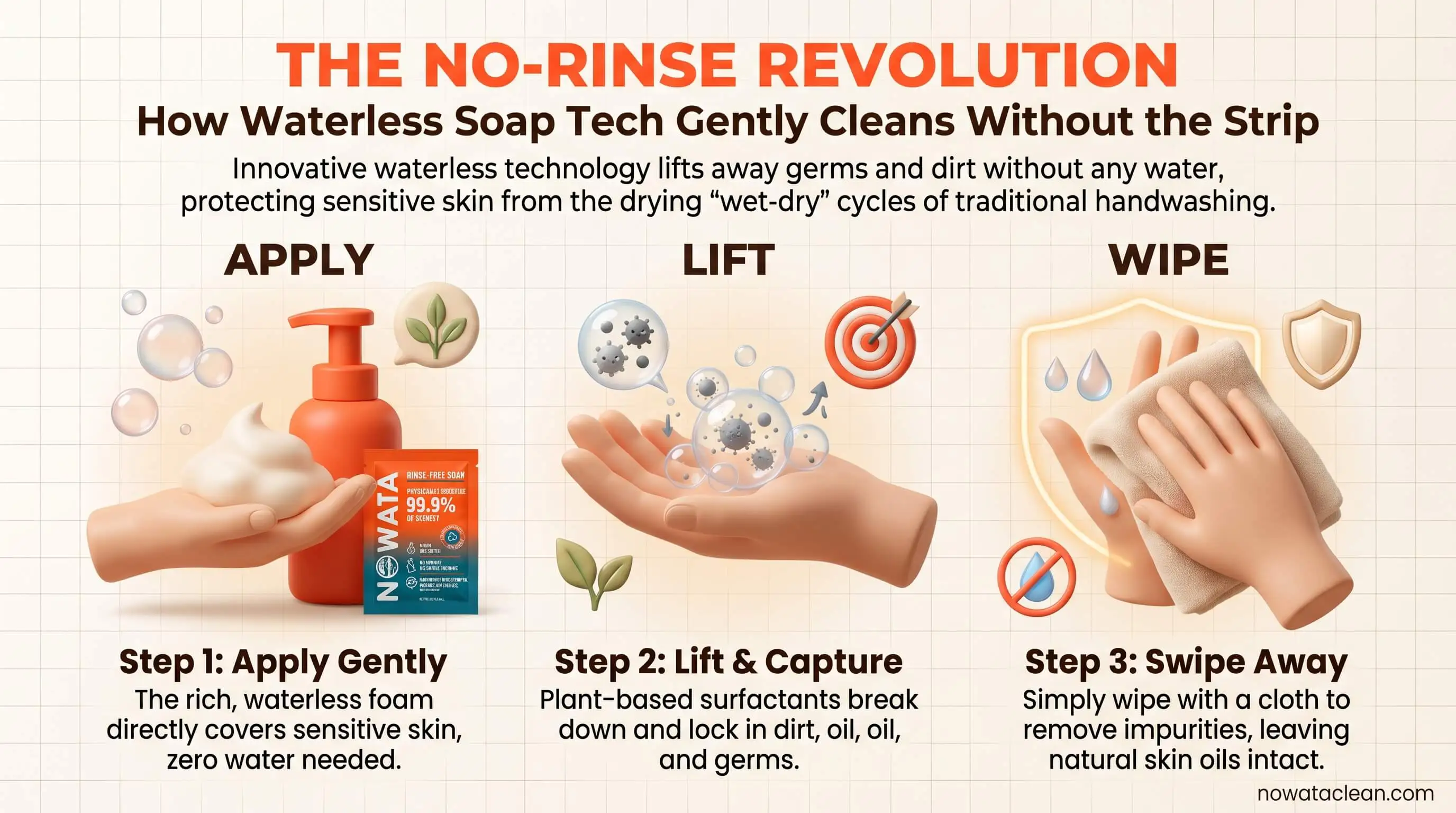
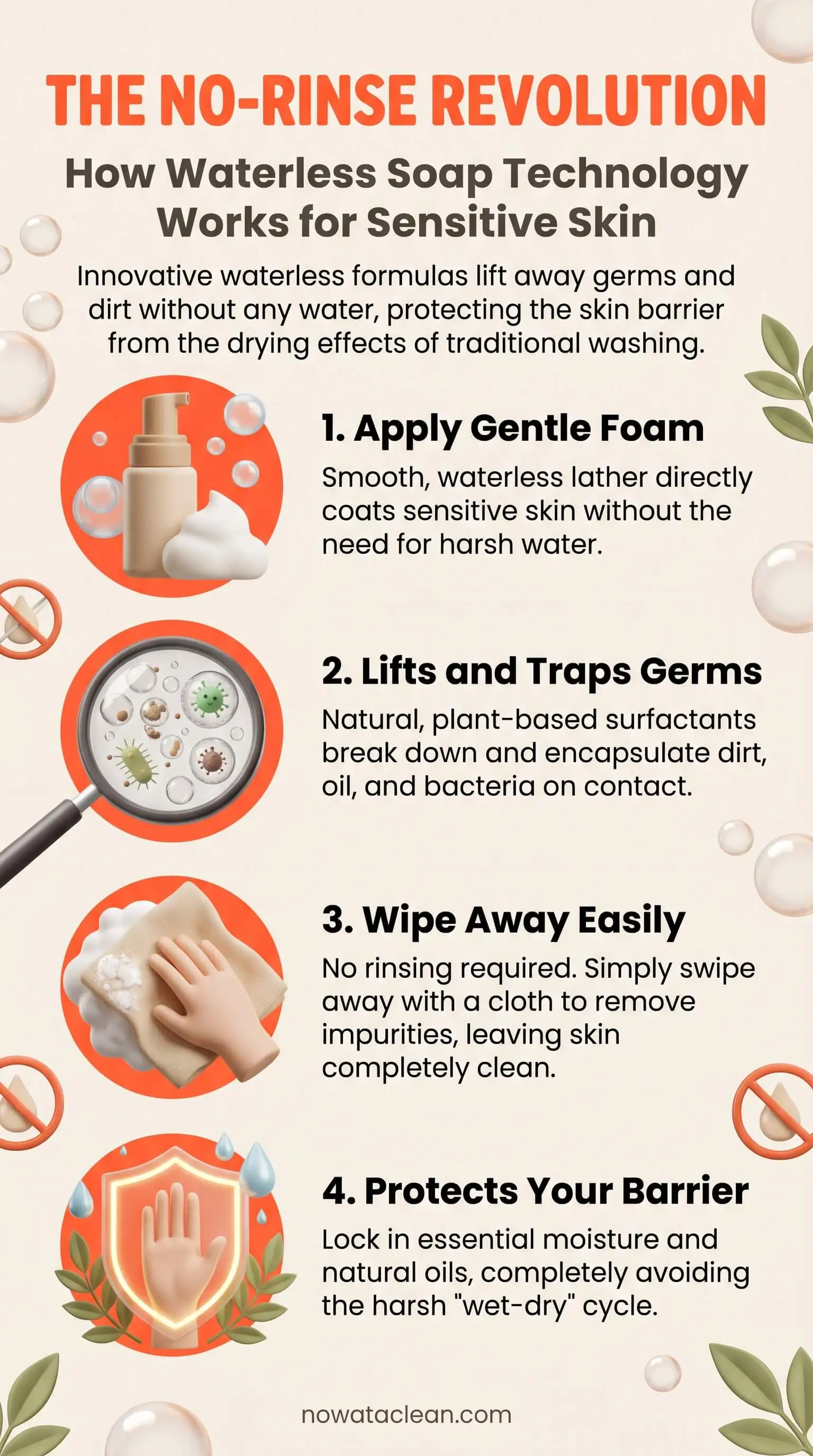
Waterless soap is a rinse-free cleanser you rub onto dry hands until it forms small clumps, and those clumps carry dirt and germs away when you brush them off.
The Clumping Mechanism
The whole process takes about as long as a normal hand wash.
Squeeze a small amount onto dry hands.
Rub it over your palms, the backs of your hands, between your fingers and around your nails.
Keep going until the formula starts to clump. Those clumps are binding to whatever was sitting on your skin.
Brush the clumps away over a trash can or the floor mat.
You never touch water, so you skip both the rinse and the towel dragging across sore knuckles.
Removal Versus Killing
Most people miss this part. Hand sanitizer kills microbes chemically, usually with alcohol, and whatever it leaves behind sits on your skin until it evaporates. Waterless clumping soap physically lifts contaminants off your hands and takes them with it.
For reactive skin, that difference counts. The less that stays behind, the less an inflamed barrier has to react to.
Waterless Soap vs Hand Sanitizer vs Soap and Water
Soap and water needs a sink and usually contains no alcohol. It handles heavy grime better than either alternative, but every use adds another wet-dry cycle. Reach for it when hands are visibly dirty, after the bathroom and before you cook.
Alcohol hand sanitizer works anywhere and typically runs 60% alcohol or higher. It kills germs on the skin instead of removing them, leaves visible dirt where it is, and stings anything cracked. It's fine for a quick germ check on the go.
Waterless clumping soap also works anywhere, and you can find fragrance-free, alcohol-free versions. It lifts light soil and germs and brushes them away with no wet-dry cycle, which makes it the better pick when your skin can't take another trip to the sink.
What Waterless Soap Means for Sensitive Skin
The biggest win for sensitive skin is less total irritation across a heavy hand-washing day. That's real progress, though it's a long way from a cure.
Here's what changes in practice:
Fewer wet-dry cycles. Clean your hands twelve times a day, swap half of those for a waterless option, and your skin barrier gets six fewer soak-and-dry rounds.
An alcohol-free formula spares split knuckles the sting of sanitizer.
Your hands spend less time in hot water, chlorine and hard-water minerals.
Skin that's already raw avoids a rough towel several times a day.
Waterless soap won't treat eczema. It cuts down how often your hands run into the things that set it off.
Choosing a Hand Soap for Eczema: What to Leave Out
Read the back of the bottle before the front. With eczema-prone hands, what a soap leaves out matters as much as what it puts in.
Fragrance. Look for "fragrance-free" on the label, since an "unscented" product can still contain masking fragrance to hide the smell of other ingredients.
Sodium lauryl sulfate and sodium laureth sulfate, the cheap, strong cleansers most likely to strip the lipid barrier.
Alcohol, which dries compromised skin and burns the moment it reaches a crack.
Parabens, phosphates and dyes, which add irritation risk and do nothing for cleaning.
If you wash often and your hands already react, look for a hand soap for eczema that is fragrance-free and rinse-free at once, so you cut the irritants and the water together.
NOWATA was built around that idea. Dr. Ruslan Maidans, a dentist, and Dr. Yalda Shahriari, a biomedical engineer, developed it after regular soaps and sanitizers kept irritating their own children's sensitive skin. Their plant-based formula leaves out fragrance, alcohol, sulfates, parabens and phosphates. In lab testing with a modified ASTM E1174 method, it physically removed over 99.9% of a norovirus surrogate and E. coli from skin. NOWATA describes that as a hand-cleansing result only, and it makes no claim to treat or prevent disease.
The Limitations: When Waterless Soap Is Not the Answer
Waterless soap belongs in an eczema routine. It still doesn't replace the sink every time, and it isn't a treatment.
Follow CDC guidance and use soap and water when a sink is nearby, especially after the bathroom, before handling food and whenever hands are greasy or visibly dirty.
Moisturizer, avoiding your triggers and medical care do the healing. A cleanser only reduces the damage you add.
Triggers are personal. Try any new product on a small patch of skin for a few days before you use it all day.
Hands that bleed, weep, crust over or look infected need a dermatologist, and a new soap won't fix them.
Where Waterless Soap Fits in a Daily Routine
Keep waterless soap wherever you clean your hands most often without a sink in reach.
The car, your desk, a work bag and the kids' sports bag are the obvious spots. It also earns a place on camping trips, where every cup of water counts. If you're packing for the outdoors, our guide to environmentally friendly soap for camping covers the dishes.
At home, I'd keep it simple. Use soap and water at the sink when hands are truly dirty and waterless soap for everything in between, and keep a fragrance-free hand cream within arm's reach of both.
"I spend a lot of time in other people's bathrooms, and the houses dealing with eczema almost always own the right soap already. What they're short on is a break from water. When someone soaks and towel-dries their hands fifteen times a day, the gentlest bottle on earth can't keep up. So I tell those families to keep a rinse-free cleanser in the car and by the back door and save the sink for the messy jobs. Nobody calls back to say their hands are cured. They tell me the cracks on their knuckles look smaller by Friday, and that's usually enough to keep them going."
7 Essential Resources
Cracked hands and a shelf of failed products would wear anyone out. These are the sources I'd hand a friend, and none of them is selling anything. Dermatology groups, a federal agency and peer-reviewed researchers wrote them.
National Eczema Association, Hand Eczema. A plain-language starting point on what hand eczema looks like, what sets it off and how people manage it. https://nationaleczema.org/types-of-eczema/hand-eczema/
National Eczema Association, Seal of Acceptance Product Directory. Physician-reviewed cleansers and moisturizers for eczema and sensitive skin, plus the ingredients the Seal won't allow. Check any product here before you buy. https://nationaleczema.org/product-directory/
American Academy of Dermatology, Dry, Scaly, and Painful Hands Could Be Hand Eczema. Shows how frequently wet hands alone can bring on hand eczema, and why tracking down the cause beats product-hopping. https://www.aad.org/public/diseases/eczema/types/hand-eczema
American Academy of Dermatology, Dry Skin Relief from Handwashing. Dermatologists' steps for washing often without wrecking your hands, including when to moisturize and when to book an appointment. https://www.aad.org/public/everyday-care/skin-care-basics/dry/coronavirus-handwashing
DermNet, Irritant Contact Dermatitis. A detailed look at how water, soap, friction and sanitizer damage the skin barrier faster than it can repair itself. https://dermnetnz.org/topics/irritant-contact-dermatitis
Contact Dermatitis via PubMed, Hand Hygiene and Hand Eczema: A Systematic Review and Meta-Analysis. The 45-study analysis tying hand washing frequency to hand eczema risk. https://pubmed.ncbi.nlm.nih.gov/35460528/
U.S. Food and Drug Administration, Skip the Antibacterial Soap; Use Plain Soap and Water. Why "antibacterial" on a label doesn't mean better, and which ingredients the FDA pulled from consumer soap in 2016. https://www.fda.gov/consumers/consumer-updates/skip-antibacterial-soap-use-plain-soap-and-water
3 Statistics
Washing 8 to 10 times a day raises hand eczema risk 1.51-fold. Researchers who pooled 45 studies in 2022 found the risk climbed to 1.66-fold at 15 to 20 washes a day, while alcohol-based sanitizer showed no significant link. How often your hands get wet matters as much as the soap. Source: Contact Dermatitis, "Hand hygiene and hand eczema: A systematic review and meta-analysis," https://pubmed.ncbi.nlm.nih.gov/35460528/
7.3% of U.S. adults had eczema in 2021. National Health Interview Survey data put women at 8.9% and men at 5.7%. That's millions of people trading clean hands against comfortable skin several times a day. Source: CDC National Center for Health Statistics, NCHS Data Brief No. 460, https://www.cdc.gov/nchs/products/databriefs/db460.htm
Irritants cause 80% of occupational hand dermatitis. Irritants drive far more work-related hand dermatitis than allergies do, and wet-work jobs like cleaning, hairdressing, food handling and healthcare see the most of it. DermNet lists water and soap among the most common everyday irritants. Source: DermNet, "Irritant contact dermatitis," https://dermnetnz.org/topics/irritant-contact-dermatitis
Final Thoughts and Opinion
With eczema-prone hands, how often you get them wet deserves as much attention as which soap you buy.
Most advice stops at the bottle. Pick something gentle, moisturize afterward, and hope for the best. That holds up as far as it goes, but the hand washing research keeps pointing past the label to the routine of soaking, rinsing and toweling off all day.
That's where waterless soap earns its spot. Your sink still handles the dirty jobs. A rinse-free cleanser takes over the extra trips, and on a heavy day those add up to several fewer wet-dry cycles for skin that's already struggling.
For most households, I'd recommend running two tools side by side, with soap and water for truly dirty hands and bathroom trips and a fragrance-free, rinse-free cleanser for everything else. Keep a fragrance-free hand cream close to both.
Waterless soap has a ceiling, too. If your hands are bleeding or weeping, or still cracked after a few weeks of changing your routine, book a board-certified dermatologist. Stubborn hand eczema usually has a cause worth finding, and a cleanser can't go looking for it.
Frequently Asked Questions
How does waterless soap work?
You rub waterless soap onto dry hands until it forms small clumps. Those clumps bind to dirt, oil and germs on your skin, and when you brush them off, the contaminants go with them. Because you never rinse or towel off, your hands skip the wet-dry cycle entirely.
What is the best hand soap for eczema?
The best hand soap for eczema is truly fragrance-free and leaves out sodium lauryl sulfate, alcohol, parabens and dyes. If you clean your hands often, a rinse-free formula helps even more by cutting down on soaking and drying. Triggers differ from person to person, so patch-test anything new first.
Is waterless soap better than hand sanitizer for sensitive skin?
For many people with sensitive skin, yes, as long as the waterless soap is alcohol-free. Sanitizer kills germs chemically and tends to sting cracked skin. Waterless clumping soap removes germs physically and lifts light dirt too, which sanitizer can't do.
Can waterless soap replace soap and water?
Only partly. The CDC still recommends soap and water whenever you have a sink, especially after the bathroom, before handling food and when your hands are visibly dirty or greasy. Waterless soap does its best work in the moments in between, which is where it spares your skin the most wet-dry cycles.
Why does frequent hand washing make eczema worse?
Each wash strips some of the skin's protective oils, and each soak and towel-dry weakens the barrier a little more. Researchers who pooled 45 studies in 2022 found that washing 8 to 10 or more times a day raised hand eczema risk about 1.5 times. Healthy skin recovers between washes, but eczema-prone skin often falls behind.
Is "unscented" the same as fragrance-free?
No. "Unscented" only means the product doesn't smell like much, and the maker can still add masking fragrance to hide other ingredients. "Fragrance-free" means the maker added no fragrance compounds at all, so it's the label to look for with eczema-prone skin.
Can waterless soap cause irritation?
It can, like anything that touches your skin. Formulas vary and so do triggers. Choose a fragrance-free, alcohol-free option, try it on a small area for a few days, and stop if redness, burning or itching gets worse.
What to Do Next
Start small this week. Put one fragrance-free, rinse-free cleanser wherever you clean your hands most often away from a sink, whether that's the car, your desk or your work bag. Set a fragrance-free hand cream next to the bathroom faucet, then check your knuckles again in two weeks.
If your hands still won't settle, book a visit with a board-certified dermatologist and find out what's driving it.
And if a bigger bathroom refresh is on your list, browse our bathroom remodeling guides to plan a room built around the small things you use every day.