
I see some version of that bottle in most bathrooms I work on. Soap cleans by grabbing onto oils so water can carry them away, and it can't tell the grime you want gone from the natural oils your skin needs to stay soft. Pour fragrance onto skin that's already stripped, and dry hands start to sting, flake, and split.
Below is the label check we'd use for our own kids' hands, plus where a dry soap fits on the days you're nowhere near a sink.
TL;DR Quick Answers
Dry Soap
Dry soap is a rinse-free hand cleanser you rub onto dry hands, so it cleans without a sink, water, or towel. For dry, sensitive hands, that means skipping the hot water and rough paper towels that strip skin.
How it works: Rub a dime-sized drop between your palms until small clumps form, then brush them off along with the dirt.
What to look for: Plant-based ingredients, no alcohol, and no added fragrance.
Best for: The car, job sites, trailheads, and sticky little hands at the playground.
When to use water instead: Greasy or visibly dirty hands, or after the bathroom when a sink is close by.
Other meaning: "Dry soap" can also refer to a bar of soap that dries out between uses, or to old-fashioned powdered soap.
Top Takeaways
Buy soap labeled fragrance-free. Unscented products can still carry a masking fragrance.
On the ingredient list, watch for fragrance, parfum, essential oils, limonene, and linalool.
Glycerin near the top and a pH-balanced or syndet formula are good signs for dry skin.
Leave SLS, alcohol-heavy washes, antibacterial soap, and deodorant bars on the shelf.
Bar, liquid, and foam can all work when the ingredients are gentle.
Keep a rinse-free dry soap for no-sink moments, and wash with water whenever you can.
Wash in lukewarm water, pat dry, and put on fragrance-free cream while your hands are still damp.
See a dermatologist if cracking or bleeding lasts past two weeks of gentle care.
Why Fragrance Is a Problem for Dry Hands
Fragrance is a well-known trigger for allergic contact dermatitis, and dry skin lets it in more easily. Healthy skin keeps a tight outer layer. Once that layer dries out and cracks, irritants slip through the gaps, which is why a scent that never bothered you in July can burn by January.
Reactions come in two kinds. Irritation shows up fast as tightness, redness, or a hot sting after washing. An allergy builds slowly and brings itchy, bumpy patches that keep coming back no matter how much lotion you pile on. Both tend to calm down once fragrance leaves the soap you use most.
I watched this play out during a guest bath remodel. The homeowner was sure her new water softener had cracked her whole family's knuckles. The real problem was the coconut-vanilla hand wash she'd stocked up on, sitting right next to the faucet. She switched to a fragrance-free bottle, and the cracking settled within a few weeks.
Fragrance-Free vs. Unscented: What the Label Really Means
Fragrance-free means nobody added fragrance to make the product smell. Unscented only promises you won't notice a smell. The FDA points out that some unscented products contain just enough fragrance to cover the odor of other ingredients. If your hands react easily, trust the fragrance-free label.
Fragrance-free: No fragrance added for scent. The risk of hidden fragrance is low, though it's still worth scanning for essential oils. This is our pick for dry hands.
Unscented: May hide a masking fragrance. Use it with caution.
Naturally scented: Scented with essential oils or botanical extracts, which carry the same aroma compounds that set off reactions in synthetic fragrance. Often the toughest choice for sensitive hands.
A "natural" label tells you where an ingredient came from. It says nothing about how your skin will react to it.
How to Read a Soap Label for Dry Hands
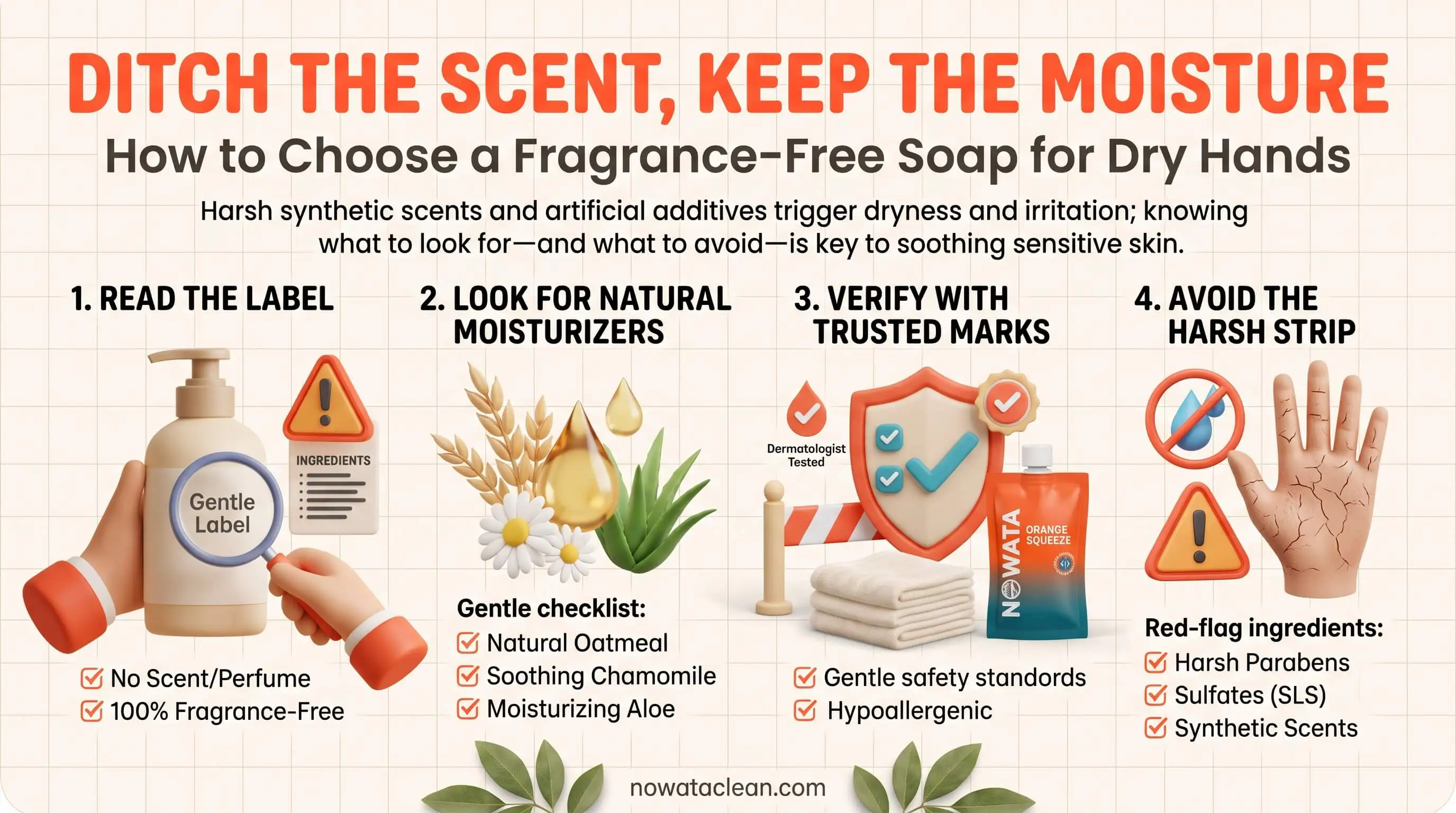
Flip the bottle over. The front panel is marketing, and the ingredient list on the back is where the answer lives. Under U.S. labeling rules, a company can list an entire fragrance blend as a single word, so one "fragrance" on the label might stand for many different ingredients. This is just as important when choosing waterless soap, especially if you have dry or sensitive hands.
Words that mean fragrance
Fragrance, parfum, or aroma
Essential oils, or any plant oil you can smell when you open the cap
Limonene, linalool, and citral
Geraniol and eugenol, which often hide near the end of the list
Signs a soap was made for dry skin
Glycerin near the top, pulling water into the skin
A syndet or pH-balanced formula, which cleans closer to skin's natural pH of about 5.5
Ceramides, shea butter, colloidal oatmeal, or panthenol to support moisture
A short ingredient list you can read in one breath
The National Eczema Association Seal of Acceptance, a handy shortcut for sensitive skin
What to leave on the shelf
Sodium lauryl sulfate, or SLS, a strong cleanser that's hard on dry skin
Alcohol-heavy formulas
Antibacterial hand wash, which the FDA says hasn't been shown to prevent illness better than plain soap and water
Deodorant bars, built for body odor rather than the thin skin on your hands
If you wash all day for work or with little ones at home, our guide to soap for frequent hand washing goes deeper on cleansers and moisturizing.
Bar, Liquid, Foam, or Dry Soap: Which Format Fits?
The formula matters more than the format, but each one earns a spot at the right sink.
Bar soap: A fragrance-free syndet bar is one of the gentlest picks for dry hands. Keep it on a draining dish so it isn't sitting in a puddle.
Liquid soap: The easy choice for a busy family bathroom. Look for glycerin and a sensitive-skin label.
Foaming soap: Uses less cleanser per pump, which can be gentler, as long as it skips SLS and fragrance.
Dry soap: A rinse-free option for when you're far from a sink. We will cover it next.
What Is Dry Soap, and Can It Help Dry Hands?
Dry soap is a rinse-free cleanser you rub onto dry hands, so you get clean without a sink, water, or towel. It's a different thing from a bar that's dried out or an old-fashioned laundry powder. Think of it as hand soap for the moments when water isn't an option.
Skipping water can actually help dry hands. You avoid the hot tap that pulls oils away and the scratchy paper towel that rubs sore skin even rawer. A plant-based dry soap like NOWATA is doctor-made and alcohol-free, with no added fragrance. Rub a dime-sized drop between your palms until little clumps form, then brush them off along with the dirt.
We reach for dry soap in spots like these:
The car after soccer practice or a drive-thru snack
Job sites and garages where the only water comes out of a hose
Trailheads and campsites, where an eco-friendly camp soap can handle the dishes
Sticky little hands at the playground
Dry soap adds to soap and water rather than replacing it. When hands are greasy or visibly dirty, or there's a sink right there after using the bathroom, wash with water. Read a dry soap's ingredients the way you'd read any label, too. NOWATA, for example, contains ethyl macadamiate, which comes from macadamia oil, so anyone with a severe macadamia allergy should spot test first and check with their doctor.
A Simple Hand-Care Routine for Dry Skin
Good soap does half the work. The other half comes down to how you wash and what you do right after. Our routine follows the American Academy of Dermatology's advice.
Wet your hands with lukewarm water, never hot.
Use about a dime-sized amount of fragrance-free soap.
Scrub for at least 20 seconds, getting between fingers and around nails.
Pat dry with a clean towel and leave your hands a little damp.
Smooth on a fragrance-free, dye-free hand cream or ointment right away.
Keep a tube by every sink, because you'll only use it if it's within reach.
How to Patch Test a New Soap
Before you swap the soap at every sink in the house, try it on one small patch of skin. Wash a spot on your inner forearm once or twice a day for a few days. Redness, itching, or a rash means stop. If the patch stays calm, you've probably found a safer soap.
When to See a Dermatologist
Book a visit with a board-certified dermatologist if your hands still crack, bleed, or itch after two weeks of fragrance-free soap and steady moisturizing. Dry hands and hand eczema can look alike, and eczema usually needs more than lotion. A dermatologist can also patch test you to find out exactly which ingredients your skin can't handle.
"You can tell how a family's hands are doing by looking at their vanity. When I walk into a bathroom mid-remodel and find a scented soap, a scented lotion, and a tube of something for cracked skin lined up together, the soap is almost always the culprit. So I ask people to turn the bottle around before they buy it. If the back says fragrance or parfum, or names a plant oil you can smell, put it back on the shelf. Swap in a fragrance-free soap, park a plain hand cream right next to it, and give it two weeks. I've seen that one change fixes more chapped knuckles than any new faucet or water softener ever has. For the car or the bleachers at a Saturday game, a rinse-free dry soap spares your hands the hot water and paper towels."
7 Essential Resources
We lean on these sources whenever the question is how to keep washing without wrecking your hands. Every one comes from a federal health agency or a dermatology organization.
American Academy of Dermatology, Dry Skin Relief from Handwashing. Board-certified dermatologists lay out a three-step routine and explain why a fragrance-free, dye-free hand cream feels better on chapped skin. https://www.aad.org/public/everyday-care/skin-care-basics/dry/coronavirus-handwashing
U.S. Food and Drug Administration, Fragrances in Cosmetics. The FDA's explanation on why an "unscented" product can still contain fragrance, and why a whole fragrance blend can show up on a label as one word. https://www.fda.gov/cosmetics/cosmetic-ingredients/fragrances-cosmetics
U.S. Food and Drug Administration, Skip the Antibacterial Soap; Use Plain Soap and Water. Covers the 2016 rule that pulled 19 antibacterial ingredients, including triclosan, from consumer hand and body washes. https://www.fda.gov/consumers/consumer-updates/skip-antibacterial-soap-use-plain-soap-and-water
MedlinePlus, Dry Skin Self-Care. The National Library of Medicine lists frequent hand washing as a cause of dry skin and recommends avoiding soaps with alcohol, fragrance, and dyes. https://medlineplus.gov/ency/patientinstructions/000751.htm
National Eczema Association, Eczema-Friendly Product Directory. Search hundreds of cleansers and moisturizers that carry the NEA Seal of Acceptance. https://nationaleczema.org/eczema-products/
American Academy of Dermatology, Hand Eczema. Helps you tell ordinary dry hands from hand eczema and explains why tracking down the trigger comes first. https://www.aad.org/public/diseases/eczema/types/hand-eczema
Centers for Disease Control and Prevention, Handwashing Facts. The science behind hand washing, including the CDC's note that warmer water can cause more skin irritation. https://www.cdc.gov/clean-hands/data-research/facts-stats/index.html
3 Statistics
About 3.5% of adults in Europe's general population are allergic to a common fragrance mix used in patch testing. Among people already seeing a skin specialist, that figure climbs to 7.8%. The jump is a good reason to go fragrance-free once your hands are already irritated. Source: EDEN Fragrance Study paper, via PMC
People who wash their hands at least 8 to 10 times a day face a 51% higher risk of hand eczema. At 15 to 20 washes a day, the added risk reaches 66%. A 2022 analysis of 45 studies produced those numbers, and they're why your soap choice matters more the more often you wash. Source: Contact Dermatitis, 2022, via PubMed
Hand washing prevents about 30% of diarrhea-related illnesses and about 20% of respiratory infections like colds. So keep washing, and pick a soap your skin can live with. Source: CDC, Handwashing Facts
Final Thoughts and Opinion
If your soap smells wonderful and your hands feel awful, believe your hands.
Picking a fragrance-free soap for dry hands comes down to reading the back label, skipping fragrance in all its disguises, and keeping a plain moisturizer close enough that you'll actually use it. Glycerin near the top of the list is a good sign. Lukewarm water does far less damage than hot.
Our honest opinion is that most families don't need a whole new routine. They need one better bottle at the sink and a tube of cream beside it. When you're away from a sink, a plant-based dry soap keeps hands clean without the hot water and rough towels that make dryness worse. And if your hands still crack or bleed after a couple of weeks of gentle care, skip the fifth soap and see a dermatologist.
Frequently Asked Questions
Is fragrance-free soap better for dry hands?
For most people, yes. Dry skin has a weaker barrier, so fragrance ingredients get in more easily and are more likely to sting or cause a rash. Switching to fragrance-free takes one of the most common irritants out of a product you touch many times a day. Pair it with a fragrance-free moisturizer for the best results.
What is the difference between fragrance-free and unscented soap?
Fragrance-free means no fragrance was added for scent. Unscented means you won't notice a smell, but the FDA notes that some unscented products contain a small amount of fragrance to cover other odors. If your hands react easily, go fragrance-free.
What is dry soap, and is it good for dry skin?
Dry soap is a rinse-free hand cleanser you rub onto dry hands, so it works without a sink, water, or towel. It can be easier on dry skin because you skip hot water and towel friction. Choose one that's alcohol-free and fragrance-free, and keep using soap and water whenever a sink is available.
Are essential oils safe in soap for sensitive, dry hands?
Not always. Essential oils contain aroma compounds such as limonene and linalool, which can irritate sensitive skin or trigger an allergy. If your hands are dry or reactive, pick soaps with no essential oils and no added fragrance of any kind.
Is bar soap or liquid soap better for dry hands?
Both can work well. A fragrance-free syndet bar is one of the gentlest options, and a glycerin-rich liquid soap is often more practical at a busy family sink. Either way, the ingredient list decides it.
What pH should hand soap be for dry skin?
Look for a soap labeled pH-balanced, or a syndet bar, which cleans closer to skin's natural pH of about 5.5. Traditional soaps run more alkaline and can leave dry hands feeling tighter after repeated washes.
How do I know if my soap is causing my dry hands?
Watch for tightness, stinging, or redness right after washing, or rough patches that get better when you're away from home for a few days. Try a fragrance-free soap for two weeks and see if things settle. If they don't, a dermatologist can patch test you to find the exact trigger.
Give Your Hands a Two-Week Reset
The easiest upgrade in your bathroom costs less than a new towel bar. Tonight, turn the soap on your vanity around and read the back. If you spot fragrance, parfum, or essential oils, swap it for a fragrance-free bottle and set a plain hand cream right beside it. Then tuck a rinse-free dry soap into your bag or glove box for the days you're away from a sink.
Give it two weeks and pay attention to your knuckles. If you're planning a bigger refresh while you're at it, our bathroom remodeling guides can help you design the rest of the room around the small things you use every day.